





 Portuguese
  English
  Spanish
  8 min of reading
  0 comments


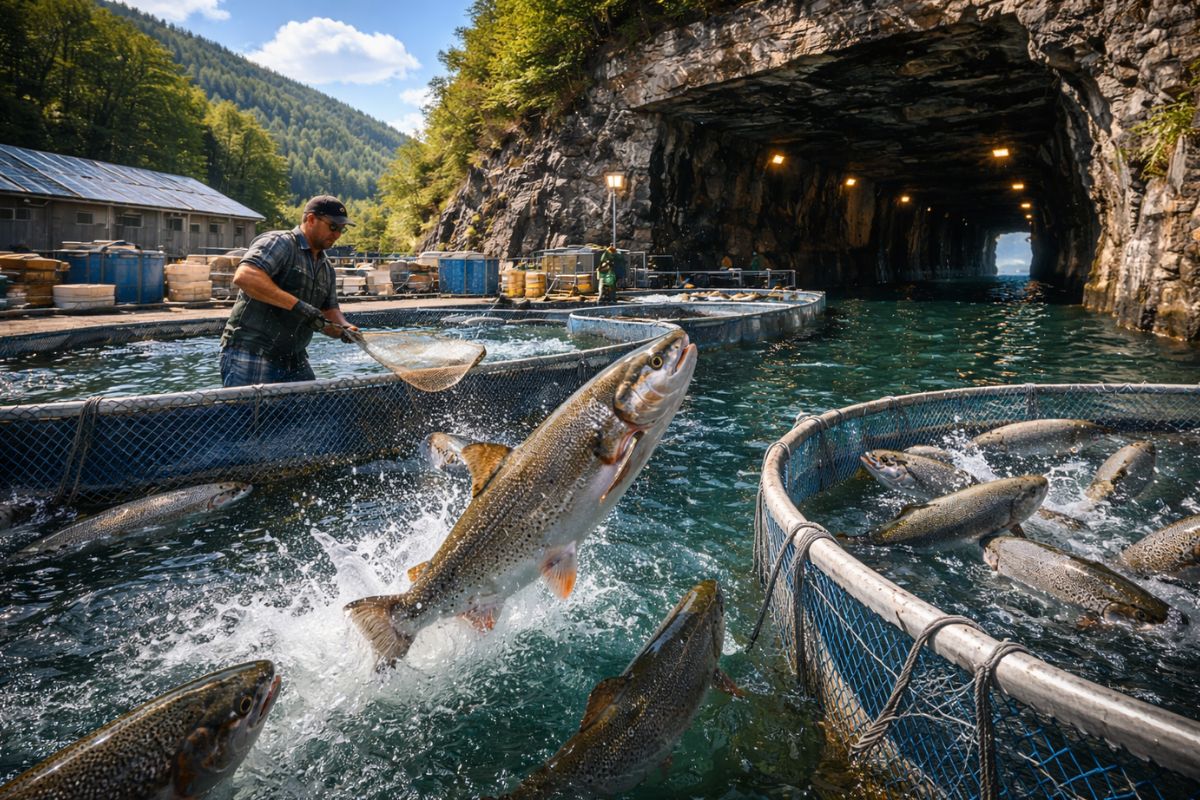
An Abandoned Coal Mine in the Appalachians, in Mingo County, West Virginia, Turned into an Arctic Trout Farm in Industrial Aquaculture, Using RAS Systems and Flooded Tunnels as Stable Cold Water Reservoirs to Produce Premium Fish at an Industrial Scale.
An abandoned coal mine in the Appalachians, in Mingo County, West Virginia, has been transformed into an arctic trout farm that uses flooded tunnels as stable cold water reservoirs to produce premium fish at an industrial scale. Instead of coal for steel mills, what now comes out of these tunnels is high-value protein, with intense engineering, water reuse, and a lot of economic math.
For over a century, the region was synonymous with coal, heavy employment, and landscapes marked by sealed shafts and rusty infrastructure. When the mines closed and the industry collapsed, unemployment, environmental scars, and the dilemma of what to do with this liability remained. The unexpected answer came from aquaculture engineers who looked at the flooded mines and saw a geological resource worth millions of dollars.
From Abandoned Coal Mine to Farm for Arctic Trout

The idea of installing an arctic trout farm inside a coal mine seems absurd at first glance.
-
He started running at 66 years old, broke records at 82, and is now a subject of study for having a metabolic age comparable to that of a 20-year-old, in a case that is intriguing scientists and inspiring the world.

-
Oldest tree on the planet reappears after 130 years of searches: Wattieza, 385 million years old, was 10 meters tall and had no leaves or seeds; Gilboa fossils in New York solved the mystery in 2007.

-
A 48-square-meter house assembled in hours with 4,000 bricks made of recycled plastic that does not absorb moisture, has natural thermal insulation, and costs less than 90,000 reais in a complete kit.
-
Luciano Hang revealed that Havan’s air fleet has already accumulated more than 20,000 landings, 10,000 flight hours, and 6 million kilometers traveled, and he says that without the planes, the company would never have grown so quickly.

Mines are associated with heavy metals, acid drainage, and toxic water, while the arctic trout is a delicate fish that is usually raised in clean glacial waters of Iceland, Canada, or subarctic regions.
However, the project in Mingo County did not arise from romanticism, but from thermodynamics and energy economics. In industrial aquaculture, after feed, the largest cost is electricity, especially for cooling water in warm countries.
Arctic trout stop feeding if the water exceeds about 15 °C and can die from thermal stress shortly after. In a typical land-based farm, a chiller park would be necessary, working 24 hours a day during summer.
In the flooded tunnels of the mine, the opposite happens: the mountain itself does the job. When the drainage pumps were turned off, groundwater filled the galleries and became isolated by millions of tons of rock.
Down there, the water remains stable between 50 and 55 °F, about 10 to 13 °C, year-round, like a natural refrigerator with no energy cost.
The “Free” Cold Water That Comes from the Depths
Having cold water is a huge advantage for an arctic trout farm, but that doesn’t mean you can just pump it and dump it into the tanks.
The water from the deep galleries is not acidic like the typical orange drainage from surface mines because it is in an anaerobic environment, with no contact with atmospheric oxygen.
At depth, the pH is neutral, around 7.2, and the water is surprisingly clear. The problem is different: there is almost no oxygen and there is an excess of nitrogen and carbon dioxide, a result of decades under high underground pressure. In many measurements, nitrogen saturation exceeds 105%.
If this water were dumped directly into the tanks, it would be disastrous. The excess nitrogen causes trauma from bubbles, a form of “decompression sickness” in fish, forming bubbles inside the tissues and behind the eyes. To prevent this, the water needs to undergo aggressive treatment before it touches the first fish.
How to Transform “Dead” Water into Life-Supporting Water
Engineering begins with high-capacity turbine pumps, installed in wells about 40 cm in diameter that drill down to the flooded galleries at a depth of 120–210 meters.
These are industrial units of around 100 HP, moving approximately 1,500 to 2,000 gallons per minute, ensuring continuous flow for the installation.
At the surface, this water rises directly to degassing columns about 4.5 meters tall. The water descends through these towers over a high surface area packing medium, breaking the surface tension and allowing CO₂ and nitrogen to escape into the atmosphere.
Thus, the carbon dioxide levels drop from around 60 mg/L to near 15 mg/L, and the excess nitrogen is dissipated.
After removing the “bad gases,” the “good gas” enters: pure oxygen is injected into cones under pressure, which quickly dissolves the O₂ in the water to near 100% saturation.
In a few minutes, the once anoxic water is transformed into a cold, oxygenated, and stable fluid, ideal for keeping thousands of fish alive at high density.
Why Choose Arctic Trout

The choice of Arctic trout, Salvelinus alpinus, is not just gastronomic. It is perfect for an arctic trout farm in a closed environment because it supports high density and behaves well in compact schools.
While Atlantic salmon or rainbow trout tend to be more territorial and stressed in crowded tanks, fighting, tearing fins, and releasing a lot of cortisol, the Arctic trout does the opposite.
In nature, this species congregates in icy pools to survive, and this schooling instinct can be leveraged in intensive systems. In a traditional aquaculture setting, reaching 40 kg of fish per cubic meter is already close to the limit.
In tanks using water from the mine, densities can reach 80 or even 100 kg per cubic meter, literally a wall of living muscle underwater.
This doubles productivity per square meter of structure without needing more water, greatly multiplying the economic efficiency of the system.
RAS: Recycling Up to 99% of the Water from the Arctic Trout Farm

With so much biomass in such a small volume, the next obvious problem is waste. A tank with 10,000 fish is a continuous ammonia factory, excreted through the gills. At high density, safe levels can turn lethal in less than an hour if there is no treatment.
That’s why the heart of the arctic trout farm is a RAS, or Recirculating Aquaculture System, which recirculates 95 to 99% of the water.
Instead of discarding everything, the same water is continuously filtered and reused hundreds of times before it exits the facility.
At the center of this process is the biofilter, a reactor filled with millions of small plastic spheres that serve as a surface for nitrifying bacteria like Nitrosomonas and Nitrobacter.
They convert ammonia to nitrite and then to nitrate, which is much less toxic to fish. It is basically an invisible chemical factory that needs to operate 24/7. If the bacteria die, the fish die with them.
The feeding system is also designed for maximum efficiency. Protein pellets are administered in an automated fashion, with acoustic sensors and underwater cameras monitoring when the fish are actually eating.
When the feed starts to sink without being captured, indicating satiety, the feeders shut off. The goal is to maintain an FCR, or feed conversion ratio, of around 1.1 to 1, meaning 1.1 kg of feed for every 1 kg of meat produced.
Operating at the Limit: Plant Redundancy and Risk in 15 Minutes
In such an intensive system, dissolved oxygen is consumed at a rate that no natural source could replenish.
All life in the arctic trout farm depends on mechanical injection of liquid oxygen and continuous water circulation.
This creates a scenario of extreme risk. If the main power goes out and nothing takes its place, the oxygen in the tanks can drop to zero in less than 15 minutes, suffocating millions in fish. To mitigate this risk, the farm operates with redundancy similar to that of a nuclear power plant.
Diesel backup generators come online within seconds. Gravity-fed oxygen reservoirs maintain minimum levels even without pumps.
There is continuous monitoring of pressure, flow, oxygen saturation, and real-time alarms. It is biology mixed with heavy engineering, always on the edge.
How Much Is an Arctic Trout Farm Inside a Mine

Arctic trout is a premium product. While a common salmon may fetch around $3.50 to $4.50 per pound wholesale, arctic trout is often sold between $6.50 and $8.50 per pound, thanks to lower supply and perceived quality.
The facility in the Appalachians was designed to produce about 1.2 million pounds per year, around 544 metric tons. This projects an annual gross revenue in the range of $8 to $10 million.
But the key point lies in the margins. The cold water from the mine eliminates much of the cooling cost, reducing the electricity bill by about 30% compared to equivalent farms.
The location, just a few hundred miles from major markets like New York, Washington D.C., and Boston, allows for replacing international air freight with much cheaper refrigerated truck transport, cutting logistics costs by nearly an order of magnitude—about 90% compared to fish imported by air.
Even with a heavy initial investment estimated between $30 and $40 million for a high-tech plant, the combination of premium product, cheap energy, and lean logistics creates an economic structure that is hard to compete with.
When the Miner Becomes an Aquaculture Technician
Beyond the environmental and economic aspects, there is a relevant social aspect. The arctic trout farm repurposes the “industrial DNA” of the Appalachian region.
Instead of requiring former miners to become software programmers, the project needs exactly the kind of people who know how to handle pumps, valves, pressure systems, piping, welding, and heavy mechanical maintenance, reading manometers, industrial panels, and alarms.
The professional who spent decades tending to drainage pumps in coal shafts has the same muscle memory needed to maintain the oxygen injection system and tank circulation.
The transition stops being “from coal to office” and becomes “from coal to fish,” within an industrial logic that these workers already dominate.
From the Coal Belt to the Blue Belt
The Mingo mine is just one example of the potential. Agencies like the West Virginia Department of Environmental Protection and the USGS estimate that there are thousands of abandoned mines in the state, with underground reservoirs totaling over 1 trillion gallons of water. Today, this is seen as a liability, a flooding risk, mandatory monitoring, a containment obligation.
If the model can be replicated, these mines could turn into a decentralized network of protein production, transforming the old Coal Belt into a true Blue Belt of high-value aquaculture.
Just 50 mines operating at the scale of Mingo could produce over 60 million pounds of high-quality fish per year, replacing a significant portion of the imports of salmon and trout in the American market.
Instead of extracting carbon from the ground to burn, the region would use the voids left by mining to create food, with much more added value and less climate impact.
In a world facing fresh water shortages, pressure on wild fishing, and rising demand for protein, repurposing abandoned mines as arctic trout farms is a complete inversion of the logic from depleted land to reborn infrastructure.
And you, looking at this scenario, do you think abandoned coal mines should become arctic trout farms or remain sealed underground?







-

-

3 pessoas reagiram a isso.