





 Portuguese
  English
  Spanish
  4 min of reading
  5 comments


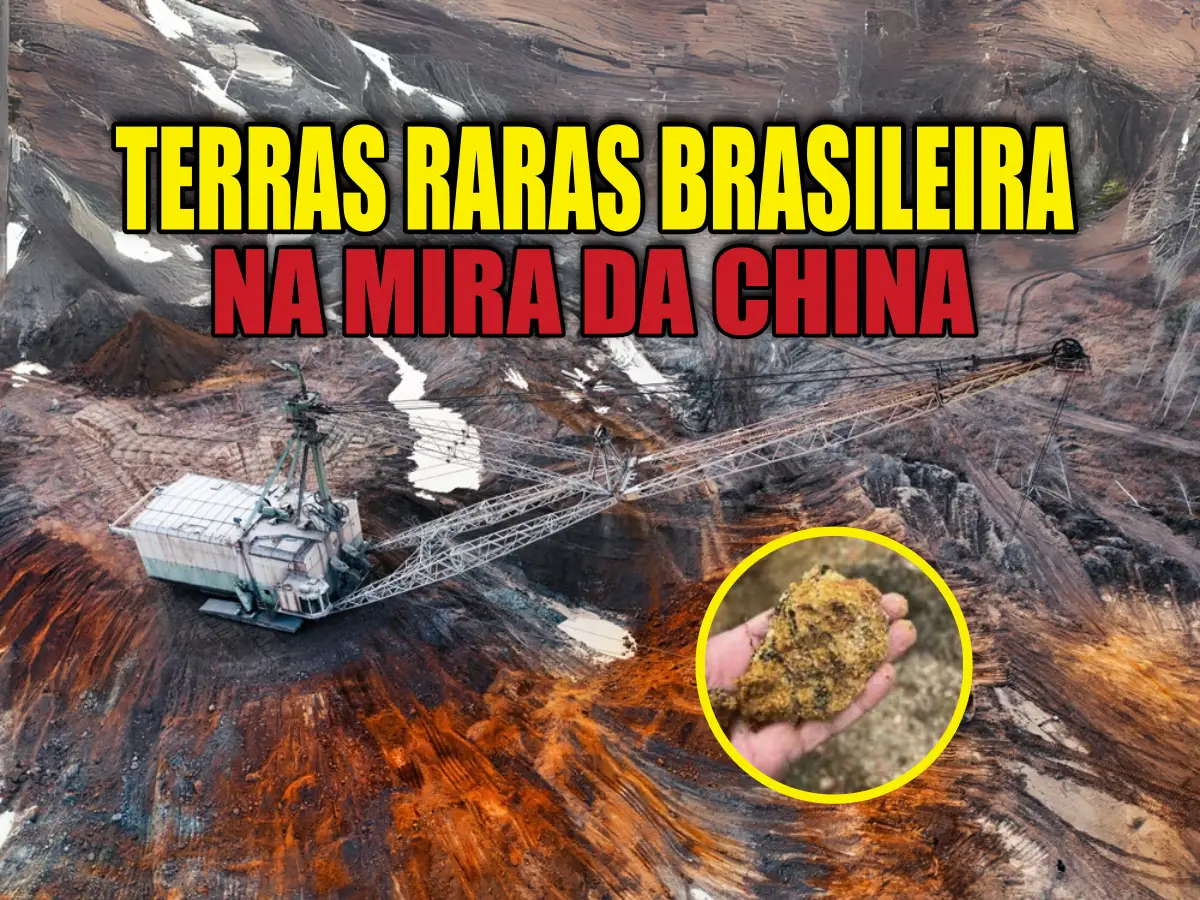


Brazil Is Giving Its Greatest Wealth to China and Almost No One Talks About It
Did you know that Brazil owns the second largest rare earth mineral reserve on the planet, falling behind only China? That’s right, we are sitting on a true treasure, essential for the global high-tech industry. But instead of using this advantage to become a power, the country is allowing this resource to end up in the wrong hands. And worse: with the government’s approval.
While other countries protect their strategic resources tooth and nail, we are selling our mines to foreigners, including Chinese state-owned companies, which now control sensitive parts of our economy. This has a direct impact on our sovereignty, defense sector, and the country’s industrial future.
What Are Rare Earths and Why Are They So Valuable?
The so-called rare earths are a group of 17 chemical elements used in cutting-edge technology: from smartphones to wind turbines, from electric car batteries to military missiles, radars, lasers and advanced communication systems. In other words, without these minerals, there is no cutting-edge technology.
-
A new Brazilian shopping center worth R$ 400 million will be built in an area equivalent to more than 4 football fields, featuring 90 stores, 5 cinemas, a supermarket, a college, and parking for 1,700 cars, potentially generating 3,000 jobs.

-
Larger than entire cities in Brazil: BYD is building a 4.6 km² complex in Bahia with a capacity for 600,000 vehicles per year, but the discovery of 163 workers in conditions analogous to slavery has shaken the entire project.

-
With an investment of R$ 612 million, a capacity to process 1.2 million liters of milk per day, Piracanjuba inaugurates a mega cheese factory that increases national production, reduces dependence on imports, and repositions Brazil on the global dairy map.

-
Brazilian city gains industrial hub for 85 companies that is equivalent to 55 football fields.


And guess who dominates over 80% of global production? China. Besides having the largest reserves, they are also the leaders in refining and processing these elements, a highly technical process restricted to a few countries. This dependency creates a kind of silent blackmail: if Beijing turns off the tap, the West halts.
Brazil Could Be a Key Player in This Global Game
Even with China at the top, Brazil has about 23% of the known rare earth reserves in the world. This positions us as the only country with real potential to rival the Chinese in this sector. The two main Brazilian mines are the Serra Verde Mine, in Goiás, and the Pitinga Mine, in Amazonas.
The production at Serra Verde started recently and is expected to reach 5,000 tons per year. The mine primarily produces Neodymium, Praesodymium, Dysprosium and Terbium, all essential for the production of permanent magnets used in electric vehicles, wind turbines, and military equipment.
The Pitinga mine has a rare feature: it is rich in Yttrium and Xenotime, which are used to manufacture precision lasers and medical materials, such as in cancer radiation therapy.
But Who Really Controls These Mines? The Shocking Answer: It’s Not Brazil.
The Serra Verde mine belongs to a private company called Serra Verde Group, based in Switzerland. Who buys almost everything extracted from there? China. According to the company’s CEO, Tracy Moraitis, the Chinese are practically the only ones in the world with the technology to separate the minerals and turn them into valuable products.
“They were the only clients that could process the product and separate it”, Moraitis stated in a recent interview.
The Pitinga mine, in turn, was in the hands of a Peruvian company but was s sold to a Chinese state-owned company for only US$ 340 million. The transaction raised suspicions in Brasília and sparked an alert in the international community. There were claims that China wanted to explore uranium from the region for military purposes, but according to Brazilian legislation, uranium mining can only occur under the direct supervision of authorities and with participation from national nuclear industries, which is not the focus of the Chinese operation.
What really interests Beijing there are the rare earth minerals, which still face loose and permissive regulation in Brazil. And this had been anticipated since 2011 by a study from the IPEA, which warned about Chinese interest not only in buying but in directly controlling our deposits.
China’s Strategy to Get Its Hands on Brazil’s Rare Earth Mines
The direct acquisition of Brazilian rare earth mines is part of a larger geopolitical plan by China. The objective is clear: maintain dominance over strategic minerals and ensure that the world remains dependent on Chinese industrial capability.
Meanwhile, Brazil continues exporting raw materials at ridiculous prices, while importing high value-added products made from our own natural resources. This logic is well known to those studying economic colonialism.
The stance of the Lula government, in light of all this, has been criticized by experts. In an effort to avoid friction with Beijing and secure investments in the country, the Planalto has been ignoring the strategic risk of losing control over this key sector.
According to economist Eduardo Costa from UFMG, “without an industrial policy focused on local processing, we will continue to be at the mercy of countries that dominate the technology. This is serious for the economy, but even more so when it comes to national defense.”
If you think this issue is important, share this article. And tell us in the comments: what do you think Brazil should do with its rare earth mines? Your opinion is essential!





Basta dessa **** de nossos presidentes, irresponsaveis. Todo mundo sabe q por tras desse governo do PT e STF estao os politicos e empresarios CHINESES.
Mas nao é culpa deles. Nossos politicos e governo é q tem de defender nossa soberania e nossos potenciais e estrategicos minerios.
Cade as grandes UNIVERSIDAFES??? Onde estao nossos ENGENHEIROS? Senadores, Diplomatas??? Acorda Brasil, ou seremos os escravos dos chineses
A China levando tudo, inclusive o próprio Brasil, é uma questão de tempo
O **** do **** está ‘entregando’ o Brasil para o **** chinês.