





 Portuguese
  English
  Spanish
  4 min of reading
  0 comments


Scientists Reveal Discovery Of A Giant Structure That Extends 300 Km Below The Surface Of The Moon
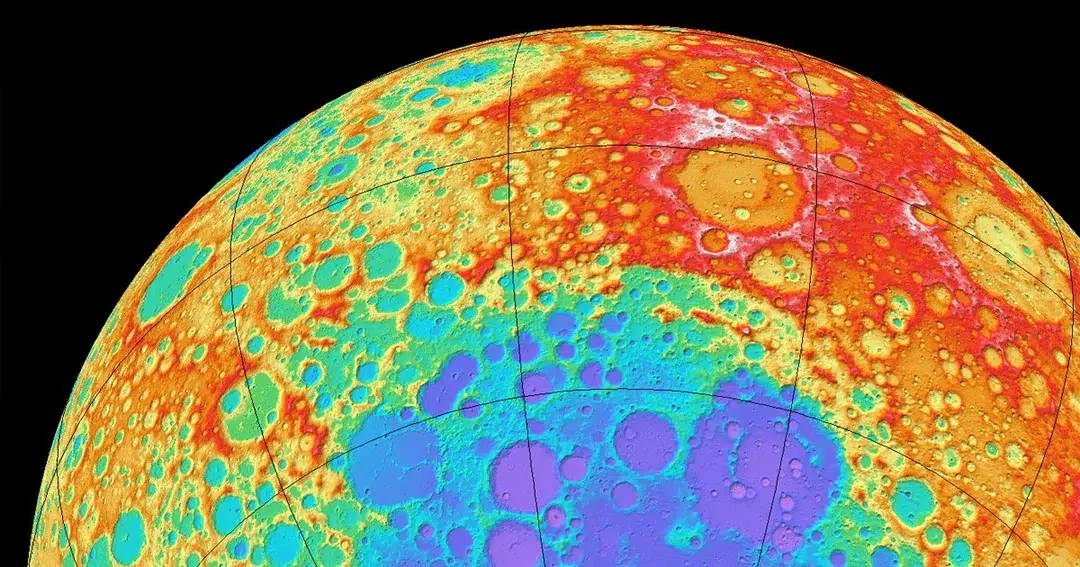
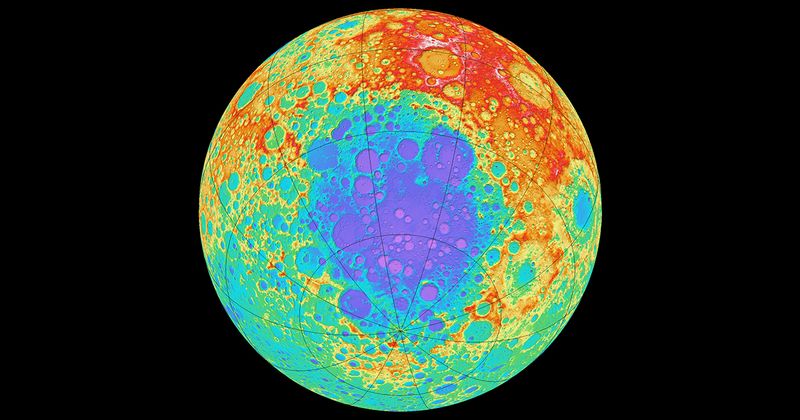
Imagine a structure so massive that, even buried kilometers deep, it manages to deform the surface of a celestial body. This is exactly the case of an anomaly detected beneath the South Pole-Aitken Basin, on the far side of the Moon.
In 2019, planetary scientists made a surprising discovery: a dense mass hidden beneath this basin, weighing 2.18 quintillion tons. To put it in perspective, it’s like a structure five times the size of Hawaii being buried there.
This basin, about 2,500 kilometers in diameter, is one of the largest craters in the Solar System. Scientists had long studied it, fascinated by its geological importance and the answers it could provide about the Moon’s early days. The discovery of the anomaly beneath it, however, has opened doors to new hypotheses and possibilities.
-
In a flooded well, archaeologists found a 1,700-year-old Roman egg that still contains clear and yolk intact inside the very thin shell.

-
Something is happening around the Earth: Inside the huge explosion of fireballs in 2026

-
A hot air bubble coming from Argentina expands over Brazil, causing thermometers to exceed 38 degrees with a thermal sensation of 40 degrees in late March, affecting 6 states at once.

-
The radish leaf that almost everyone throws away has more polyphenols, flavonoids, and fiber than the consumed root, and a 2025 study showed that the leaf contains compounds that protect the intestine, combat inflammation, and may inhibit the growth of cancer cells.


The Discovery That Changed Everything
The team responsible for the discovery used data from NASA’s Gravity Recovery and Interior Laboratory (GRAIL) mission. GRAIL detects variations in the lunar gravitational field, allowing the identification of denser areas underground. When an anomaly was detected, researchers noted that its gravitational effect was so intense that it had pulled the bottom of the basin downwards, sinking it by nearly a mile.
This is no small feat: this dense mass beneath the South Pole-Aitken Basin is shaping and modifying the structure of the Moon. For those used to seeing the Moon as a barren and relatively static body, this discovery suggests that there are still many secrets beneath its seemingly calm surface.
What Could This Anomaly Be?
Scientists have discussed two main hypotheses to explain what this mass could be. One possibility is that it is a remnant of an asteroid that collided with the Moon about 4 billion years ago, during the intense bombardment period that marked the beginning of the Solar System.
This impact would have formed the South Pole-Aitken Basin itself and left the asteroid’s metallic core embedded in the lunar crust, without penetrating to the Moon’s core. This type of impact is rare and helps illustrate how the Moon – and possibly other planetary bodies – preserves signs of its ancient history.
The second theory is that the mass consists of dense oxides formed from the Moon’s primordial magma, which would have solidified and crystallized over time. During the early stages of the Moon’s formation, it likely had a “magma ocean” on its surface, where lighter materials rose to form the crust, while denser materials sank, forming the mantle.
This process may have left a concentration of dense material precisely where the South Pole-Aitken Basin is located.
Both theories are intriguing and have huge implications for understanding lunar geology. If the anomaly is indeed a remnant of an impact, then this discovery confirms that the Moon preserves signs of its violent formation and the collisions that helped shape the Solar System like meetings.
On the other hand, if it is a remnant of the magma ocean, then there is much more to understand about how the Moon cooled and formed its layers.
Exploring The Future Of The South Pole-Aitken Basin
The anomaly beneath the South Pole-Aitken Basin is already influencing plans for future missions. International interest in lunar exploration has been driven in part by the promise of new geological discoveries. NASA’s Artemis 3 mission, for example, is set to take astronauts to the Moon’s South Pole soon, and India, with its expanding space program, is also developing missions to explore this region.
Recent discoveries indicate that the Moon’s far side still holds surprises. For instance, a heat-emitting structure has been found beneath the Compton and Belkovich craters, suggesting the existence of other geologically active areas. Lunar research is far from complete, and each new discovery reinforces the Moon’s potential as a natural laboratory for understanding planetary formation processes.
The Moon Under A New Light
The South Pole-Aitken Basin has already been notable for its size and for being one of the largest scars in the Solar System. But now, with the revelation of this mass anomaly, the region becomes even more fascinating. It is incredible to think that, even after decades of exploration and study, the Moon still manages to surprise us with mysteries that challenge our knowledge.
For those interested in astronomy, the South Pole-Aitken Basin is a powerful reminder that the Moon’s past is far from fully understood. As we gaze at the full Moon in the sky, we can remember that, even though we cannot see it, this dense and ancient structure is there, hidden and waiting for us to continue exploring the secrets of our Solar System.






-

-

2 pessoas reagiram a isso.