





 Portuguese
  English
  Spanish
  7 min of reading
  0 comments


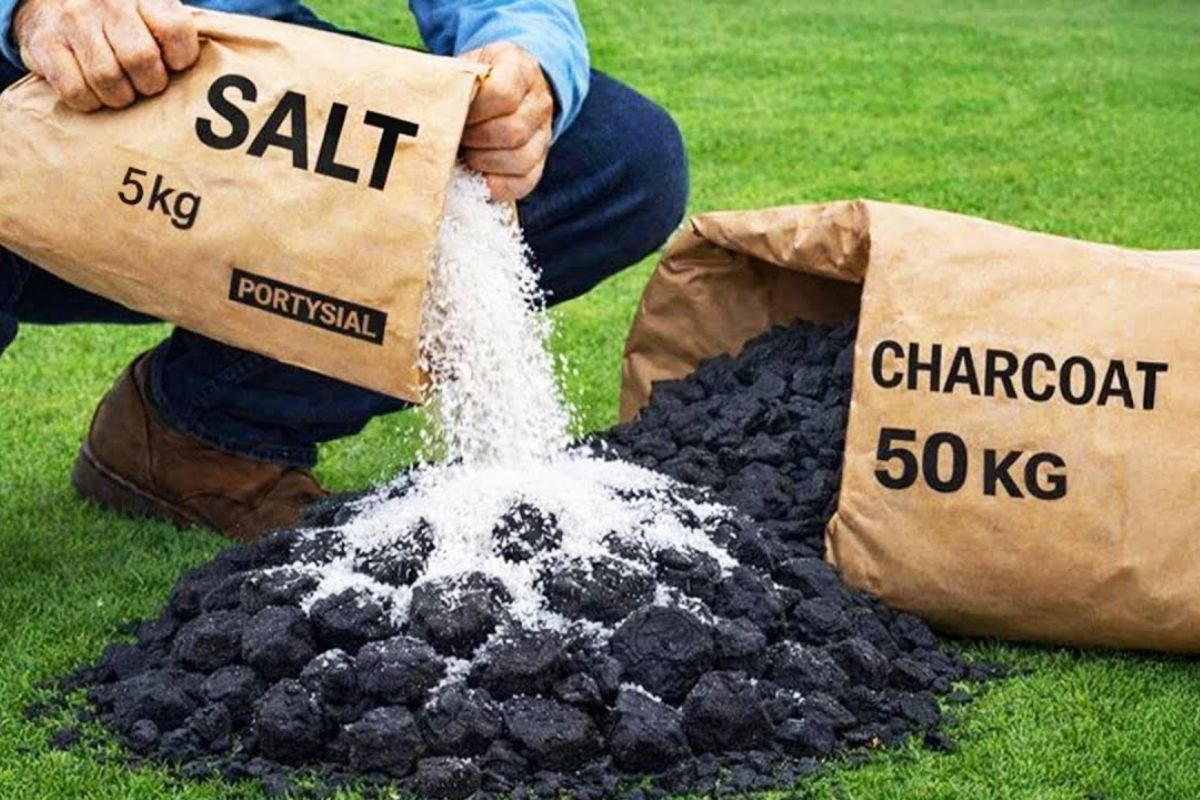
In A Controlled Experiment, The Mixture Of Coal And Salt Combined With Other Flammable Components Showed Rapid, Stable And Moisture-Resistant Combustion, Reigniting Discussions About Reusing Daily Waste And Revealing How Seemingly Simple Processes Can Hide Risks, Requiring Technical Care And Responsibility When Testing Ideas In A Domestic Context
The mixture of coal and salt originates from something that almost everyone discards after a barbecue: small pieces of coal considered useless. Instead of going straight to the trash, these residues were separated, cleaned, dried, and reintegrated into an experimental process that sought to understand how common materials can be reorganized to produce a flammable effect faster and more stable than expected. The goal was not to create a new commercial product, but to observe, under controlled conditions, the behavior of an unintuitive combination of simple inputs.
Throughout the tests, the person responsible for the experiment followed a methodical routine: first treating the coal, then preparing the salt, and finally bringing everything together with other solid and liquid materials capable of favoring combustion. The final result was a dark, compact mass, with a texture adjusted to maintain cohesion without breaking apart, and which, upon contact with a heat source, was capable of igniting almost immediately and burning continuously. The ease of ignition and stability of the flame attracted attention not only for performance but primarily for the risks involved when manipulating this type of mixture outside of a testing environment.
From Discarded Coal To Flammable Mixture

The starting point of the experiment was the reuse of leftover coal, a material abundant after any use of a grill or stove. Instead of discarding the smaller pieces, the author decided to transform them into the main input.
-
Spain surprises the world by erecting 62 artificial dunes, mixing sand with natural remains of posidonia, and causing the structure to lose only 1.4% of its volume in 1 year.

-
With 16 Bulava missiles, improvements in acoustic stealth, and a design focused on silent patrols, Russia’s nuclear submarine was born to ensure Moscow’s invisible retaliation and has become one of the pillars of its maritime strength.

-
‘Populous’ city in Rio among the worst in Brazil in national ranking and exposes silent development crisis.

-
Couple buys house in the South Zone of São Paulo, opens a hidden door in the garage, and finds a secret wine cellar with dozens of old wines forgotten since the 1970s.

First, these fragments were boiled in water, a process that helps remove surface impurities and reduce the amount of loose dust. This pre-treatment was not aesthetic but functional: the less dust suspended, the more controlled the handling becomes, and the more predictable the material’s behavior during grinding and burning.
After boiling and draining, the coal was crushed in a mortar until it reached a fine particle size, sufficient to allow good compaction but without forming a cloud of black dust with every movement.
The material was then sifted, separating the more homogeneous powder from larger particles that could be ground again.
This attention to particle size is typical of procedures that seek repeatability: the more uniform the coal, the more consistent the reaction tends to be when mixed with other inputs.
How The Mixture Of Coal And Salt Was Structured

Alongside the preparation of the coal, common salt underwent a hot drying process, removing any trace of residual moisture.
Then, it was ground to a very fine powder. This detail, which at first glance may seem excessive, has a clear function: a well-dried and powdered salt distributes better among the grains of coal, helping to stabilize the mixture, reduce the feeling of loose powder, and avoid the formation of lumps.
In the next step, the salt was gradually incorporated into the ground coal, in small portions, and mixed patiently until it relatively uniformly covered the dark powder.
Only then did the addition of a third solid component come: sawdust, also used in small quantities, to add body, create air spaces, and make the mass looser, facilitating ignition.
Instead of a single dominant ingredient, what was obtained was a kind of porous matrix where the mixture of coal and salt circulates among organic fibers, creating channels of oxygen that sustain combustion.
Finally, the experiment integrated small portions of everyday flammable liquids into the dry combination, with a clear function as a binder and ignition accelerator.
This step was done gradually, just until the mixture stopped behaving as loose powder and began to act like a slightly moist, cohesive but still manageable compound.
The central concern was not to soak the material but to create a balance in which it remained stable, storable, and capable of responding quickly to the presence of a flame.
Controlled Tests, Stable Flame And Behavior In Humid Environment

With the mixture of coal and salt ready, the next step was to evaluate practical performance. In tests conducted in a controlled environment, the material demonstrated a clear pattern: it was enough to bring a heat source close for ignition to occur almost instantaneously, without explosions or pops, but with a continuous, well-defined orange flame.
Instead of a quick and erratic flash, what was observed was a relatively gentle fire, remaining active long enough to be evaluated calmly.
Another point that drew attention was the behavior in conditions of higher humidity. Even when exposed to less dry environments, the mixture did not disintegrate nor completely lost its burning ability.
Part of this can be explained by the presence of components capable of repelling water and by the porous structure created by sawdust and fine coal.
In practice, the experiment suggested that the combination can work as a robust fire starter in adverse situations, something that naturally attracts the interest of camping and survival enthusiasts, but also raises the alert about the potential for misuse.
Reuse Of Waste And Environmental Hypotheses
In environmental terms, the experiment raises a relevant question: how to reuse waste that usually goes to the trash, such as broken coal and sawdust, without increasing the risks of fire or domestic accidents.
The central proposal is to show that underestimated materials can be intelligently reorganized, reducing waste and exploring new functions, as long as this occurs under technical criteria and in environments prepared to handle possible failures.
The mixture of coal and salt illustrates this ambivalence. At the same time it demonstrates that waste can gain a new use, it lays bare the need to discuss limits.
Not every reuse is inherently positive: when it involves combustion, open flames, and flammable liquids, the line between innovation and danger becomes narrower.
Therefore, the experiment reinforces the importance that any similar attempt should be treated as a subject of study, not as a trivial solution for everyday life.
Who Does It, Why They Do It And Where This Curiosity Finds Limits
The backstage of this type of test usually involves content creators or practical chemistry enthusiasts who work in small workshops, garages, or adapted spaces at home.
In general, these are people who are familiar with simple tools, enjoy measuring, observing, and recording what happens when they combine common materials in unusual ways.
In this case, the declared motivation passes through three fronts: saving resources, reducing waste, and exploring, on a small scale, the impact of reorganizing mundane substances in controlled contexts.
As for the volume, the focus remains on small quantities, produced only for testing, with no intention of large-scale manufacturing. This choice is not casual: handling large portions of any flammable compound increases the destructive potential in case of error.
In a domestic environment, the recommendation is clear among safety experts: such experiments, when conducted, should be restricted, brief, and always accompanied by basic protective equipment, adequate ventilation, and immediate means of flame containment.
Technical Risks And Safety Recommendations
The experiment shows that mixtures that ignite with extreme ease are not toys, nor quick solutions for those wanting to light bonfires or improvise heating.
The combination of solid waste with liquid fuels creates a scenario where a simple spark can have a disproportionate effect.
Even without visible explosions, a continuous flame in an inappropriate location can start a structural fire, cause serious burns, or generate toxic smoke in enclosed spaces.
Therefore, any serious analysis of mixture of coal and salt must emphasize that reproducing this type of procedure without experience, without ventilation, and without control mechanisms is dangerous.
Protective goggles, gloves, heat-resistant containers, suitable fire extinguishers, and a flame-free area should be minimum requirements in any test close to flames.
Even so, the risk never disappears. Treating this type of experiment as harmless entertainment ignores the reality that small failures can have permanent consequences.
Potential Applications And Ethical Limits
From a theoretical standpoint, a mixture that ignites quickly, burns steadily, and moderately resists moisture has obvious applications: starting fire in outdoor environments, supporting camping in adverse conditions, or serving as a basis for research on alternative solid fuels.
However, the flammable nature also opens up space for misuse, from reckless pranks to situations where the intention is to cause deliberate harm.
It is precisely for this reason that the discussion cannot be limited to technical performance.
The responsibility of those who test, publicize, and comment on flammable experiments includes contextualizing risks, discouraging uninformed reproduction, and reinforcing that mixing flammable products at home is not a task for unprepared curiosities.
By demonstrating how simple processes can generate powerful results, the experiment simultaneously points to the need for a safety culture to accompany every step of this practical curiosity.
Curiosity, Fire And Responsibility
The experience with mixture of coal and salt shows that seemingly mundane waste can, when reorganized, gain surprising flammable behavior, with quick ignition, stable flame, and consistent performance in controlled tests.
At the same time, it highlights how thin the boundary is between creativity and risk when working with combustible materials, volatile liquids, and open flames in domestic settings.
In a scenario where videos of “tricks” with fire multiply on social media, the main message that remains is less about “how to do it” and more about “why to think twice before attempting.”
Scientific curiosity is valuable, but it needs to walk hand in hand with basic safety concepts, respect for the surroundings, and awareness that not every experiment shown in a controlled environment should be replicated at home.
To conclude, a direct question for readers: have you ever tried to reuse waste like used coal in any safe project, or have you ever been tempted to imitate any flammable experiments seen on the internet? What concrete precautions would you adopt, in practice, to ensure that curiosity does not cross the safety line?








Seja o primeiro a reagir!