





 Portuguese
  English
  Spanish
  6 min of reading
  1 comment


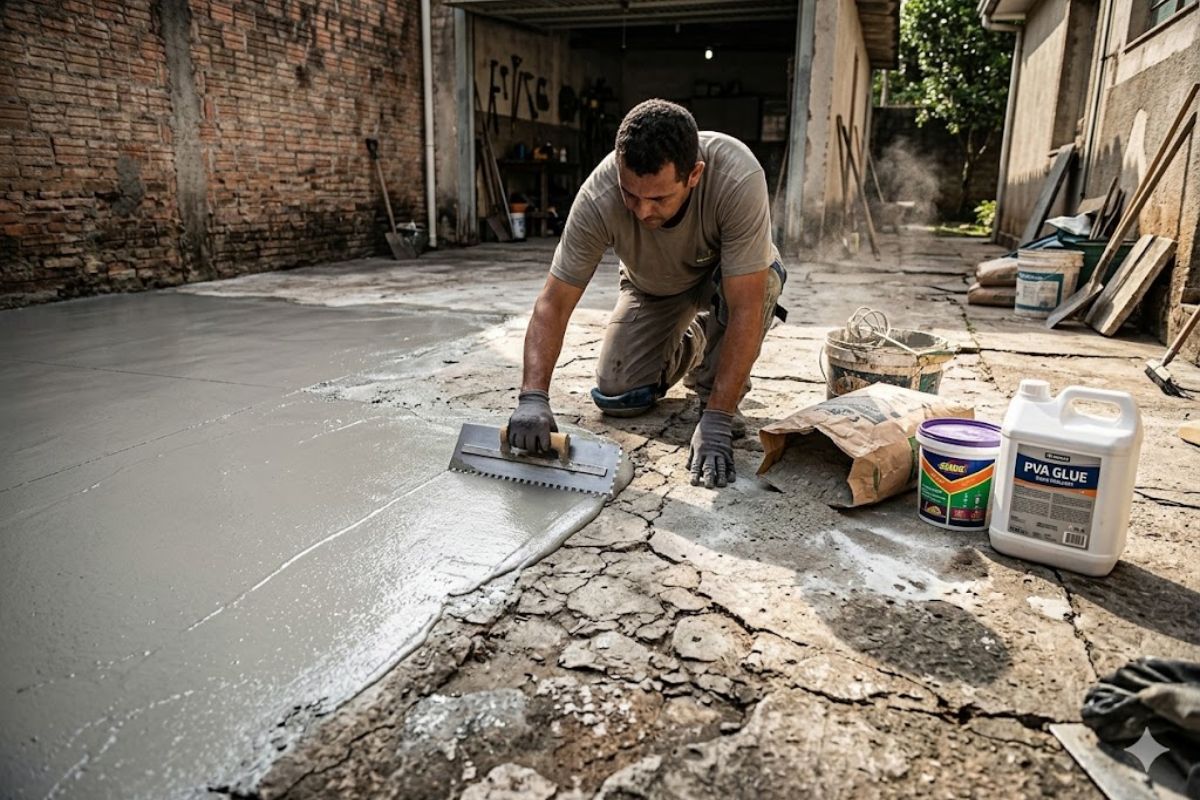


The Simple Mixture Made with AC3 Mortar, Grout, and Glue Has Been Pointed Out as a Solution to Restore Old Floors, Reduce Dust, Cover Wear, and Prevent Breakage in Slabs, Garages, Bathrooms, and Sidewalks, Using Two Coats, 24-Hour Drying, and Yielding Over 30 m² Per Bag of Mortar Today.
The simple mixture that brings together AC3 mortar, grout, water, and glue has started to attract attention in construction and renovation projects as an alternative to restore floor surfaces without demolition. The proposal is to create a new layer over the old surface, reducing dust, correcting visible wear, and aiding in leveling areas that have lost their finish.
The interest is growing because this solution appears as a direct response for those looking to renew slabs, garages, bathrooms, sidewalks, or even ceramic floors without incurring the costs and mess of breakage. The appeal is less about miracles and more about practicality, as the technique relies on accessible materials and a simple application, involving prior cleaning, a squeegee, and two coats to improve the finish.
What Goes into the Mixture and Why It Has Attracted Attention
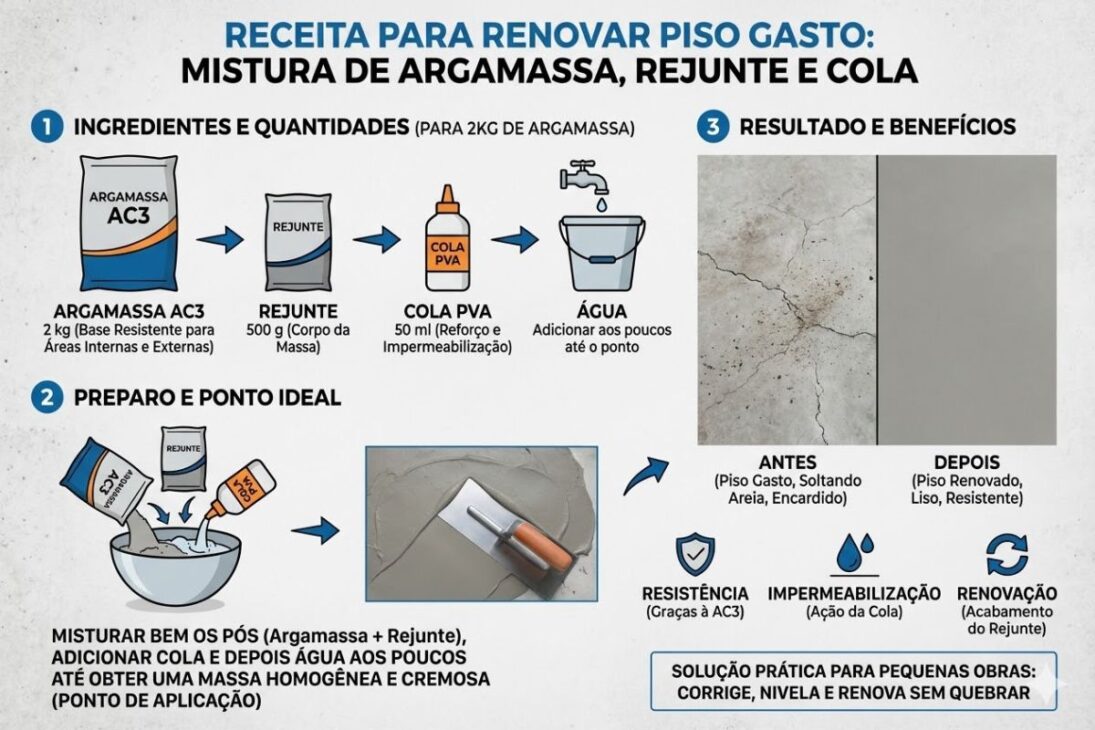
The presented formulation is straightforward. For every 2 kg of AC3 mortar, 500 g of grout, water added gradually until the right consistency, and 50 ml of glue are used.
-
With 30 meters in length, a house in England appears to float in the air and surprises engineers and architects around the world due to its visual effect and construction method suspended over sloped terrain.

-
Called El Inmortal, the building that survived earthquakes in Ecuador seems to balance, defies the laws of physics, and impresses with its bold construction structure.

-
A gigantic dam project in the Himalayas could solve one crisis but silently create another for millions of people.

-
Nikola Tesla said that intelligent people tend to have fewer friends, and now science partially confirms this: a study with over 15,000 people showed that for the more intelligent, socializing too much can even reduce life satisfaction.


The choice of AC3 mortar is deemed crucial because, according to demonstrations, it offers sufficient resistance for use in both indoor and outdoor areas, unlike AC1 and AC2 versions, which have been discarded for this function.
This point helps explain why the simple mixture has become a topic of discussion in small projects.
It is not presented as an isolated decorative finish, but as a corrective mass to renew a worn floor, especially when the surface is flaking sand, dust, or showing a stained appearance.
The grout is included to compose the body of the mixture, while the glue is indicated as a reinforcement for strength and waterproofing.
Where the Application Makes Sense and What It Promises to Correct
The application is indicated over thick floors, slabs, garages, sidewalks, burnished cement, and even ceramic tiles that are chipping, provided that the base is firm and prepared.
The logic is to cover the poor surface layer without removing everything that already exists. This significantly changes the cost and time of the work, as the proposal is to renew the face of the old floor rather than rebuild the entire structure from scratch.
In practice, the simple mixture aims to address a very common problem in home renovations: the surface ages, loses its appearance, starts to dust, and gives a sense of abandonment, but the homeowner does not want to replace everything.
It is precisely here that the technique gains strength, as it promises to level initial irregularities, hide wear, and restore functionality to highly visible areas of the house without heavy intervention.
How the Floor Needs to Be Prepared Before Application
Before receiving the mixture, the floor must be swept, washed, and degreased. This step is considered mandatory because adherence depends on a clean surface.
If there is loose dirt, grease, or accumulated dust, the layer applied on top will lose efficiency, and the renewal may be compromised. In this sense, preparation is as important as the recipe itself.
After cleaning, the simple mixture is spread using a squeegee. The choice of squeegee is not only seen as a domestic improvisation but as a practical solution for application.
It helps to distribute the mixture more evenly and also reduces strain on the back, as it prevents the person from working bent over for too long.
Instead of pressing too hard, the implicit recommendation is to pull the mixture gently, covering the area gradually.
What Changes Between the First and the Second Coat
The first coat already provides visual improvement and begins to close more evident imperfections. In many cases, according to demonstrations, it already resolves a large part of the problem for those who just want to stop the dust and reorganize the appearance of the floor.
Even so, the second coat is presented as the moment when the finish gains more regularity and the surface becomes more homogeneous.
In this interval, the mixture tends to harden a bit, and the orientation is to correct the consistency with more water before the new application. The second layer can be a bit thinner without compromising the job.
This shows that the technique does not work with absolute rigidity, but with fine-tuning as the mixture changes during use.
The important thing is to mix well again and repeat the distribution with a clean squeegee, aiming to reduce the marks left in the beginning.
How Much It Yields and Why the Cost Seems to Attract Attention
According to the presented base, a 20 kg bag of mortar can yield more than 30 m² for this type of application.
Maintaining the shown proportion, this volume requires about 5 kg of grout, equivalent to five 1 kg units.
Since the grout is used in relatively small quantities per batch and the glue is only needed at 50 ml for every 2 kg of mortar, the final cost tends to appear affordable for those looking to restore large areas.
This calculation helps explain why the simple mixture has gained so much attention.
It positions itself between makeshift patches and complete renovations, promising wide coverage with relatively inexpensive material.
In domestic terms, this is highly significant in slabs, garages, and sidewalks, where integral replacement of the covering usually costs a lot and generates more waste than the homeowner wants to deal with.
How the Finish Looks After Drying
Once dry, the described result is a renewed surface, without the formation of “bumps” and with a visually cleaner finish.
One important detail is that the floor would not be excessively smooth but would have a non-slip characteristic.
This makes a difference in outdoor areas, bathrooms, and garages, where appearances cannot compromise safety during movement.
The indicated waiting period is 24 hours before washing, frequent walking, or even parking a car on the applied area.
This point is crucial because it transforms the technique into a quick solution for resuming use, without requiring long pauses.
For those needing to renew a sidewalk, garage, or slab without losing many days, this short interval helps sustain interest.
What This Technique Really Represents in Small Projects
The strength of this proposal lies in addressing a concrete problem of popular renovations: the surface becomes ugly, worn, and dusty, but a complete replacement of the floor requires breakage, waste disposal, more time, and more money.
The simple mixture comes precisely at this juncture, offering a corrective layer made with mortar, grout, and glue, applied directly over the old base.
At the same time, what the technique delivers needs to be understood clearly. It is presented as a solution for superficial renewal and leveling, not as a structural reconstruction of the area.
This matters because it separates real utility from exaggerated expectations. For slabs, garages, sidewalks, bathrooms, or worn ceramics, it can represent an interesting shortcut.
For deep foundational problems, the logic is different.
In the end, what made this simple mixture attract so much attention was the combination of low cost, accessible application, and the promise of restoring old floors without demolition.
In a scenario where many renovations stall out of fear of breakage, this solution gains traction because it seems to restore use and appearance with few materials and in little time.
The question now is practical, not theoretical. Would you use this simple mixture of mortar, grout, and glue to renew the floor of your slab, garage, or sidewalk, or do you still think nothing replaces a complete renovation?








Que sería en México lo que aquí llaman Reajuste salarial??