





 Portuguese
  English
  Spanish
  5 min of reading
  3 comments


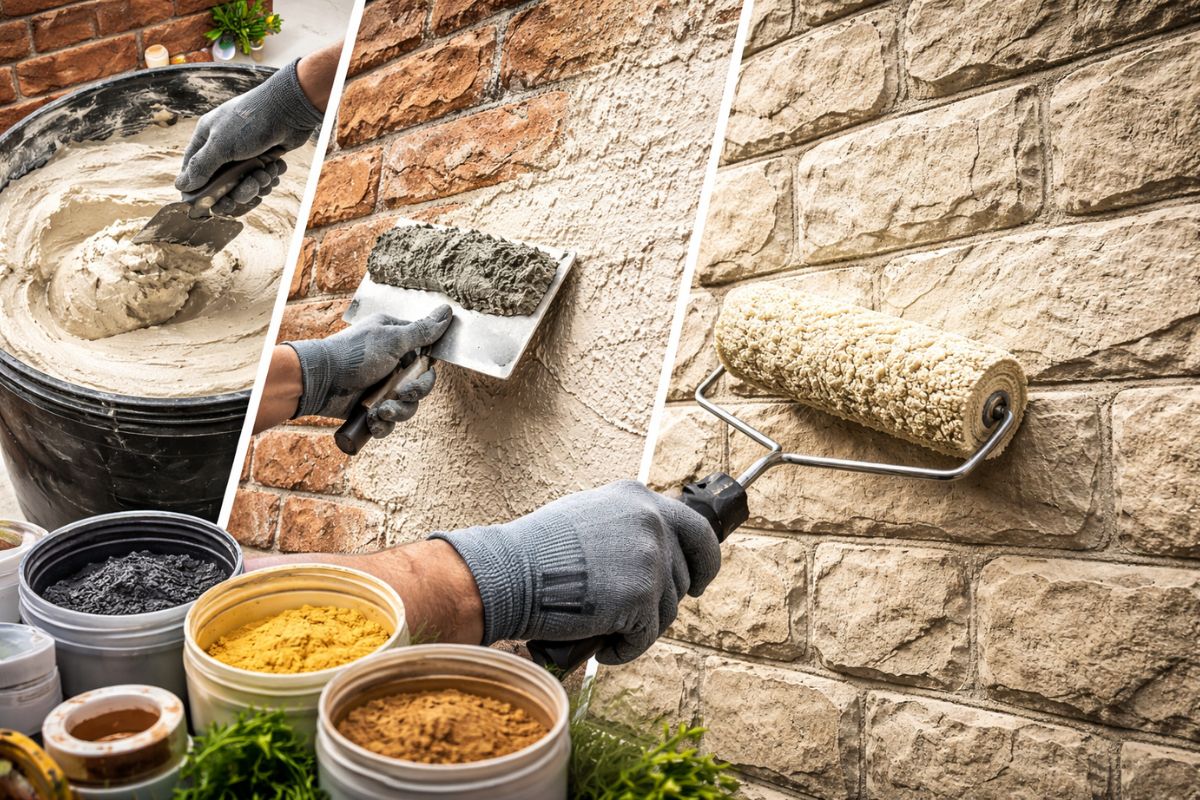


With AC2 Mortar Applied In Thin Coats, Textured With A Roller And Scratched While Still Wet, The Raw Brick Surface Gains Decorative Relief, Greater Resistance To The Weather And A Visual That Simulates Natural Stone, Opening Space For Pigmented Paint, Contrast Between Shades And Final Protection With Durable Acrylic Resin.
The AC2 mortar no longer functions merely as a covering and takes on two roles simultaneously when it meets the texture roller on the raw brick: closing the exposed surface and creating a relief that resembles natural stone. It is a solution that combines protection and appearance in the same process, without relying on pre-made panels or a separate coating.
The effect arises from a simple yet sensitive sequence, but crucial to the timing of each step. First come the coats that cover the brick; then, with the mortar still wet, the roller and the scratches that draw the stones are introduced, the adjustment of imperfections, and finally, the layered painting that alternates light backgrounds, darker marks, and finishing with resin to enhance durability.
How The Mortar Changes The Function Of A Raw Brick Wall
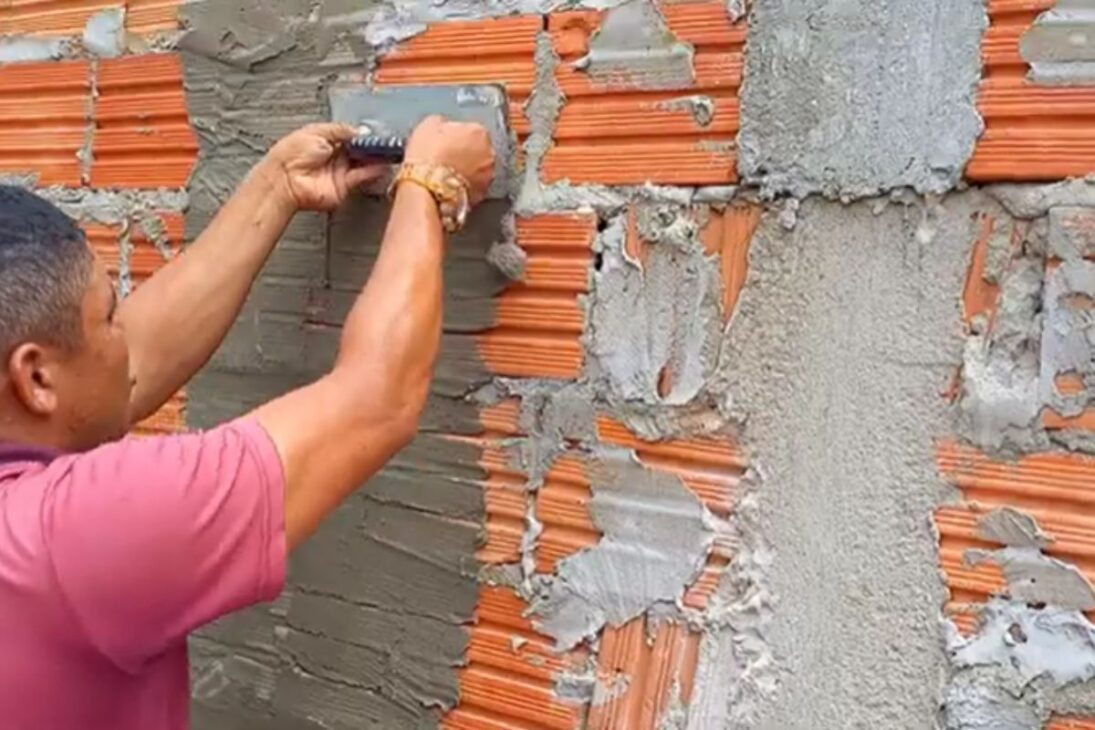
The basis of it all lies in the application of mortar on the still-exposed masonry. The first coat serves to cover the brick and begin closing a surface that, when left exposed, suffers more from sun and rain. It is not merely about improving appearance. The mortar serves as an initial barrier against the direct wear of the weather, which is important for exterior walls or very open areas.
-
New CCR concrete paving technology promises roads up to 3x more durable, less maintenance, and cost reduction in Brazil.

-
Made from recycled plastic, plastic wood is gaining space in the construction industry because it does not rot, resists moisture, and reduces maintenance costs over the years.

-
Florianópolis will receive a million-dollar BRT that will begin construction in 2026 with nearly 400 million in funding from the federal government and the Inter-American Development Bank, and the map already shows the routes for the exclusive bus corridors.

-
Without a blueprint, without an engineer, and using scrap from the dump, a father spends 15 years building an 18-room castle for his daughter, featuring tram tracks, 13 fireplaces, and over 700 m², which may now be demolished.

In the next step, the layer is further reinforced with a second coat. At this point, the recommended thickness is around 3 to 4 millimeters, with no need for excess. This measurement helps create enough body to receive the texture but without turning the finish into a mass that is too heavy. For those seeking this type of effect, the logic is clear: cover the brick, minimally level the face, and prepare the wall to gain design and depth.
Where The Stone Relief Really Begins
The stone aspect does not appear during the final drying or painting. It begins to form the moment the texture roller passes over the second layer of still-fresh mortar. This detail completely changes the result, as the relief depends on the mass being wet enough to receive the marking without losing consistency. The movement of the roller, moving up and down, creates the visual irregularity that separates the wall from the common smooth finish.
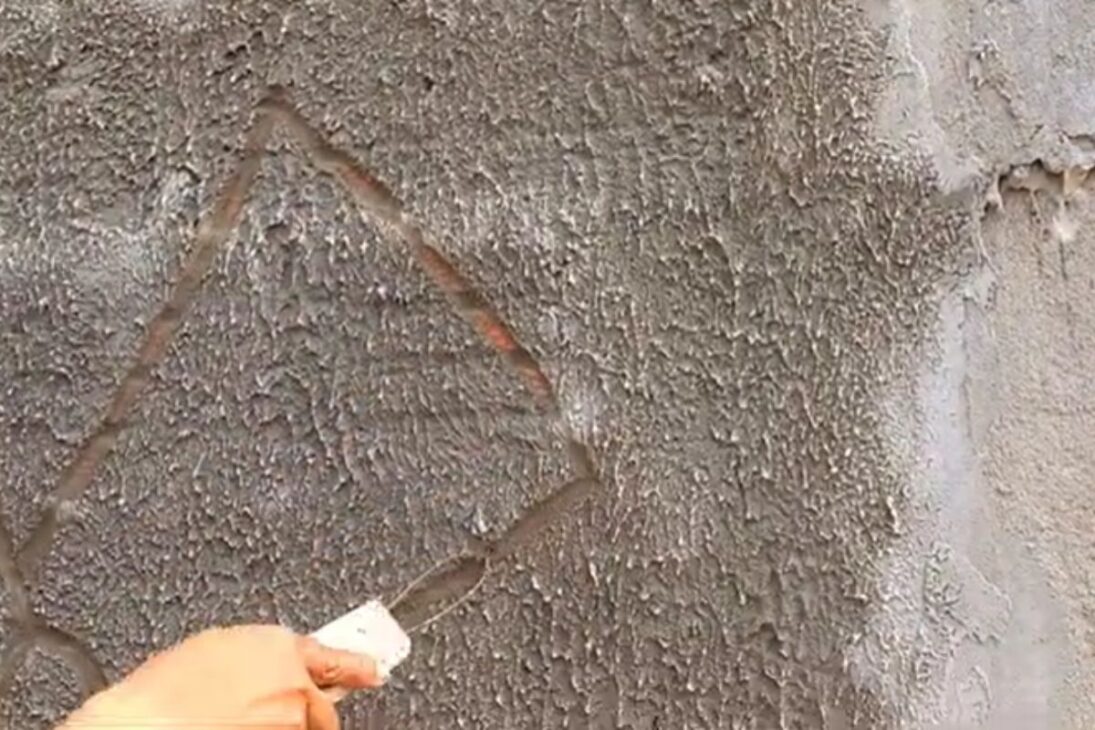
After that, the drawing of the stones comes in. Cuts can be made with an improvised wire tool, an adapted lid, or even simple materials like stone, wood, or a small piece of brick.
The important thing is to scratch the divisions firmly before total drying. At this moment, the coating ceases to be merely a layer of mortar and instead functions as a decorative composition, with joints, visible blocks, and a visual reading similar to laid stones.
Why The Choice Of AC2 Mortar Makes A Difference
The choice of AC2 mortar is not accidental. It is used because the surface will be exposed to the sun and rain, which requires a material better suited to withstand this condition.
When the finish faces the weather, resistance stops being a detail and becomes a central part of the service. That is why the technique combines the visual effect with concern for permanence, rather than just immediate impact.
This concern continues after drying. The burrs and small balls of mass are removed with the trowel so that the relief looks cleaner and more readable. Then, the painting needs to follow the same logic of durability.
The guidance is to use high-quality paint, precisely because the work will be exposed. In other words, it is pointless to create texture with mortar and a well-defined relief if the final layer cannot withstand the same routine of sun, rain, and weather variations.
How Color Creates Depth Without Hiding The Texture
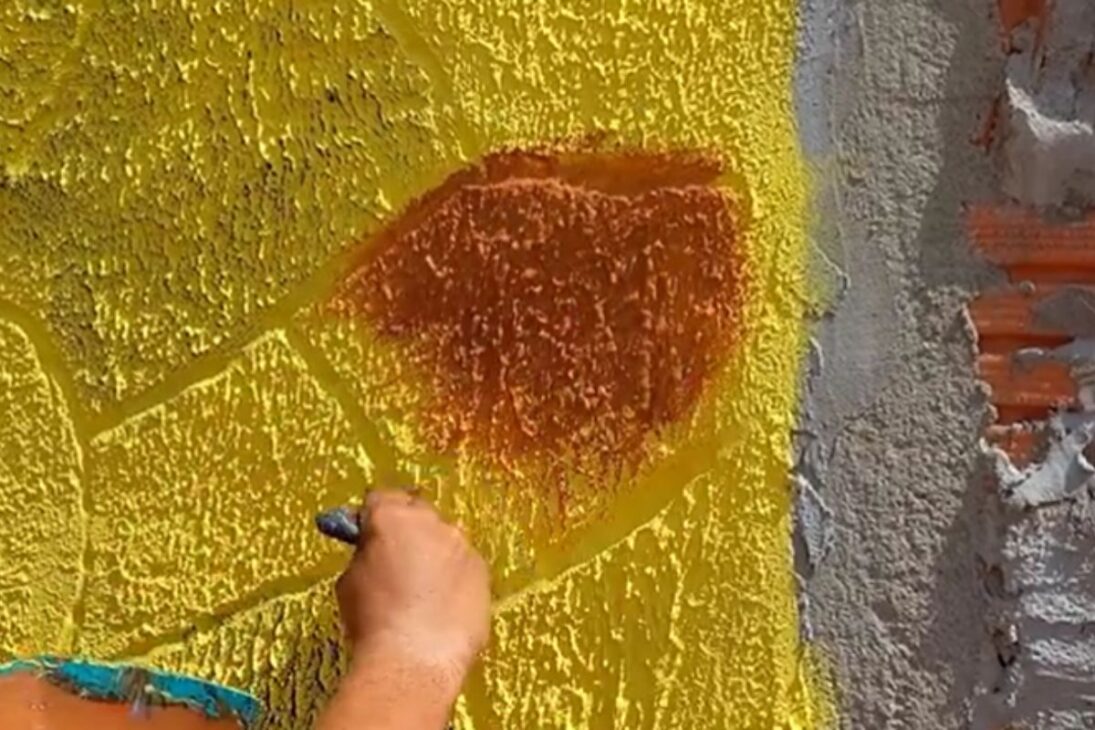
The painting begins with a yellow base, which serves as a foundation to receive the following shades. This first color is not mere filling. It helps to add warmth to the set and prepares the surface so that the stones appear less flat.
When this base spreads across the entire relief, the design created by the roller and the scratches becomes more visible, as each protrusion and division begins to respond to the light differently.
Next, dark markings on some stones come in, without needing to repeat the same effect on all. This alternation between lighter and darker areas is what prevents the wall from looking too artificial.
Instead of uniformizing everything, the technique works with different shades to suggest natural variety. Thus, some pieces appear visually deeper while others remain more open, creating a set that is more convincing and less repetitive.
The Final Finish That Defines The Decorative Aspect
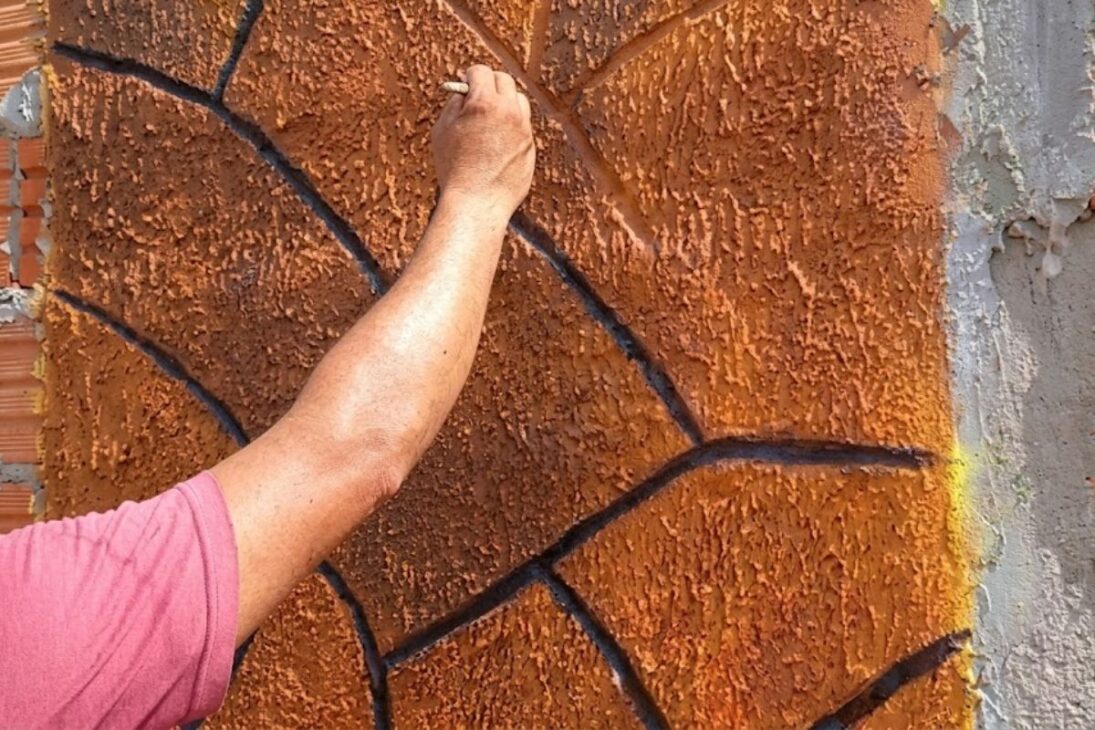
The final stage mixes water-based acrylic resin with pigments, especially orange and brown, until it reaches a shade similar to mahogany.
There is no single, fixed measure for this. The shade is adjusted gradually, with the pigment being added slowly until the desired color is achieved. This point is important because it shows that the finish does not depend solely on covering the wall with mortar but on controlling the final appearance without obscuring the texture already created.
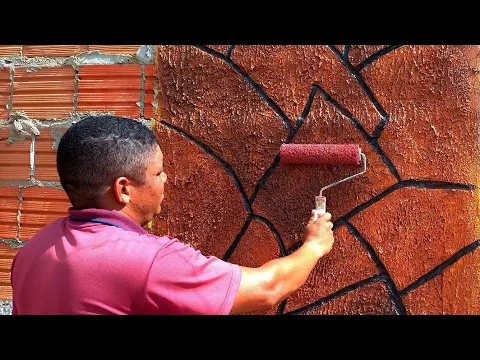

Besides the color, the resin has another decisive function: providing shine and protection. Since it can be used indoors and outdoors, it reinforces the final layer and helps preserve the work against the elements. The grout between the stones, done with a fine brush, finishes organizing the drawing’s reading. In the end, the result emerges precisely from this combination of steps: mortar to form body and relief, paint to create depth, and resin to seal and enhance the set.
In the final result, the wall that was once merely an exposed raw brick now has a decorative presence and protection that is more in keeping with the environment.
It is not a transformation based on a ready-made piece, but on sequence, timing, and finish. And that is exactly what makes the technique stand out: it shows that mortar can leave the role of raw material and also take on an aesthetic function. Would you use this stone effect on your home’s exterior, or do you prefer to keep the exposed brick without coating?








¿ Que precio tendría una superficie de 24m? Cuadrados
Sobre un enfoscado de cemento¿ Podría parecer una piedra uniforme,sin junta?
Sobre superficie lisa. ¿ Cómo se comporta el producto?