





 Portuguese
  English
  Spanish
  5 min of reading
  0 comments


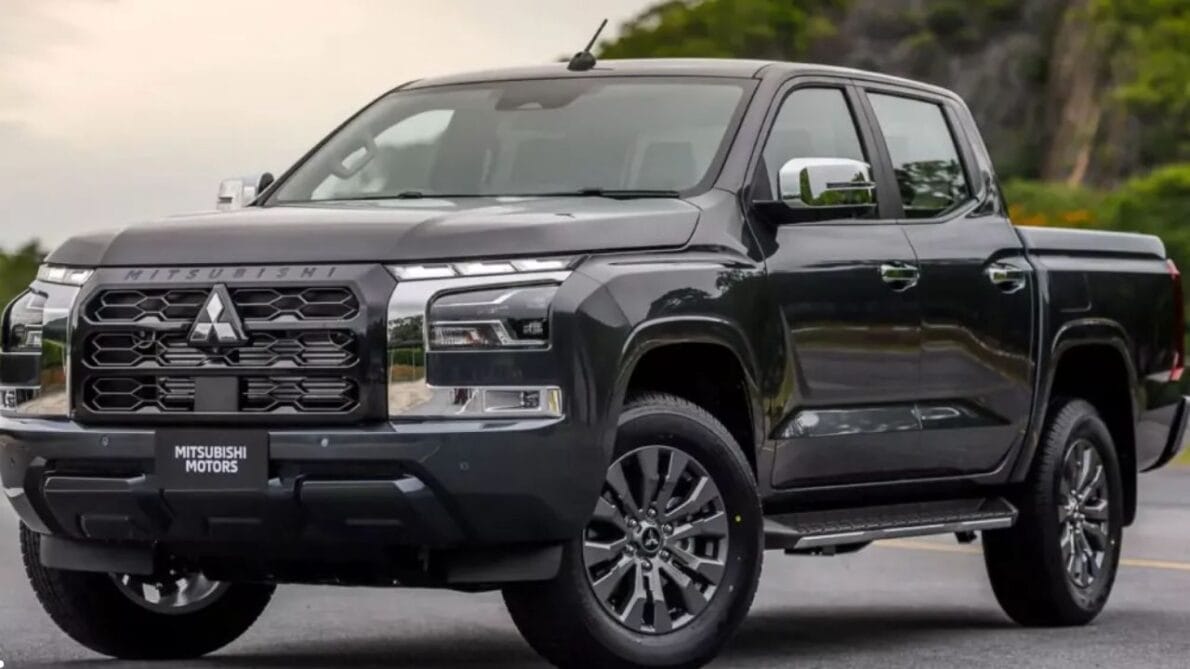
With Bold Design, Biturbo Engine, and Surprising Autonomy Promise, the New Mitsubishi Triton Katana Debuts as One of the Most Complete Pickups in Its Class. Find Out What’s Different and If It Delivers Everything It Promises.
Imagine a pickup with a warrior’s face, a name from Japanese swordsmanship, and the courage to traverse any terrain in Brazil, from the mud of Barueri to the roads of the Pantanal. This is the proposal of the New Mitsubishi Triton Katana, the sixth generation of the brand’s classic truck, arriving in the national market promising to shake the throne of the Hilux, Ranger, and S10. And it’s not an exaggeration: the Katana is larger, stronger, more comfortable, and yes, more expensive. But is it worth all this?
Officially presented at the end of 2024, the New Mitsubishi Triton Katana will start circulating here in 2025 and, from the first contact, it impresses. Far beyond just a restyled look, it received structural improvements, a new robust engine, a more comfortable interior, and technologies that make urban and off-road use much more balanced.
New Generation, New Structure, and New Name
The first major change is the name. Mitsubishi decided to simplify, dropping the “L200” and calling the model simply Triton, with the surname Katana marking the top-end version. A marketing move aimed at highlighting the renewed character of the model, which may also cause some confusion among fans of the classic L200 Triton. In any case, the intention is clear: to show that we are facing something new.
-
An irregular parking case gains attention after a Mercedes Classe A was removed in such a strange way that it even raised doubts about damage to the car.

-
Costing R$ 16,000, the new Yamaha features a 125 cc hybrid engine with electric assistance, delivers 8.3 hp, includes ABS, optimized fuel consumption, Y-Connect connectivity, 25 liters of storage space, and a surprising 4-year warranty in the urban segment.

-
OMODA & JAECOO grows in Europe in 2026 with an integrated strategy of sales, innovation, local production, and technological advancement in the United Kingdom, Italy, and Spain.
-
OMODA & JAECOO expands after-sales service in Brazil with competitive maintenance, a 7-year warranty, and high availability of parts for technological SUVs.

What’s new is indeed the chassis. Dubbed the “megachassis” by the manufacturer, it is now 60% more rigid to flex and 40% more resistant to torsion, all through the use of high and ultra-high strength steel. This evolution has brought more safety, stability, and, most importantly, comfort. The new base allowed for an extended wheelbase, now measuring 3.13 meters—no less than 13 centimeters longer than the previous generation. This has made the pickup gain more internal space and perform better on uneven terrains.
Boxy and Imposing Design: A Look with Personality
If in previous generations Mitsubishi flirted with a sporty look, now the bet is on a “rugged-chic” style. The New Mitsubishi Triton Katana is wider, sporting full LED headlights with straight cuts, robust bumpers, and a front end with a strong, almost intimidating visual identity. Those who see it in person get a better understanding: it’s a pickup that commands respect.
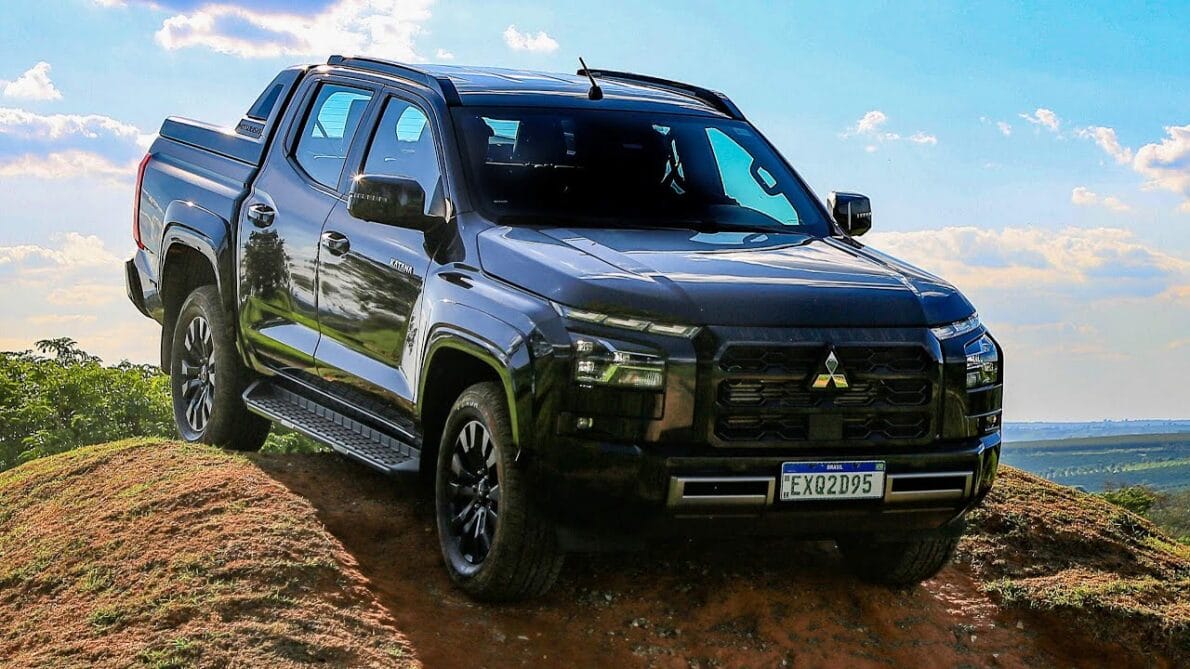
Additionally, there are exclusive details like black trims on the fenders, piano black door handles and mirrors, a sturdy roof rack, 18-inch wheels, and a stylized roll bar in the bed. These elements together give the Katana its own face among rivals.
Biturbo Diesel Engine Surprises with Torque and Consumption
Under the hood, what powers the Katana is a new 2.4 biturbo diesel engine, replacing the old mono turbo configuration. Now there are 205 hp of power and 47.9 kgfm of torque, available from just 1,500 rpm. This means quicker responses when accelerating, more vigorous recoveries, and less effort required for towing or transporting loads.
Mitsubishi promises economy and delivers. In tests conducted, the New Mitsubishi Triton Katana achieved 14.1 km/l on the highway and 10.2 km/l in the city. For a pickup weighing over 2 tons, equipped with 4×4 traction and a full off-road arsenal, these numbers are impressive. The 76-liter tank also allows for a range of over 1,000 km, which is very relevant for those who drive long distances.
Comfort and Technology: The Leap the Pickup Needed
Inside, the leap was as significant as outside. The finish still uses hard plastics in some areas, but there are more zones with soft-touch coatings, modern textures, and details that evoke carbon fiber. The cabin is quieter, and rear space has increased, improving comfort for all occupants.
Among the standout features, the New Mitsubishi Triton Katana includes a 9-inch multimedia center, 360º camera, dual-zone automatic air conditioning, wireless phone charger, adaptive cruise control, and various driving modes including specific configurations for mud, snow, sand, and gravel. In other words, ready for both city and backcountry.
The instrument panel retains analog displays but features an informative and clear central screen. The steering is now electric, improving drivability, especially in urban use, where a slightly larger turning diameter could have been a downside.
Larger Bed and Increased Load Capacity
The Katana is also more practical. The bed received a new design, is flatter, more spacious, and can now carry up to 1,080 kg of cargo—an increase of 80 kg compared to the previous generation. The tailgate has a damping system and protection against scratches. For off-road lovers, the pickup maintains a ground clearance of 22.3 cm and generous approach (29º) and departure (23º) angles, with full and low traction.
It’s the classic robustness of the Mitsubishi Triton Katana, now with more comfort, more technology, and more efficiency. All this without relinquishing what the brand has always valued: the ability to face any challenge.
The New Mitsubishi Triton Katana didn’t just come to replace the previous generation. It arrived to redefine what the Japanese brand understands by a midsize pickup in Brazil. With a striking design, efficient biturbo engine, reinforced chassis, and a respectable list of equipment, it enters with full force in the competition against Hilux, Ranger, and S10.
Despite the high price starting at R$ 330 thousand, the Katana offers a technical set that’s hard to ignore. For those seeking true robustness with more comfort and technology, it delivers on its promises. And more: it shows that the Mitsubishi Triton Katana still has a lot to say in the national market.
Source: A Roda








-

2 pessoas reagiram a isso.