





 Portuguese
  English
  Spanish
  5 min of reading
  0 comments


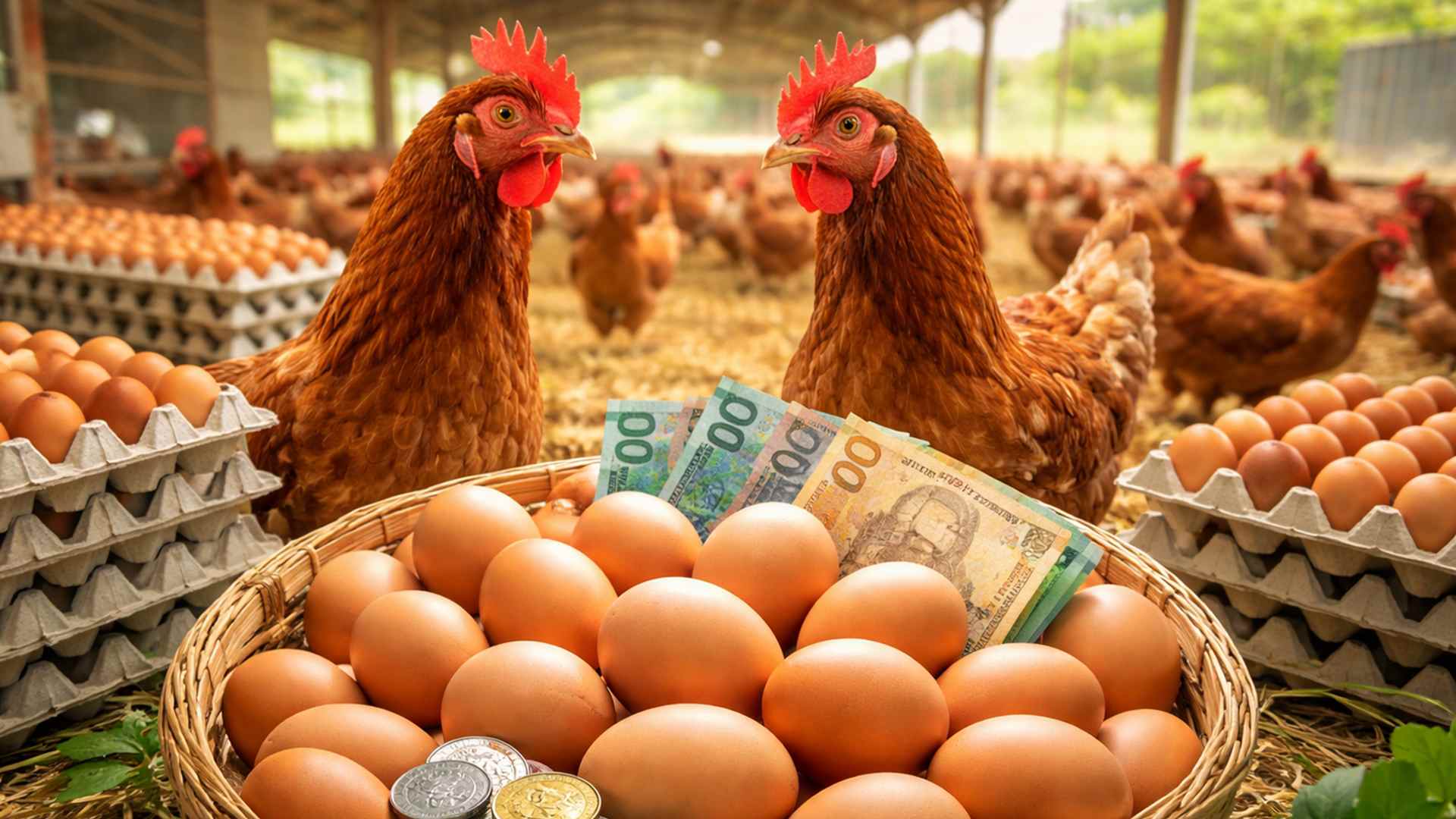
With the price of eggs rising in March 2025, the projection for money with chickens shows that 200 layers can generate 450 dozen per month and leave R$ 2,860 net, provided the producer maintains an average productivity of 90% and strict cost control
With the price of eggs on the rise and more producers eyeing money with chickens, raising 200 laying hens in a free-range system can generate a monthly net income of R$ 2,860, considering an average production of 90%, selling at R$ 12 per dozen, and the operational costs detailed for March 2025.
The information is based on a video on the channel Lá da Roça, which details the calculations of production, costs, and profit in raising 200 laying hens.
The estimate was presented based on a scenario with 200 hens in the laying phase, taking as a reference the prices practiced in the breeder’s city. The calculation considers monthly revenues and expenses related to production, packaging, and delivery of the eggs, excluding the costs of forming the flock from the initial phase.
-
As dams and pollution advance, migratory freshwater fish are facing a silent global crisis that has already decimated populations, threatened fisheries, and raised alarms in major basins.

-
Crotalaria, mucuna, and other cover crops stop being “weeds” between harvests and become central to agriculture by improving the soil, adding biomass, and enhancing green fertilization in vegetable production.

-
Coruripe Mill secures international financing of R$ 530 million and boosts the sugar-energy sector.

-
The sugar-energy sector advances with agricultural technology, but agricultural productivity still raises concerns.


According to the explanation, the profit from the activity depends directly on the number of housed birds and, mainly, on the quality of management. It was also highlighted that working with commercial laying hens requires stricter care than managing backyard chickens, as they are more fragile and sensitive to failures.
High egg prices encourage new breeders
The rise in egg prices has encouraged people who previously thought about starting a breeding operation but felt demotivated by lower product prices. In this scenario, the free-range system appears as an alternative for those seeking financial returns from selling production.
Despite this growing interest, the recommendation for those who are still inexperienced is to start with 100 birds. The guidance takes into account the need for learning in management and reducing the risk of losses due to animal loss, barn structure, and equipment acquisition.
It was emphasized that experience in management directly impacts the final result. Therefore, even in the face of potential revenue, starting with a smaller flock is pointed out as the safest way to learn before expanding the breeding.
The analysis presented for 200 birds was based on the local selling price, but there is a warning that prices may vary by region. Therefore, the most accurate calculation should consider the price of eggs and the costs practiced in each locality.
How much 200 hens can produce per month
In the example used for the calculation, the eggs are sold to supermarkets for R$ 12 per dozen. The recording was identified as made in March 2025, precisely to situate the values used and avoid comparisons with prices from other periods.
At peak laying, it was reported that some strains can reach an average of 95% productivity. Still, to facilitate a more realistic projection, the calculation was based on an average production of 90%, considered more accessible for those who do not yet fully master management.
In this scenario, 200 hens producing at 90% would deliver 180 eggs per day. This volume corresponds to 15 dozen daily and, over 30 days, reaches 450 dozen per month.
With the sale of each dozen at R$ 12, the monthly gross revenue reaches R$ 5,400. The observation made is that this total could be higher if the breeding can approach 95% productivity, provided that management and strain favor this performance.
The calculation, however, is presented as a reference. Those wishing to estimate more accurately the potential for money with chickens should redo the numbers based on the selling price practiced in their own region and the real conditions of their breeding.
Monthly costs with feed, packaging, and delivery
After projecting revenue, the calculation moves on to the monthly expenses necessary to produce, package, and market the 450 dozen of eggs. The largest weight among the indicated costs is that of feeding the flock.
A laying hen at peak production, raised in light strains such as Novogen, Tinta, BKB, and GLC, consumes an average of 112 grams of feed per day. With 200 birds, this daily volume is about 22.5 kilograms, reaching approximately 672 kilograms per month.
Considering the average cost of R$ 2.50 per kilogram of feed, the monthly expense for feeding reaches R$ 1,680. It was also mentioned that this amount can decrease when the producer makes their own feed and can buy the inputs at a lower price.
In the specific case reported, local feed is costing R$ 2.25 per kilogram. Still, for the overall calculation, the average value of R$ 2.50 was maintained, precisely to approximate the projection to a reality found in various regions.
Packaging also enters the account of money with chickens. The packaging for a dozen costs R$ 0.80, while that for 30 eggs costs R$ 0.60, but the average was made based on the selling method used in the example, in packaging of a dozen.
Thus, the monthly spending on packaging amounts to R$ 360. As deliveries are made once a week, there is also an expense of R$ 400 per month for fuel to take the production to buyers.
Net profit and observations on starting the breeding
In the case of water, there is no direct cost, as the supply is made from a well. Still, there is an expense with electricity, estimated at around R$ 100 per month, related to the lighting program and the operation of the pump that supplies the aviaries.
Adding the expenses with feed, packaging, fuel, and electricity, the reported monthly cost reaches R$ 2,540. Given the gross revenue of R$ 5,400, the projected net result for the month is R$ 2,860.
It was clarified that this calculation does not include expenses with the chicks from the initial phase until the start of production. This point was mentioned to address inquiries about the complete investment, making it clear that the presented projection is limited to the ongoing production stage.
Another important warning involves the formation of the flock. To end up with 200 birds effectively in production, the guidance is to consider buying 210 to 220 animals, as males may be born in the flock and losses may also occur throughout the process.
The acceptable loss mentioned is up to 5%. Therefore, buying a number greater than the final goal appears as a necessary measure to compensate for losses and ensure that the breeder reaches the desired number of birds at the time of laying.
Profitability, according to the explanation, depends on maintaining high productivity. Without proper management, production falls and, instead of profit, the breeding can generate losses, even with the price of eggs on the rise.
In this scenario, the presented calculation indicates that 200 hens can generate a significant monthly return, but the result is conditioned on discipline in management, cost control, and attention to the performance of the flock. The projection shows that, with 90% production and monthly expenses of R$ 2,540, money with chickens can reach R$ 2,860 net per month.






Seja o primeiro a reagir!