





 Portuguese
  English
  Spanish
  9 min of reading
  0 comments


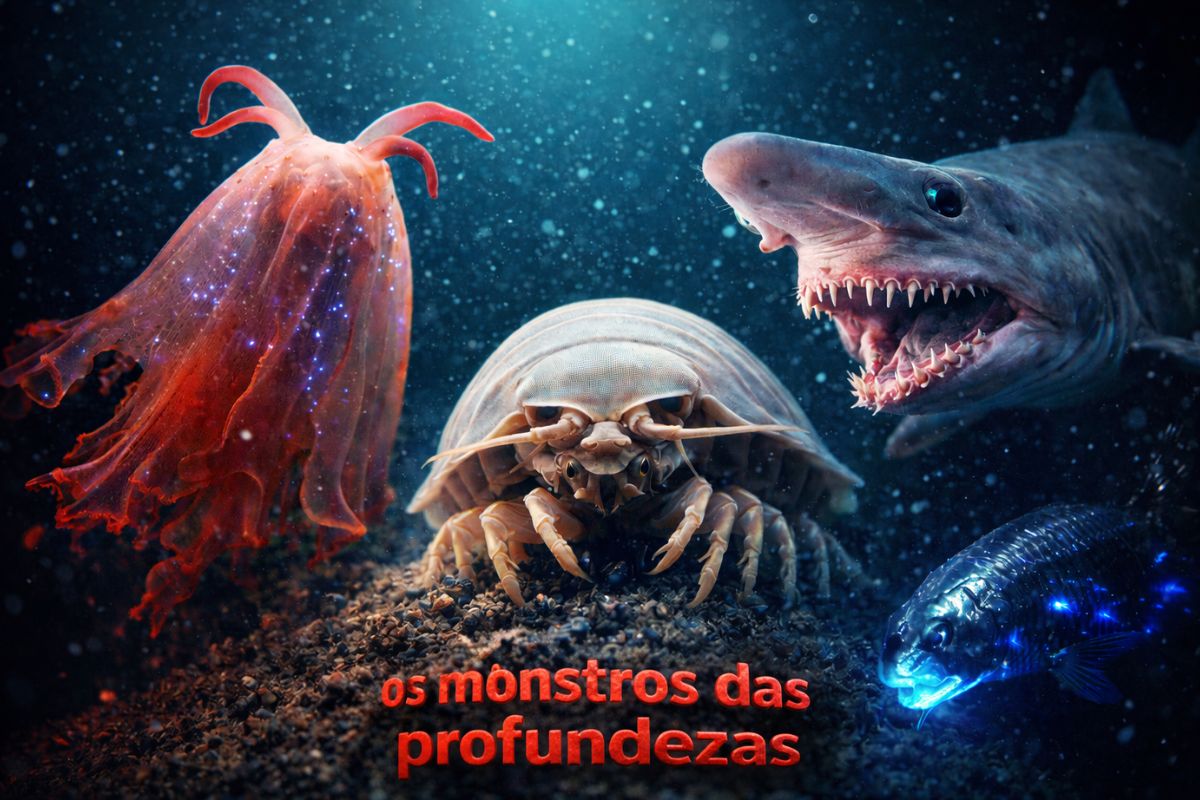
From Headless Chicken Monster to Giant Sea Cockroach and to Anglerfish, These Real Creatures of the Deep Sea Live Up to 7,000 Meters, Glow in the Dark, Withstand Crushing Pressure from Antarctica to the Gulf of Mexico, and Look Like They Are Out of a Horror Movie.
In the deepest and darkest regions of the ocean, where there is almost no light, food is extremely rare, and the pressure could crush a submarine, real deep-sea creatures have developed bodies so strange that they seem imaginary. Headless chicken monster, vampire squid, barrel-eyed fish, and giant sea cockroach truly exist and showcase how far evolution can go in extreme environments.
From a distance, we describe these life forms as “bizarre,” “scary,” or “monstrous.” But for those who study the deep sea, these real deep-sea creatures are perfect packets of adaptations: bioluminescence, transparent heads, disproportionate mouths, and fuzzy “skins” of bacteria, all calibrated to survive where almost nothing else can.
What Makes These Real Deep-Sea Creatures So Extreme
The regions where these real deep-sea creatures live are very different from the coast we know. Down there, total darkness prevails, temperatures are low, food falls in the form of organic remains and carcasses, and the pressure is so high that the body of many shallow-water animals simply collapses.
-
Tourists were poisoned on Everest in a million-dollar fraud scheme involving helicopters that diverted over $19 million and shocked international authorities.

-
Hidden beneath the dense forest of the Sierra Nevada, Betoma emerges in a neighbor of Brazil as the greatest archaeological discovery of the century, revealing a colossal ancestral city covering over 18 km², with 8,334 stone structures and the potential to rewrite the history of South American civilizations.

-
Goodbye iron: new technology from Xiaomi promises to revolutionize the way we iron clothes with 500 kPa steam, continuous flow of 120 g/min, heating in 65 seconds, and six smart modes for different fabrics.

-
Rio Pardo, the most mysterious city in Rio Grande do Sul: untouched Pampas castle, the missing treasure of the Devil Boy, bride’s saint, invisible tunnels, and a 200-year curse today.


So, it’s no surprise that the anatomy appears “wrong” to our eyes. Giant mouths to take advantage of any prey, disproportionate eyes to see the slightest light, gelatinous bodies that don’t break under pressure, bioluminescence, and transparency are characteristics that together define these creatures more as spectacular than as monsters.
Headless Chicken Monster: The Sea Cucumber That “Flies” in the Dark

The list begins with one of the most unexpected names in all zoology: the headless chicken monster, also known as the pink-transparent fantasy.
Despite the nickname, it is neither a monster, nor a chicken, and far from a bird. In fact, it is a type of floating sea cucumber that lives between about 500 and 7,000 meters deep.
It is one of the real deep-sea creatures most bizarre ever recorded. Its body is bulbous, with structures resembling wings, and a frightening transparency that exposes the internal organs. From a distance, it literally looks like a decapitated chicken “flying” in the darkness.
Unlike most sea cucumbers, which are benthic and crawl slowly on the seafloor, the headless chicken monster can actively swim through the water column.
It uses fins that move like a billowing cape, earning the informal title of “chicken that flies in the deep sea.”
A curious detail is the “ritual” before it takes off underwater: it releases feces before starting to swim, probably to lighten its load.
It feeds as a detritivore, sucking sediments off the seafloor with tentacles for a few seconds, and then returns to gliding for long periods without eating.
Although it has been known to science since the late 19th century, the first record of a living individual only occurred in 2018, in the Southern Ocean, in the Antarctic region.
Since then, it has been spotted in the Pacific Ocean and the Gulf of Mexico, establishing itself as a true “cosmopolitan monster” of the depths.
Yeti Crab: The “Farmer” of Hydrothermal Vents

If the headless chicken monster seems invented, the yeti crab looks like a character from a fantasy movie. It lives in even more extreme regions of the depths, in the so-called hydrothermal vents, chimneys that spout hot water heated by the Earth’s mantle, laden with chemical compounds like hydrogen sulfide.
Discovered in 2005, the yeti crab got its nickname because of the hairy structures on its limbs, reminiscent of hair. However, these “hairs” are actually filaments where colonies of chemosynthetic bacteria live.
These bacteria produce energy from the chemical compounds released by the hydrothermal sources. The yeti crab literally cultivates and feeds on these bacteria, in one of the most bizarre examples of “agriculture” in the animal world.
It can live up to about 2,200 meters deep, in extreme temperatures and surrounded by toxins.
It is one of the real deep-sea creatures that seem to have been designed for a underwater horror tale, but in practice, it is just taking advantage of an energy source that almost no other animal can use.
Blobfish: The “Ugliest Animal in the World” That Pressure Deforms

Another famous face from the depths is the blobfish, or fat-headed fish. It became famous on lists of the “ugliest animal in the world,” always with that melted and depressed appearance in surface photos. However, this fame is unjust.
That “collapsed” look only appears when the blobfish is taken out of its natural habitat, in depths over a thousand meters.
Without the constant pressure of its environment, its gelatinous body loses shape and literally looks like it melts. Down there, however, it has a functional body suited to what it needs to do.
Instead of swimming actively, the blobfish lives quietly floating, almost without expending energy. It doesn’t have much developed musculature and practically waits for food to “fall from the sky,” that is, from the waters above.
Among the real deep-sea creatures, it is a perfect example of a maximum energy-saving strategy in a world where every piece of food counts.
Vampire Squid: The Vampyroteuthis Infernalis of “Marine Snow”

With a scientific name that seems to have been created for Halloween, the vampire squid officially carries the title of Vampyroteuthis infernalis, which in Latin means “vampire squid from hell.” In practice, it is neither a squid in the classic sense, nor a vampire, nor did it come from hell.
It belongs to a unique group of cephalopods called Vampyromorpha, an ancient lineage related to octopuses, and lives between about 600 and 900 meters deep in tropical and temperate oceans.
Its appearance mixes giant eyes, tentacles joined by membranes that look like a vampire’s cape, as well as reddish or black coloring.
Despite its appearance, the vampire squid is only about 30 centimeters long and is not a voracious hunter like other squids.
Instead, it feeds on “marine snow”, a mixture of organic remains and particles that fall from the ocean surface.
When threatened, the strategy is quite literally brilliant. Instead of releasing dark ink, it releases a cloud of bioluminescent mucus, confusing potential predators. If that is not enough, it turns upside down and covers itself with its own arms, forming a “living cape.”
From an outsider’s perspective, it looks like a ready scene from an underwater horror movie starring one of the most dramatic real deep-sea creatures.
Giant Sea Cockroach: The Armored Cleaner of the Ocean Floor

Imagine finding a “cockroach” the size of a cat. That’s more or less the feeling when faced with the giant sea cockroach, an isopod that lives between about 500 and 2,100 meters deep.
It isn’t a true cockroach, nor an insect. It is a crustacean, a distant relative of pill bugs and the “small cockroaches” that live in rocky shores.
However, in the case of the giant sea cockroach, we are talking about an animal that can reach around 60 centimeters, with compound eyes and a segmented armored shell, full of legs.
This creature is a classic example of abyssal gigantism, a trend for deep-sea animals to achieve sizes much larger than their shallow-water relatives.
Hypotheses include the need to store more oxygen in environments with little water circulation and the scarcity of predators, allowing them to grow without becoming easy prey.
The giant sea cockroach is a scavenger and feeds on carcasses of fish, whales, and any remains that sink to the bottom. It acts as a cleaner of the ocean floor.
In one expedition report, one of the researchers states that collecting a giant sea cockroach during an oceanographic campaign was one of the most memorable experiences of his doctoral program, reinforcing how these real deep-sea creatures still impress even those who work with them every day.
Barrel-Eyed Fish: Transparent Head and Rotating Eyes

The barrel-eyed fish is another case where reality seems like a special effect. It has a transparent head and green eyes looking upward, living between about 600 and 800 meters deep, where light is nearly nonexistent.
The species has been known to science since 1939, but only in 2004 did researchers film a living individual for the first time, which allowed for a better understanding of its biology and behavior. Inside the transparent head, the eyes are protected by a dome of tissue.
When the animal is collected and subjected to decompression, this tissue collapses, giving the impression of a crushed head in preserved specimens.
For a long time, scientists believed that the eyes were fixed. More recent discoveries showed that it can rotate its eyes forward, helping to detect and capture small crustaceans.
Another study indicated that the transparent head may distort light less, facilitating prey detection. The result: with about 15 centimeters in length, this fish is a true “ghost of the depths,” a sophisticated example of how real deep-sea creatures make the most of every available photon.
Telescope Fish: A Living Trap and Victim of Fake Video
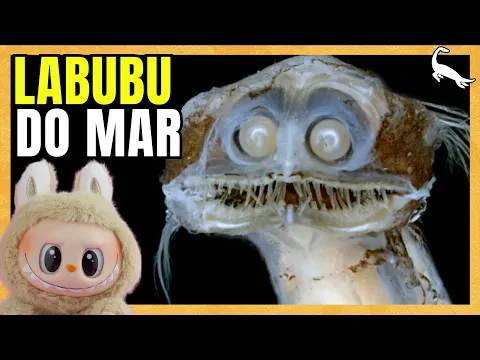

Among the strangest inhabitants of the deep sea is also the telescope fish, with a long and slender body, almost like that of an eel.
The highlight is the tubular eyes pointed forward, perfect for a world where sight is a rare resource.
It lives between approximately 500 and 2,000 meters deep and is an active predator. Its mouth can open much wider than normal, allowing it to swallow prey nearly the size of its own body. It’s like a living trap combining visual range and a horror movie jaw.
Recently, this fish became the target of careless AI usage. A video of it “supposedly alive” circulated on social media, frightening many people.
But the clip was fake: a CGI created from a photo of a dead telescope fish, manipulated to look like a moving record.
This adds to another important detail. When collected, many deep-sea fish come to the surface “destroyed” by decompression, which further distorts their appearance.
In their natural habitat, these real deep-sea creatures are not as deformed as the most sensational images make them seem, even if they are never exactly “cute.”
Anglerfish: Spring-Loaded Jaw and Live Fossil Face

To close the list, a shark that seems to have come straight out of a prehistoric nightmare takes the stage: the anglerfish.
It can live up to about 1,300 meters deep and draws attention with its elongated and flattened snout, covered with sensors capable of detecting the electric field of its prey.
What impresses the most, however, is the extendable jaw. It quickly projects its mouth forward, as if it springs out of its face to grab food.
With a translucent-looking body, gelatinous texture, and pinkish-gray coloring, the anglerfish is among the most enigmatic sharks of the depths.
It is often described as a “living fossil” because it is the only existing species of a group of sharks that was very abundant in the past, especially during the Jurassic period.
Despite that, it has been seen alive only a few times, and much about its biology and way of life is still a mystery, reinforcing how even the most famous real deep-sea creatures still hold secrets.
Scary to Us, Perfect for the Deep Sea
Terms like “scary” and “bizarre” are used all the time to talk about abyssal animals. The researchers themselves admit that they resort to these Halloween comparisons to bring the public closer to a distant universe.
But from a biological standpoint, this strange anatomy is exactly what ensures the survival of these species.
Enormous mouths to waste no prey, large eyes to take advantage of any trace of light, gelatinous bodies that withstand pressure, bioluminescence to communicate or defend, “hairs” of bacteria to generate energy where there is no sunlight.
All of this makes real deep-sea creatures more of a catalog of creative solutions of evolution than a cast of horror movie monsters.
After learning about the headless chicken monster, yeti crab, blobfish, vampire squid, giant sea cockroach, barrel-eyed fish, telescope fish, and anglerfish, it’s hard to look at the ocean floor as an “empty” place.
It is a living laboratory of extreme adaptations, which science has only begun to truly explore in recent decades.
And you, which of these real deep-sea creatures surprised you the most, and which one would you never have the courage to encounter up close?









-

-

-

5 pessoas reagiram a isso.