





 Portuguese
  English
  Spanish
  4 min of reading
  2 comments


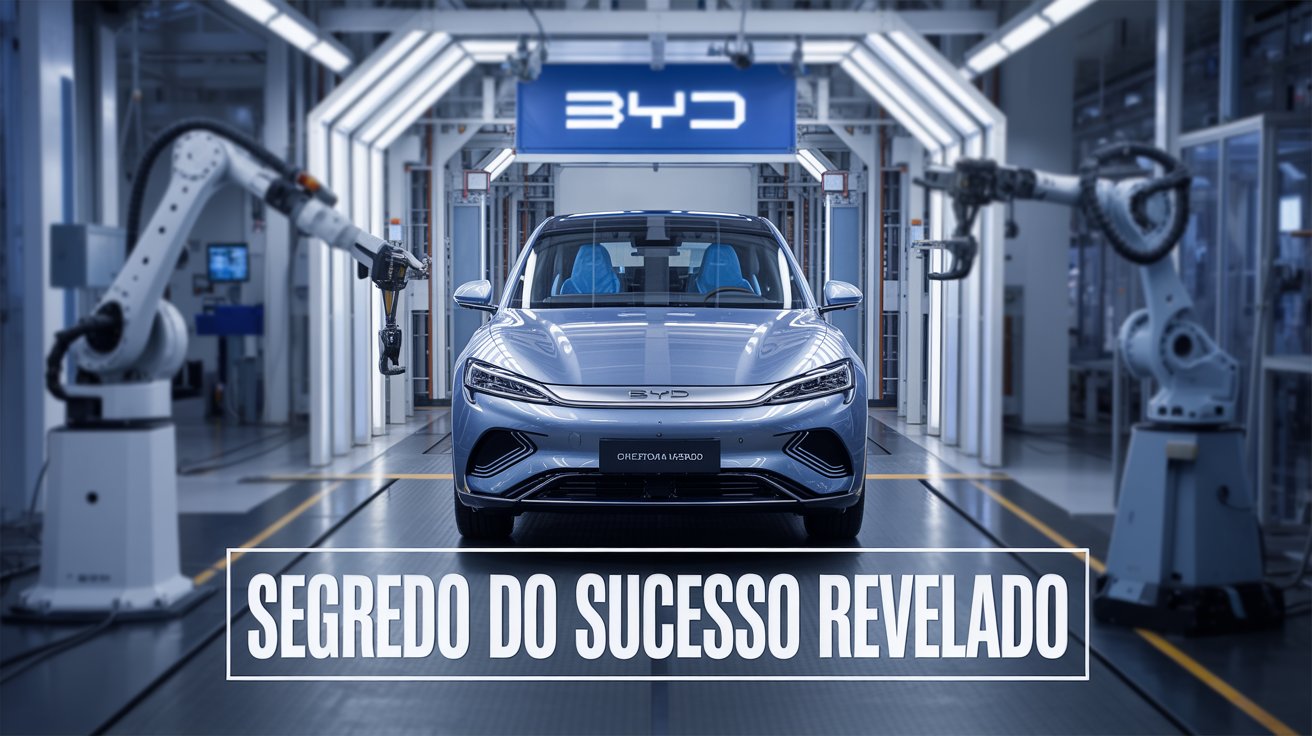


BYD Changes The Game With Vertically Integrated Production And Challenges Giants Like Toyota And Tesla With Much Cheaper And More Efficient Electric Cars.
The global automotive industry is undergoing a profound transformation, driven by the rise of Chinese BYD.
The manufacturer, which has stood out in the electric vehicle (EV) market, has sparked a true race for innovation by adopting a highly vertically integrated production model, in contrast to the traditional lean Japanese system.
The question that mobilizes experts and consumers is clear: How does BYD manage to deliver electric cars at such competitive prices?
-
The Argentine government celebrates the lowest poverty rate in 7 years, but experts warn that the methodology has changed, real wages have fallen, unemployment has risen, and the number of people on the streets of Buenos Aires has increased by 57% since Milei took office.

-
The 2026 electric Vitara arrives in Brazil and proves that Suzuki is not leaving: 4×4 traction, 184 hp, 61 kWh LFP battery, 293 km range, R$ 259,000, and a trunk capacity of 224 L.
-
7.8 magnitude earthquake in Indonesia frightens the population, triggers tsunami alert, and hits an island with over 200,000 inhabitants this Thursday.
-
Google will finally let you change that embarrassing Gmail address you created in your teenage years without losing any accounts, logins, or old emails: the feature is already available in the United States.

The answer lies in a strategy that reconfigures the logic of the automotive industry: the almost total control of the production chain, from the extraction of raw materials to the delivery of the finished car.
This verticalization model has posed direct challenges to giants like Toyota, Nissan, Honda, and even Tesla, which practiced productive integration but in a different manner.
The Japanese Efficiency And The Lean Model
In the post-war period, Japan faced a bleak economic scenario. It was in this context that Toyota developed the system of lean production, based on two central principles: Just In Time — on-demand manufacturing with minimal inventories — and Kaizen, a philosophy of continuous improvement.
This model became a global reference by ensuring high quality, low cost, and efficient production. For decades, it was the foundation of the competitiveness of Japanese automakers.
However, with the electrification of the global fleet, new demands for technology, energy efficiency, and more resilient supply chains have tested this traditional approach.
The Secret Of BYD: Absolute Control Of Production
Unlike the Japanese strategy, BYD adopted a radically vertically integrated model. Today, the company internally manufactures over 70% of the components used in its vehicles — including batteries, motors, chips, and electronic control systems.
The FinDreams division, BYD’s arm focused on battery production, is already the second largest in the world, with over 155 GWh in 2024.
The company also owns transport ships and its own logistics infrastructure, significantly reducing costs and delays.
This operational autonomy has allowed BYD to drastically reduce the final price of its cars. In markets like Asia, the Dolphin model can cost the equivalent of US$ 7,780 — an unthinkable amount for Western competitors.

Tesla: Automation As A Differential
Tesla also practices vertical integration, although not at the same level as BYD. Its so-called Gigafactories concentrate a good part of the production of batteries, motors, and software.
A differential for the American automaker is the intensive use of artificial intelligence and robotics, allowing for agility in production line adjustments and in the personalization of vehicles.
Despite this, Tesla still depends on suppliers like Panasonic, CATL, and LG for a significant part of its batteries. This dependency, absent in BYD’s model, creates limitations in terms of cost and volume.
Japan Reacts With Investments In Innovation
In light of the Chinese advance, Japanese automakers began to reassess their strategies. Toyota announced investments of 245 billion yen to double its battery production capacity in Japan, increasing from 80 to 120 GWh by 2030.
Additionally, factories are being expanded in regions like Kyushu, Hyogo, and even abroad, such as in North Carolina (USA) and Canada.
The brand also established partnerships with companies like LG Energy Solution to develop next-generation batteries.
Research centers in Japan and outside the country are now exploring technologies such as artificial intelligence, advanced automation, solid-state batteries, and proprietary semiconductors — in an attempt to adapt the lean model to the new electric production scenario.
Comparative Between The Two Productive Models
Total verticalization provides absolute control of the chain, less exposure to supply crises, and reduced costs. The lean system, on the other hand, offers flexibility and focus on operational excellence with qualified suppliers.
| Strategy | Lean Production (Japan) | Verticalization (BYD) |
|---|---|---|
| Supply Chain | Outsourced and Efficient | Internal and Integrated |
| Initial Cost | Lower | High, but with returns at scale |
| Agility in Innovation | Limited to Partners | High, with control over everything |
| Consumer Price | Moderate | Very Competitive |
The Impact In Brazil
The transformations are not limited to major global centers. BYD has already announced the installation of a battery factory in Brazil, in Camaçari (BA), taking advantage of the growth of the national electric vehicle market.
Toyota and Honda, on the other hand, have started updates in their local assembly lines, incorporating robots and automation, as well as evaluating partnerships to develop batteries in the country.
This movement is expected to generate jobs, boost national technology, and accelerate the electrification of the Brazilian fleet.
A New Era In The Automotive Industry
The dispute between the production models is still open. Verticalization has proven efficient for the current scenario of electrification and logistical uncertainty, but the Japanese lean model may still surprise with technological adaptations.
What is clear is that innovation, automation, and technology dominance will be the key competitive differentials in the global market.
Do You Believe BYD Is Just Innovating, Or Does Its Total Production Chain Dominance Strategy Represent A Real Threat To The Survival Of Traditional Automakers?







A grande pergunta é: Com a inundação de carros elétricos no Brasil, qual é o planejamento de estrutura para atender o carregamento destas baterias em nossas cidades e estradas?
Impossível de ler, site poluído de publicidade.
BYD deixando concorrentes para trás.