





 Portuguese
  English
  Spanish
  4 min of reading
  0 comments


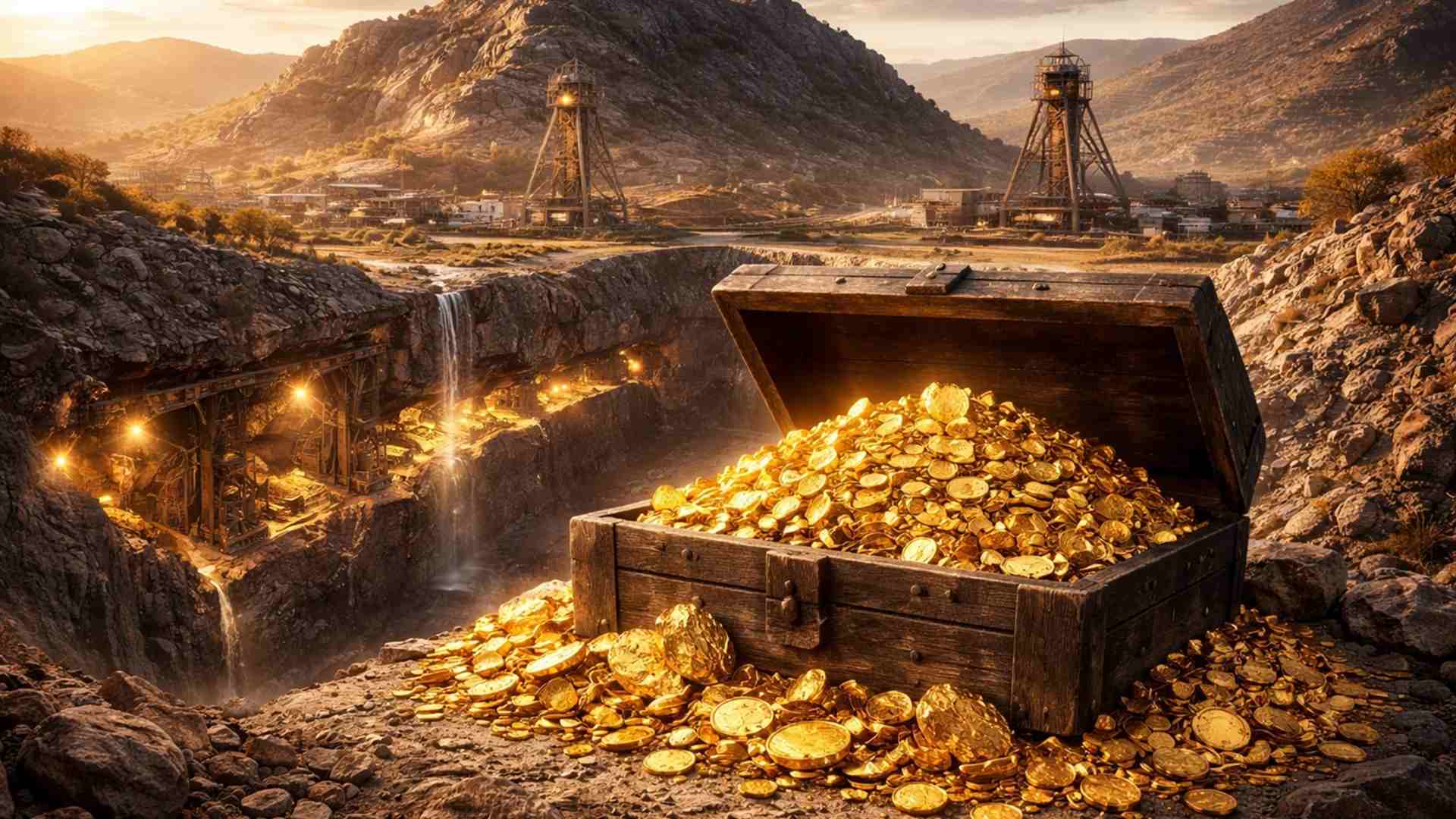
Formed Approximately 2.7 Billion Years Ago During the Archean Eon, the Mountain of the Witwatersrand Basin in South Africa Concentrates About 40% of All the Gold Ever Extracted by Mankind and Sustains Mining Operations That Exceed 4 Kilometers in Depth Since 1886
In South Africa, the mountain associated with the Witwatersrand Basin, formed 2.7 billion years ago, accounts for about 40% of all the gold ever extracted since 1886 and maintains operations that exceed 4 kilometers in depth.
The mountain located in the Witwatersrand Basin has established itself as the richest gold-producing geological formation ever identified. Geological studies and mining records indicate that approximately 40% of all the gold ever extracted by mankind comes from this single basin.
The rocks of the mountain formed during the Archean Eon, when the Earth’s crust was still stabilizing and the atmosphere contained little oxygen. Currently, the ridges near Johannesburg appear arid, with highways, residential neighborhoods, and old mining towers.
-
Motorola launched the Signature with a gold seal from DxOMark, tying with the iPhone 17 Pro in camera performance, Snapdragon 8 Gen 5 that surpassed 3 million in benchmarks, and a zoom that impresses even at night.

-
Satellites reveal beneath the Sahara a giant river buried for thousands of kilometers: study shows that the largest hot desert on the planet was once traversed by a river system comparable to the largest on Earth.

-
Scientists have captured something never seen in space: newly born stars are creating gigantic rings of light a thousand times larger than the distance between the Earth and the Sun, and this changes everything we knew about stellar birth.

-
Geologists find traces of a continent that disappeared 155 million years ago after separating from Australia and reveal that it did not sink, but broke into fragments scattered across Southeast Asia.

Nothing on the surface of the mountain indicates the extent of what lies underground. Beneath the hills is the most productive gold formation ever recorded, responsible for sustaining more than a century of unparalleled continuous mining in other regions.
Mountain Formed by Ancient Fluvial Systems Almost 3 Billion Years Ago
The mountain is not made up of a metallic massif. It is a vast sedimentary basin formed by layered rocks that, in the past, were part of fluvial systems, floodplains, and shallow basins in the continental interior.
Nearly three billion years ago, water flowed through volcanic terrain known as greenstone belts. This flow eroded mineral-rich rocks and transported fragments along waterways.
Due to its high density, gold quickly settled in running water. Over time, it accumulated in gravel banks and riverbeds. As new sediments piled on, the deposits were buried and compressed.
The heat and pressure transformed these sediments into conglomerates, preserving the original gravel in solid rock form. Geologically, this type of deposit is classified as a paleoplacer, meaning ancient lithified alluvial deposit.
The rounded grains of gold found in the conglomerates still exhibit typical characteristics of particles transported by running water. This evidence has become central to the understanding of the mountain’s formation and its gold deposits.
Discovery in 1886 Transformed the Mountain and Originated Johannesburg
In 1886, prospectors identified gold outcrops along the Witwatersrand range. This event marked the beginning of one of the longest mining operations in history.
In a few years, an improvised camp gave way to Johannesburg, a city built around gold extraction. The mountain began to sustain the foundation of South Africa’s mining economy.
With the expansion of activities, production advanced from shallow areas to industrial operations. By the early 20th century, the country had become the world’s largest gold producer.
Railway lines, processing plants, and financial institutions were established to support the mines. The mountain connected to global markets through this infrastructure.
The gold extracted rarely appeared in large nuggets. It was dispersed in microscopic particles within the conglomerates. Its extraction required crushing large volumes of rock and refined chemical treatment over decades.
In addition to gold, mining also resulted in the extraction of significant amounts of uranium, incorporating another strategic mineral into the basin’s production.
Geochemical Studies Reinforce the Paleoplacer Origin of the Mountain
For much of the 20th century, scientists debated whether the gold in the mountain resulted solely from ancient fluvial processes or whether later hydrothermal fluids played a predominant role.
Modern geochemical research has brought new elements to the debate. Researchers from the University of Arizona analyzed isotopic signatures in minerals from the basin.
The results indicated evidence compatible with the erosion of surrounding greenstone belts during the Archean. The conclusions corroborated the paleoplacer interpretation.
The data reinforced that rivers initially concentrated the metal at the Earth’s surface. Subsequently, burial and tectonic processes preserved the deposits within the mountain’s structure.
The surrounding rocks have been dated to between approximately 2.7 and 3 billion years. This range places the formation of the deposits in a period prior to the emergence of complex plants and animals.
The mountain thus preserves not only large quantities of gold but also records of early continental development.
Mountain Sustains Mining Over 4 Kilometers Deep
As surface deposits became exhausted, operations advanced to deeper levels of the Earth’s crust. The mountain became a global reference for deep mining.
Several shafts exceed 4 kilometers below the surface. In these areas, the temperature of the rocks can exceed 50 degrees Celsius.
The pressure conditions increase the risk of seismic events. To maintain production, companies installed cooling systems and reinforced support structures.
These measures aim to cool work areas and stabilize tunnels. Despite the technical challenges, production from the mountain has continued for over a century.
Although annual production has decreased from peak levels, the basin remains one of the most significant in mining history.
Formed during the Archean and explored since 1886, the mountain associated with the Witwatersrand Basin has produced about 40% of all the gold ever extracted in modern history, according to records compiled by the industry and geological surveys.








-

-

4 pessoas reagiram a isso.