





 Portuguese
  English
  Spanish
  5 min of reading
  0 comments


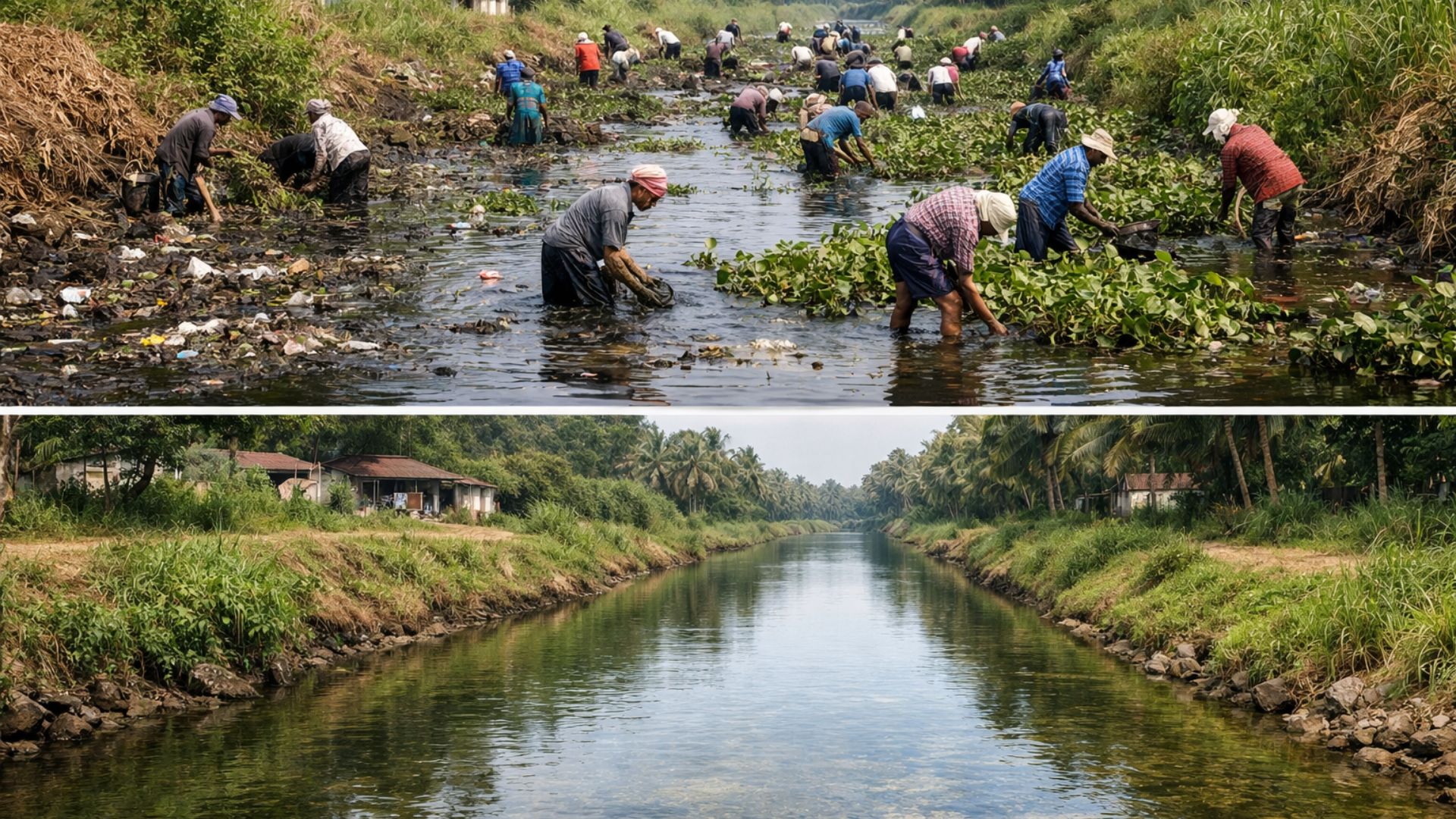
Community Mobilization in Southern India Transforms Trash- and Vegetation-Filled Canal Into Active Watercourse After 70 Days of Manual Labor Involving Hundreds of Workers and Direct Impact on Well Supply and the Return of Aquatic Life.
Residents of the Alappuzha district in the state of Kerala, in southern India, managed to restore the flow of water in the Kuttemperoor, a natural canal that had turned into stagnant pools after years of siltation, trash, and aquatic plants.
The resumption of flow occurred after a cleanup led by local administration, with community mobilization and manual labor funded by the rural MGNREGA program.
Reports covering the case describe an operation with around 700 workers over 70 days, focused on clearing the riverbed and removing vegetation and waste.
-
Motorola launched the Signature with a gold seal from DxOMark, tying with the iPhone 17 Pro in camera performance, Snapdragon 8 Gen 5 that surpassed 3 million in benchmarks, and a zoom that impresses even at night.

-
Satellites reveal beneath the Sahara a giant river buried for thousands of kilometers: study shows that the largest hot desert on the planet was once traversed by a river system comparable to the largest on Earth.

-
Scientists have captured something never seen in space: newly born stars are creating gigantic rings of light a thousand times larger than the distance between the Earth and the Sun, and this changes everything we knew about stellar birth.

-
Geologists find traces of a continent that disappeared 155 million years ago after separating from Australia and reveal that it did not sink, but broke into fragments scattered across Southeast Asia.
At the end, the local assessment was that the watercourse regained continuity over approximately 12 kilometers, restoring part of its environmental and daily functions.
Degradation of the Kuttemperoor Canal Over a Decade
The Kuttemperoor appears in Indian media as a water link connected to the Pamba and Achankovil rivers, in a region with strong agriculture and a network of canals historically used for irrigation and transportation.
In accounts cited by the media, the canal previously had sufficient depth and width for navigation and for supporting agricultural, domestic, and drainage routines.

Over time, however, the riverbed lost depth, flow was interrupted, and the landscape changed to the point where the canal was described as practically “stopped” for about a decade.
The coverage associates this process with the accumulation of aquatic plants, the dumping of waste, and the impacts of sand mining, which reduced continuity and drainage capacity.
In one of the reports, degradation is depicted as a recurring use of the watercourse as a dumping site, including septic waste transported by trucks, along with tons of plastic.
The combination of pollution and obstruction by vegetation reportedly created a scenario where water no longer circulated, reinforcing foul smells and worsening environmental conditions around.
Local Mobilization and Use of the MGNREGA Program
The turning point began when the Budhanoor gram panchayat, a local government body, started treating the Kuttemperoor as a community asset to be restored rather than as an unsolvable problem.
The strategy, according to the press, was to fit the intervention within the MGNREGA, a federal program that guarantees rural employment and funds paid work in rural areas.
Although the idea of restoring the canal has been discussed since 2013, execution only gained traction years later due to the cost and scale of the service.
In the reconstruction presented by the media, the cleanup was launched in January 2017 and lasted for 70 days, ending on March 20 of that year, with signs of flow returning even during the process.
The panchayat president, Viswambara Panicker, told local news that the project needed to overcome a long inertia to come to fruition, attributing to the MGNREGA the ability to ensure operational consistency.
In another report, he stated that the cost to pay workers amounted to about 1 crore rupees, which was cited as part of the effort to keep teams in the field for weeks.
Manual Cleanup Reopens 12 km of Watercourse

The cleanup was described as a step-by-step process, starting with cutting and removing aquatic plants that covered the surface and trapped water in isolated stretches.
Next came the removal of plastic and solid waste accumulated at the bottom, along with the removal of layers of compacted sediments and trash that, according to reports, acted as barriers to drainage.
One aspect highlighted by the coverage is the intensive nature of the manual effort, involving both men and women mobilized locally and the use of simple tools, without relying on heavy machinery.
In the count presented by The News Minute, the work amounted to about 40,000 “man-days,” an indicator that aggregates service days totaled among participants over the period.
The resumption of flow, according to the same reconstruction, could be noticed around the 45th day, when water began to move and new volumes started to enter the canal.
Nevertheless, the service continued until the formal completion on March 20, 2017, when the panchayat described the water as clearer and the drainage as “normal.”
Impact on Wells and Return of Fish
After reopening the riverbed, one of the most cited effects was the increase in water levels in wells near the canal.
In an interview with The Indian Express, the panchayat president stated that wells within a five-kilometer radius had significantly improved after water began to flow again, associating the result with the restoration of circulation and reduced stagnation.
The return of fish also appears as a recurring sign of recovery, in statements attributed to environmentalists or local authorities cited in the reports.
In The Indian Express, environmentalist N K Sukumaran Nair said that fishermen were pleased with the reappearance of the animals, pointing to the return of fauna as a practical indication that the watercourse had ceased to be merely a stagnant deposit.
Another change recorded was the resumed use of the canal for daily activities, such as bathing and washing clothes, presented as a social marker of trust in the recovered water, albeit with no indication of immediate use for drinking.
In the account by The News Minute, Panicker stated that, at that time, the community still avoided direct consumption, while maintaining use for other purposes.
Agricultural Function and Flood Control in the Kerala Region


The case also gained attention for being linked to agricultural needs and flood management, common in the mosaic of rivers and canals of Kerala.
According to The News Minute, the Kuttemperoor had previously served as a source of irrigation for about 25,000 acres of rice paddies and also helped control floods by receiving excess water when the connected rivers overflowed.
In the report from The Indian Express, the recovery is contrasted with the dramatic reduction of the canal over the years, attributed to illegal sand mining, waste dumping, and proliferation of aquatic plants.
By clearing the riverbed, the operation sought to restore the physical continuity of the watercourse, a condition described as necessary for it to fulfill irrigation and drainage functions again.
The preservation of the result itself appears, in the reports, as a continuous challenge, as part of the degradation has been associated with dumping habits and pressures on the banks.
In an interview, the panchayat president stated that he sent the government a technical report with actions for dredging and awareness measures to reduce new pollution, indicating that the maintenance of the canal depends on supervision and continuous behavioral change.
In an interview, the panchayat president stated that he sent the government a technical report with actions for dredging and awareness measures to reduce new pollution, indicating that the maintenance of the canal depends on supervision and continuous behavioral change.







-

Uma pessoa reagiu a isso.