





 Portuguese
  English
  Spanish
  3 min of reading
  0 comments


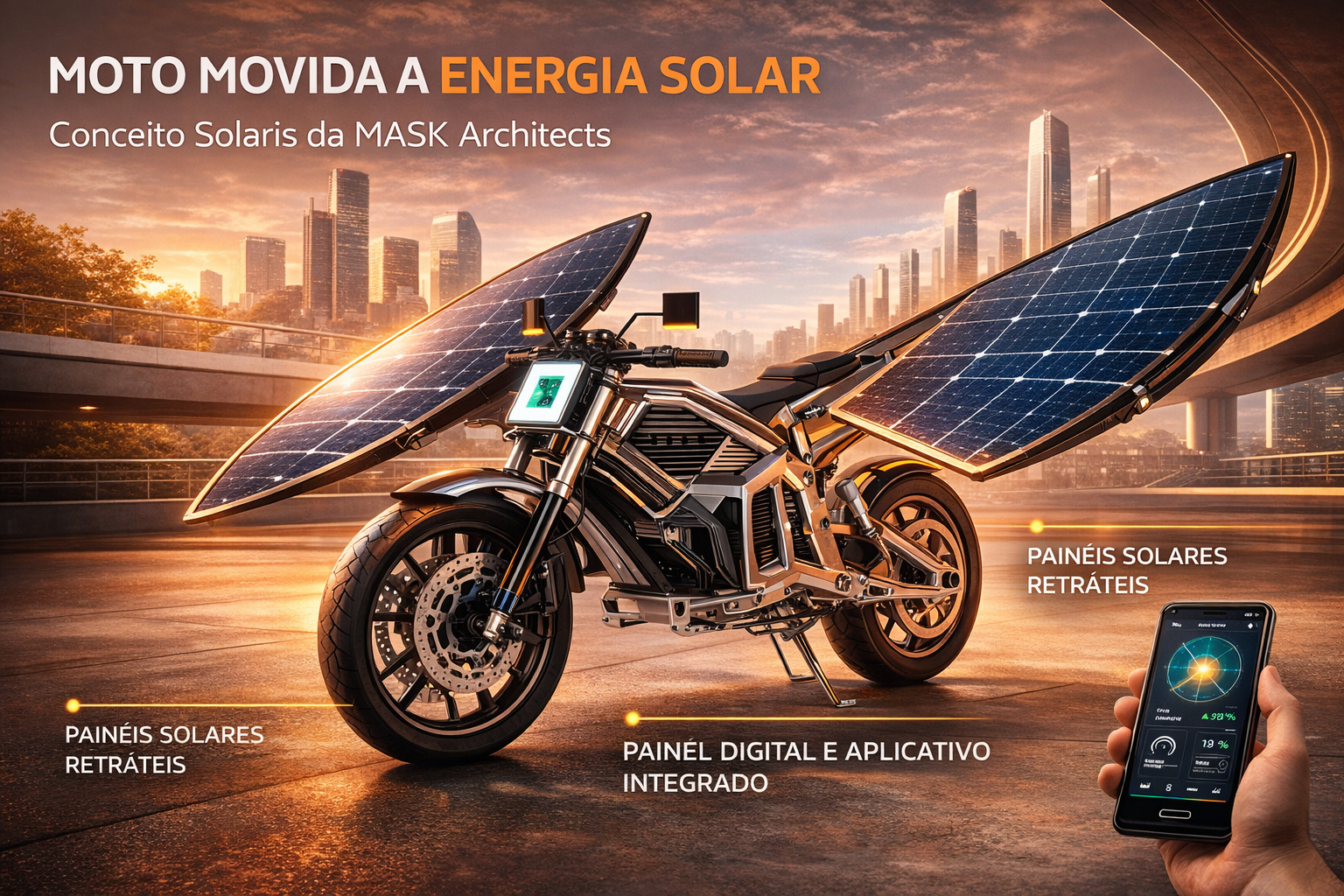
Solar-Powered Motorcycle Challenges The Automotive Market With Innovation By Eliminating The Plug In The Solaris Concept From MASK Architects.
Solaris Concept From MASK Architects Proposes A New Vision For Self-Sufficient Electric Motorcycles
A solar-powered motorcycle, presented as a concept by the Italian studio MASK Architects, draws attention from the automotive market by proposing a radical solution for innovation: an electric motorcycle that charges itself without needing to plug in, using only solar energy.
Named the Solaris Concept From MASK Architects, the project was recently unveiled in Italy and envisions a future where motorcycles can operate more autonomously, sustainably, and independently of traditional charging infrastructure, precisely at a time when electrification is gaining momentum in the two-wheeler sector.
Solar Innovation Applied To Two-Wheeled Mobility
The Solaris Concept From MASK Architects stems from an idea that, at first glance, may seem too bold for today’s automotive market. However, the proposal aims to address one of the biggest challenges of electric mobility: the dependence on charging points.
-
OMODA & JAECOO grows in Europe in 2026 with an integrated strategy of sales, innovation, local production, and technological advancement in the United Kingdom, Italy, and Spain.
-
OMODA & JAECOO expand post-sales in Brazil with competitive maintenance, a 7-year warranty, and high availability of parts for technological SUVs.
-
OMODA & JAECOO appoints Alessandra Souza as executive marketing director in Brazil and accelerates brand expansion with a focus on innovation, network, and hybrid portfolio.

-
Jaecoo 7 with super hybrid SHS system exceeds 1,200 km of combined range with a 1.5 turbo engine, high-density battery, and intelligent energy management.

The motorcycle uses a system of retractable solar panels, integrated into the vehicle’s design. When parked, the motorcycle “opens” circular structures equipped with photovoltaic cells, forming wing-like side extensions that capture solar energy directly from the environment.
How The Solar-Powered Motorcycle Works
While in motion, the panels remain retracted, allowing the motorcycle to function like a conventional electric model. However, when stationary, the solar system kicks in and directs the captured energy to a set of lithium-ion batteries.
According to the conceptual proposal, this set powers a high-torque electric motor, complemented by a regenerative braking system — technology that recovers part of the energy during deceleration. Thus, the Solaris Concept From MASK Architects tries to combine known solutions from the automotive market in an unprecedented application for motorcycles.
Lightweight Structure And Energy Efficiency As A Priority
To enable a solar-powered motorcycle, efficiency is essential. Hence, MASK Architects designed a structure made from aluminum and carbon composite materials, reducing weight and optimizing energy consumption.
Although the project does not disclose technical data such as power, range, or charging time, the designers state that, during use, the motorcycle would behave like a traditional electric model. The difference would lie in the charging process, which would occur primarily through solar energy captured while the vehicle is parked.
Digital Panel And Smartphone Integration
The concept also envisions a fully digital instrument panel. Here, the rider could monitor performance information, battery level, and efficiency of solar capture.
In addition, an app would allow remote monitoring of these data via smartphone, reinforcing the technological character and alignment with the trends of innovation that have been shaping the global automotive market.
Design Inspired By Nature And Aerodynamics
Visually, the Solaris Concept From MASK Architects features elongated lines, a low stance, and fluid shapes. According to the studio, the design was inspired by the movement of a leopard, aiming to convey speed, balance, and aerodynamic efficiency.
This approach results in a motorcycle with a futuristic appearance, yet consistent with the functional proposal of the project, integrating aesthetics and engineering in a harmonious way.
Technology Exists, But Challenges Remain
From a technical standpoint, the key components needed for a solar motorcycle are already available: photovoltaic panels, high-density batteries, efficient electric motors, and smart energy management systems.
The main obstacle, however, lies in the capacity for solar generation. The amount of solar energy captured is still limited to fully meet the demands of a motorcycle in intense urban use or during long daily commutes. Therefore, experts assess that full commercial application still requires technological advancements.
Vision For The Future Of The Automotive Market
Although there are no plans for production or industrialization, Solaris should be regarded as an exercise in design and conceptual engineering. Nevertheless, the project emphasizes a clear trend in the automotive market: to seek solutions that extend energy autonomy and reduce dependence on traditional infrastructure.
For now, the Solaris Concept From MASK Architects remains a vision for the future — bold, provocative, and technically plausible in parts, but it helps to anticipate possible paths for the next generation of sustainable electric motorcycles.









Seja o primeiro a reagir!