





 Portuguese
  English
  Spanish
  4 min of reading
  0 comments



Understand The Traffic Rules About The Left Lane And Know How The Driver Should Legally Proceed When Encountering A Driver Who Does Not Yield The Right Of Way For Overtaking.
Every driver has encountered this situation in traffic. You try to overtake a vehicle on the left. But the driver in front simply does not yield. He “locks” the left lane. The question arises: can I overtake on the right? Many are unaware of the correct rule. See what the Brazilian Traffic Code (CTB) states. Learn how to resolve this situation without committing infractions.
Overtaking On The Right: General Rule For Drivers And Penalties
Overtaking another vehicle on the right is, as a rule, a traffic infraction. The provision is clear in Article 199 of the Brazilian Traffic Code. Those who perform this maneuver commit a medium-level infraction. The penalty includes a fine of R$ 130.16. In addition, four points are recorded on the offending driver’s record. Therefore, as a general rule, overtaking must be done on the left.
The Only Exception: When Overtaking On The Right Is Allowed
There is only one specific situation in which overtaking on the right is not considered an infraction. This occurs when the vehicle in front clearly signals the intention to turn left. If the driver in front indicates that he will turn left (either to merge or to turn), overtaking on the right is permitted by law. Outside of this circumstance, the maneuver is prohibited.
-
Larger than entire cities in Brazil: BYD is building a 4.6 km² complex in Bahia with a capacity for 600,000 vehicles per year, but the discovery of 163 workers in conditions analogous to slavery has shaken the entire project.

-
With an investment of R$ 612 million, a capacity to process 1.2 million liters of milk per day, Piracanjuba inaugurates a mega cheese factory that increases national production, reduces dependence on imports, and repositions Brazil on the global dairy map.

-
Brazilian city gains industrial hub for 85 companies that is equivalent to 55 football fields.

-
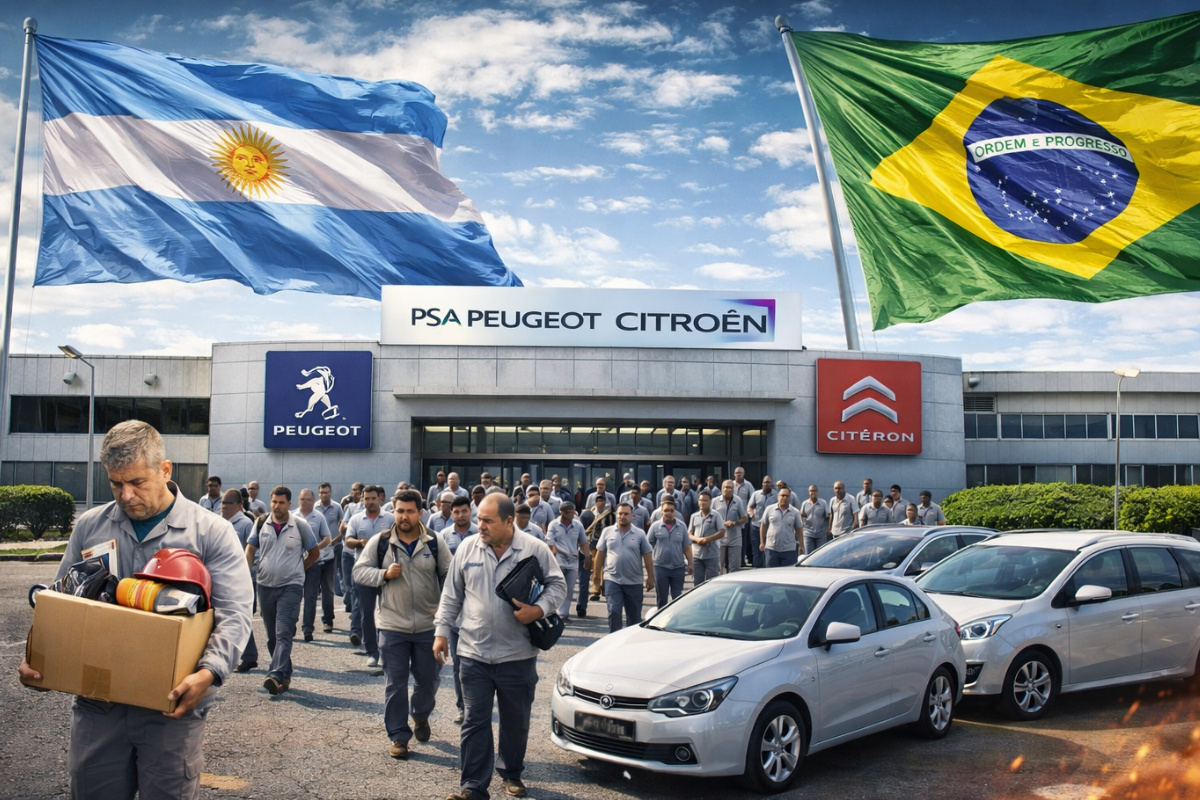
Peugeot and Citroën factory in Argentina cuts production by half and opens a layoff program for more than 2,000 employees after Brazil drastically reduced purchases of Argentine vehicles.

Left Lane: What Is It For According To The Law?
Many drivers have doubts about the correct use of the left lane. Article 29 of the CTB clarifies this issue. The left lane is intended for overtaking. But not only that. It is also used for faster vehicles. Unlike some European countries, in Brazil, the left lane is not exclusive for overtaking.
A driver can travel in it if they are going faster, even if exceeding the limit (in this case, they would commit the infraction of speeding, but not for using the lane). Brazilian law does not require the driver to immediately return to the right lane after each overtaking, although it is a more appropriate and safer behavior.
Should Those On The Left Get Out?
Even though they can use the left lane, the driver occupying this lane has an important obligation. They must yield to faster vehicles approaching from behind. This applies even if the driver in front is already at the maximum speed limit. If a car at 100 km/h is in the left lane and another approaches faster, the driver in front must yield. It is not up to the driver to make judgments about another’s speed or whether they are in an emergency. The responsibility for exceeding the speed limit lies with the other driver.
Staying in the left lane and preventing the passage of those coming faster can create more insecurity. The correct and mandatory conduct is to move out of the lane to allow passage. The driver who does not yield, after being signaled (with lights or brief honks), also commits an infraction. This infraction is provided for in Article 198 of the CTB and is also of medium nature. Enforcement can occur visually or through video monitoring, including drones on roads.
How To Pass Legally Without Overtaking On The Right
If the driver in front does not move from the left lane, overtaking on the right (outside of the allowed exception) is an infraction. But there is a legal way to resolve the situation. First, it is necessary to understand the definition of overtaking in the CTB: it is passing in front of another vehicle, leaving the lane of origin and returning to it shortly afterward.
The legal solution is not to configure this maneuver on the right. The driver must do the following:
- Signal and move to the right lane.
- Stay in the right lane, passing alongside the slower vehicle.
- Do not immediately return to the left lane after passing the vehicle.
- Stay in the right lane for a considerable distance (the original text suggests at least 1 km, but the law does not define an exact value).
By doing this, the driver makes a “passage by another vehicle”, and not an “overtaking on the right”. Only much further ahead, when it no longer characterizes the overtaking maneuver related to that vehicle, can one return to the left lane, if necessary and safe. This way, the infraction of Article 199 is avoided.









Seja o primeiro a reagir!