





 Portuguese
  English
  Spanish
  6 min of reading
  0 comments


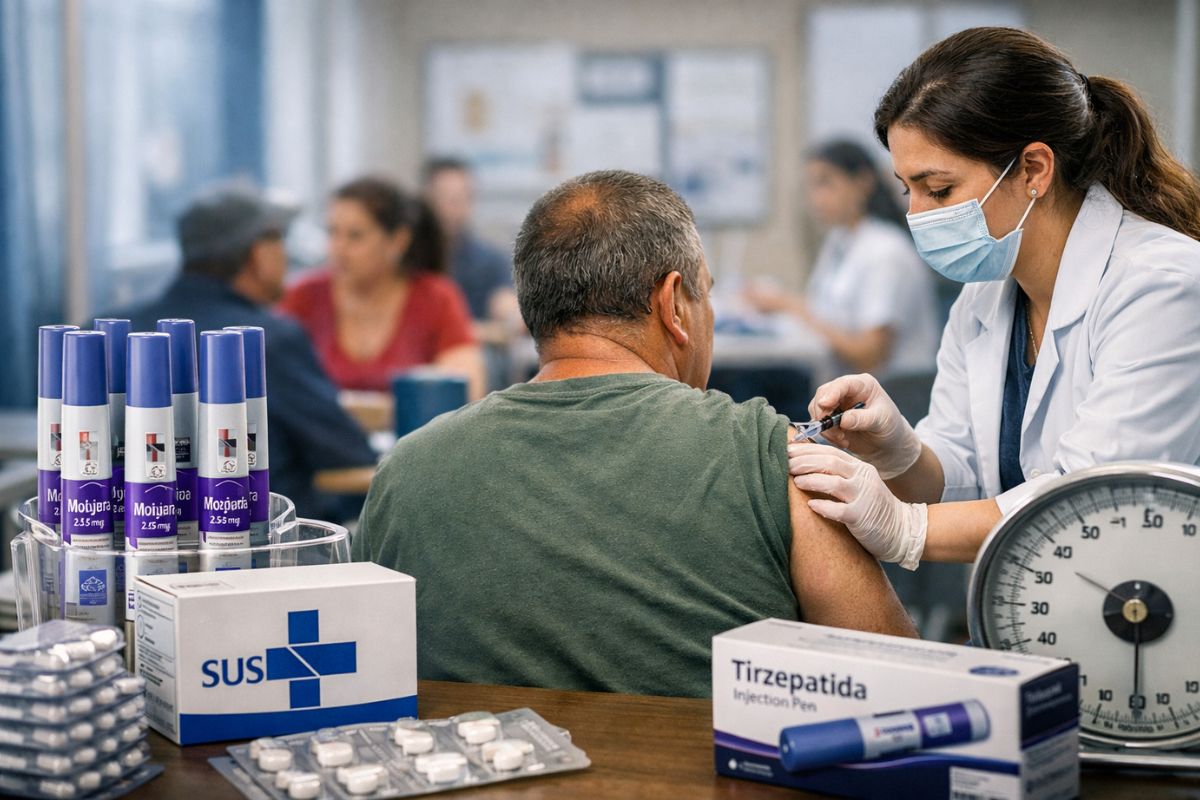
In Urupês, In The Interior Of São Paulo, SUS Begins Administering Mounjaro (Tirzepatide) Against Obesity To Up To 200 Patients, With Endocrinologist, Nutritionist, Psychologist, Physical Educator, And Social Assistant. Decree 3,390, Announced On Wednesday (25), Defines BMI Criteria, Comorbidities, And Previous Attempts, Prioritizing Vulnerable People In The Bariatric Queue.
Mounjaro has become part of the public network of Urupês, in the interior of São Paulo, after the municipality announced it will offer tirzepatide for the treatment of obesity free of charge. The measure creates a new stage of care for those already waiting for assistance, with defined clinical criteria and continuous monitoring within the local SUS.
The plan provides for a staggered start to the treatment of up to 200 patients and a multidisciplinary team to support the treatment beyond the administration of the medication. Priority is given to people in social vulnerability who are already on the waiting list for bariatric surgery, precisely because they cannot afford Mounjaro in the private network.
Urupês Introduces Mounjaro In The Municipal SUS And Creates Its Own Protocol
Urupês decided to formalize the offer of Mounjaro in the municipal SUS as a treatment strategy for obesity with clear access rules. The municipality communicated the initiative as the first in the state to make the drug available in the local public network, starting with a defined initial group and structured monitoring.
-
Brazilian city bets on the business environment to generate jobs and attract investments in the energy sector — secretary reveals strategy at Macaé Energy 2026.

-
50 viaducts, 4 tunnels, 28 bridges, and 40 kilometers of bike paths: BR-262 in Espírito Santo will receive 8.6 billion reais for the largest engineering project in the state’s history, inspired by the Immigrant Highway in São Paulo.

-
Brazil produces too much clean energy and doesn’t know what to do with it: over 20% of solar and wind capacity was wasted in 2025 while investors flee and 509 renewable generation projects were abandoned in the last year.

-
Piauí will produce a new fuel that replaces diesel without needing to change anything in the truck’s engine and reduces pollutant gas emissions by half: truck drivers from all over the Northeast are already celebrating the news that will arrive later this decade.

The central point is that it is not just about “liberating a drug”: the municipality ties Mounjaro to a dispensation, authorization, and monitoring protocol. This protocol was published in Decree No. 3,390, of February 13, 2026, and functions as a kind of “care pathway” that organizes who enters, how they enter, and how they continue to be monitored.
Who Enters First: Social Priority And The Bariatric Queue As The Initial Filter
Access to Mounjaro in Urupês starts with a focus on greater vulnerability and through a known bottleneck in the system: the waiting list for bariatric surgery.
The Health Department directs treatment, initially, to people waiting for surgery and who, in addition, are in a situation of social vulnerability and cannot afford the medication outside of SUS.
This design creates a practical answer to the question that many people ask when a new treatment arises in public debate: “who will actually receive it first?”. In Urupês, the answer combines waiting order (queue) with social condition (vulnerability), and above all, defined clinical criteria in the municipal protocol.
In addition to prioritization, the protocol establishes that the patient must meet objective requirements. Among them are:
- Age of 40 years or older;
- Diagnosis of obesity with BMI ≥ 35 kg/m² associated with at least one relevant clinical comorbidity; or BMI ≥ 30 kg/m² associated with at least two relevant clinical comorbidities;
- Documented previous attempt at non-pharmacological treatment for a minimum period of six months.
There is an important exception: the age criterion can be disregarded when the measured BMI is greater than 40 kg/m².
In practice, this prevents an age cutoff from being an automatic barrier in more advanced obesity cases, keeping the focus on clinical risk.
How Monitoring Will Be: Multidisciplinary Team And Lifestyle Changes
The Mounjaro program in Urupês has been structured to not rely solely on the medication. Monitoring will be conducted by a multidisciplinary team consisting of an endocrinologist, nutritionist, psychologist, physical educator, and social assistant.
The proposal is to treat obesity as continuous care, with clinical, nutritional, emotional, and social support, rather than as an isolated intervention.
This type of team composition also helps answer a common question: “why involve so many people in the process?”.
Because the municipal protocol links Mounjaro to lifestyle changes and regular monitoring, reinforcing that the medication is part of a larger whole and not an “automatic” solution.
Even when there is no pharmacological indication for Mounjaro, the user will not go without assistance. The municipality provides for the continuity of guidance on nutrition, physical activity, and psychological support, maintaining active care within the local SUS.
This reduces the risk of abandonment, especially for people who arrive at the service after unsuccessful previous attempts.
What The Protocol Prohibits: No Aesthetic Use And No Exceptions To Clinical Criteria
One of the most sensitive points when Mounjaro becomes a public issue is its use outside of clinical context. In Urupês, the municipal protocol explicitly states that the medication will not be made available for aesthetic purposes or outside the defined criteria. The rule exists to protect the public service itself, prevent distortions in the queue, and concentrate resources on those with clinical indications according to the decree.
In practice, this means that access depends on screening and authorization within the municipal process, with monitoring and reevaluations.
The logic of the protocol is simple: if there is an initial cap on treatment (up to 200 patients, in a staggered manner), the system needs transparent filters to avoid turning a health treatment into a dispute based only on social pressure or individual expectation.
This care also preserves the collective sense of the local SUS: prioritizing those waiting for bariatric surgery and living in social vulnerability is an equity decision and, at the same time, a choice that requires rules to remain stable over time.
What Is Tirzepatide, Known As Mounjaro, And Why Did It Enter The Obesity Debate
Mounjaro is the name by which tirzepatide has become known in the country, an injectable medication initially indicated for type 2 diabetes and which has also begun to be used in the treatment of obesity.
The drug acts on hormones related to appetite and metabolism, contributing to weight reduction when associated with medical monitoring and behavioral changes.
The medication was approved by Anvisa and has thus gained traction as a therapeutic option for glycemic control and weight loss.
Still, the scenario described in Urupês highlights an important point: Mounjaro is not widely incorporated into SUS at the national level, and therefore the path found by the municipality was to create a local protocol, with defined criteria and monitoring within its network.
By organizing this flow, Urupês also delimits expectations: the treatment is not “open access,” it is not “for any case,” and it does not sustain itself without monitoring.
The drug is used as a clinical tool, and the protocol attempts to ensure that it is used responsibly, within the reality and capacity for follow-up of the service.
Up To 200 Patients, Staggered Care, And The Size Of The Challenge In The Territory
The municipality’s forecast is to care for up to 200 patients in a staggered manner with Mounjaro in the local SUS. This staggered approach is crucial for maintaining quality monitoring, because treatment presupposes a team, schedule, reevaluations, and continuous support, not just the delivery of the medication.
Urupês also presents data that helps to illustrate why the discussion has gained strength: according to information from Sisvan (Food and Nutritional Surveillance System), about 43% of the municipality’s population is at some degree of overweight.
In such a scenario, any new care strategy tends to generate immediate demand, making the existence of protocol, criteria, and priorities even more important.
In the end, the municipal program places a question at the center of public debate: how to balance access, social justice, and clinical criteria when a treatment desired by many people becomes available in SUS?
Urupês chose to start with those already waiting for bariatric surgery and living in vulnerability, with a multidisciplinary team to maintain care over time.
The decision by Urupês to offer Mounjaro through the municipal SUS sets an important precedent: not just for the medication itself, but for the access model with protocol, BMI criteria, and comorbidities, documented previous attempts, and monitoring by a multidisciplinary team, with social priority and focus on those awaiting bariatric surgery.
For you, does this priority make sense as it has been designed?
If you have seen someone close face obesity and the wait for treatment, what weighs more: entering through the bariatric queue, due to social vulnerability, or due to clinical criteria of BMI and comorbidities?









Seja o primeiro a reagir!