





 Portuguese
  English
  Spanish
  5 min of reading
  0 comments


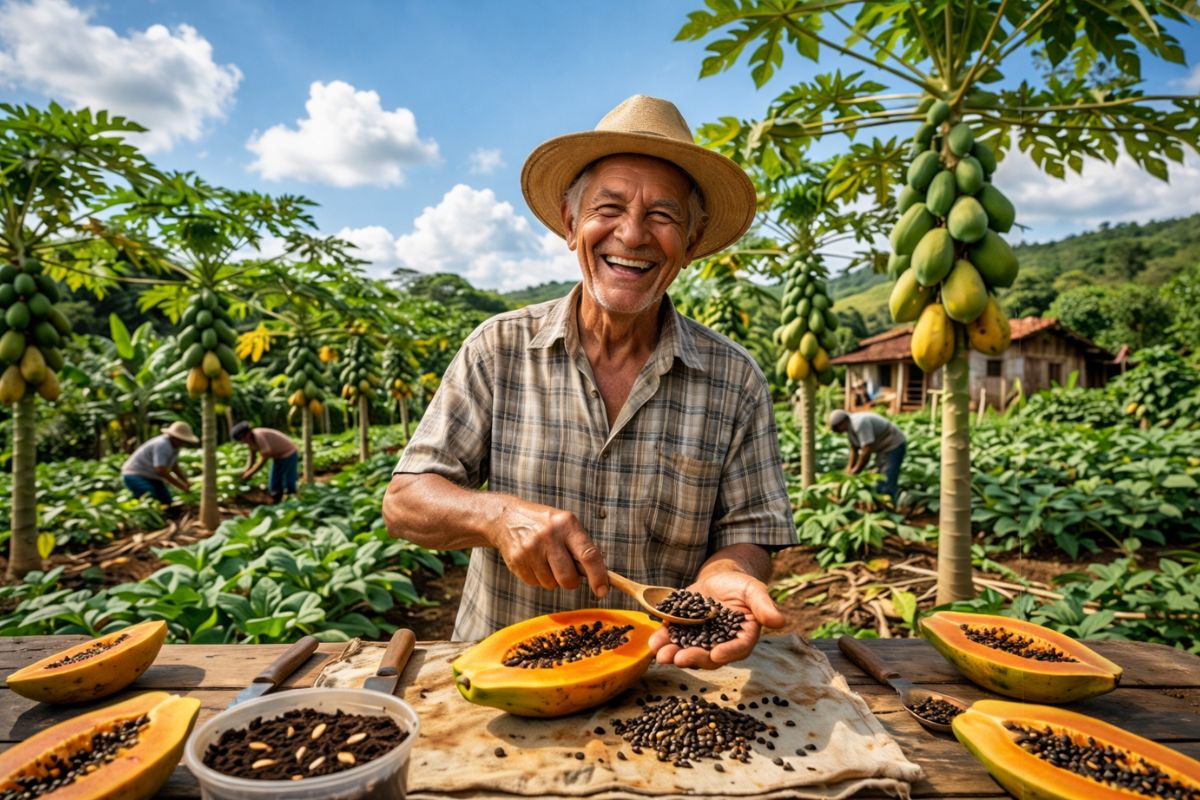
In the Serra da Canastra, Seu Mário reveals the technique of papaya and details the seed of the papaya in the caipira papaya to favor female plants and reduce male papayas.
Seu Mário reveals the technique of caipira papaya in a very straightforward way, in the middle of the field, with the fruit in hand and the loaded plant in the background. He cuts the papaya in half, shows where the seed he avoids is located, and points out which part he prefers to plant to increase the chance of producing a highly productive female plant.
His explanation comes along with an impressive setting. There are tomatoes everywhere, well-kept beds, a protected garden, and an orchard in formation. Everything is simple, but working, even in the dry season, with daily care, well-aged manure, and water applied in the right way.
The step-by-step that Seu Mário demonstrates in practice

When he decides to plant papaya, Seu Mário reveals the technique with a simple gesture. He cuts the fruit in half and advises not to use the seed from the tip. His preference is for the seeds from the back part of the papaya.
-
Few remember, but the submarine that disappeared in 1968 with 52 crew members was found after 51 years at the bottom of the sea at more than 2,000 meters, intriguing the entire world.

-
With 1,200 tons suspended, the Japan mega-structure in a grid shape with a floating sphere from Fuji TV features two 25-story towers connected by elevated walkways, titanium panels, and impresses the world with its ability to reduce wind impact.

-
The village where two rivers run side by side without mixing in Santarém and Alter do Chão reveals some of the most beautiful freshwater beaches on the planet.

-
Brazil’s nuclear submarine with a speed 5 times greater than normal advances after nearly 50 years and R$ 40 billion spent.

According to him, the probability of producing female papayas and yielding a lot is higher when choosing this part.
He also mentions that sometimes male papayas are born, which do not usually yield the same way, and that is why he tries to “select” the seed right at the cut.
Why he avoids male papayas and seeks female plants
In the conversation, Seu Mário explains that male papayas can appear in planting and that this disrupts those who want consistent production.
Therefore, he says that planting the seed from the back of the papaya is a way to increase the chance of producing a more productive female plant.
He does not present this as an absolute rule, but rather as a farming practice, repeated from experience. It is a simple technique, done by eye and habit, without complicating things.
Tricks he has already tested to “turn” the papaya tree
Besides the choice of seed, he mentions that he has tried another idea that many people talk about: cutting the plant while it is still small and cross-splitting it to stimulate lateral shoots. He says he tested it, but it did not work well in his field.
Even so, he mentions what he has heard: some lateral shoots can be female. For him, the foundation remains the choice of seed, because that is what he uses with more confidence when planting.
What he observes about the production time of the papaya tree

Seu Mário also talks about the longevity of the papaya plant. In his experience, a well-cared-for papaya tree can produce for a good period, nearing five years, as long as it is healthy and well-maintained.
And his field shows signs of this care. He shows ripening papayas, talks about the sweet flavor, and emphasizes that the caipira papaya from there is beautiful, with no signs of disease. The results show in the plant and on the plate.
Simple management in the dry season to maintain production
The technique of papaya appears within a larger context. Seu Mário lives the routine of keeping everything functioning in the dry season.
He comments that he needs to water, review the plants, and stay vigilant because pests can appear on the leaves.
He also shows how he uses well-aged manure and explains that green manure can burn and kill the plant, so it needs to be well-aged before going into the ground. The care is to apply it correctly, without excess on the plant, aiming to nourish the roots around.
The field that impresses with its organization and care

As he walks through the property, he shows a small tool room and emphasizes that he likes to keep everything organized, each thing in its place. For him, besides producing, it has to look good.
In his view, when the place pleases the eyes, the person is motivated to produce better. This is evident in the way he sets up simple structures, thinks about space usage, and keeps the area clean, even with so much work to take care of.
Tomatoes everywhere and a protected garden
In the middle of the visit, the abundance of tomatoes catches attention, with fruits scattered and looking healthy. He also presents beds and talks about what works for each crop.
In the case of carrots, for example, he explains that the bed needs to be high, loose, and more aerated for the root to grow without resistance.
In the garden, he mentions that he needed to protect lettuce and other seedlings because birds were quickly destroying everything.
The solution was to set up a cover and close the sides, with a simple but effective structure. It is the type of adjustment that maintains production day by day.
Where the papaya technique fits into the farming routine
In the end, it is clear why Seu Mário reveals the technique of papaya with such certainty. It does not appear in isolation. It is part of a way of working that combines observation, repetition, and attention to detail.
He chooses the seed, monitors the development of the plant, maintains irrigation when needed, and adjusts the management as the plant responds. It is farming in practice, with a simple method and visible results.
Have you ever tried planting papaya this way, using the seeds from the back part, or do you do it differently at home?





Seja o primeiro a reagir!