





 Portuguese
  English
  Spanish
  4 min of reading
  0 comments


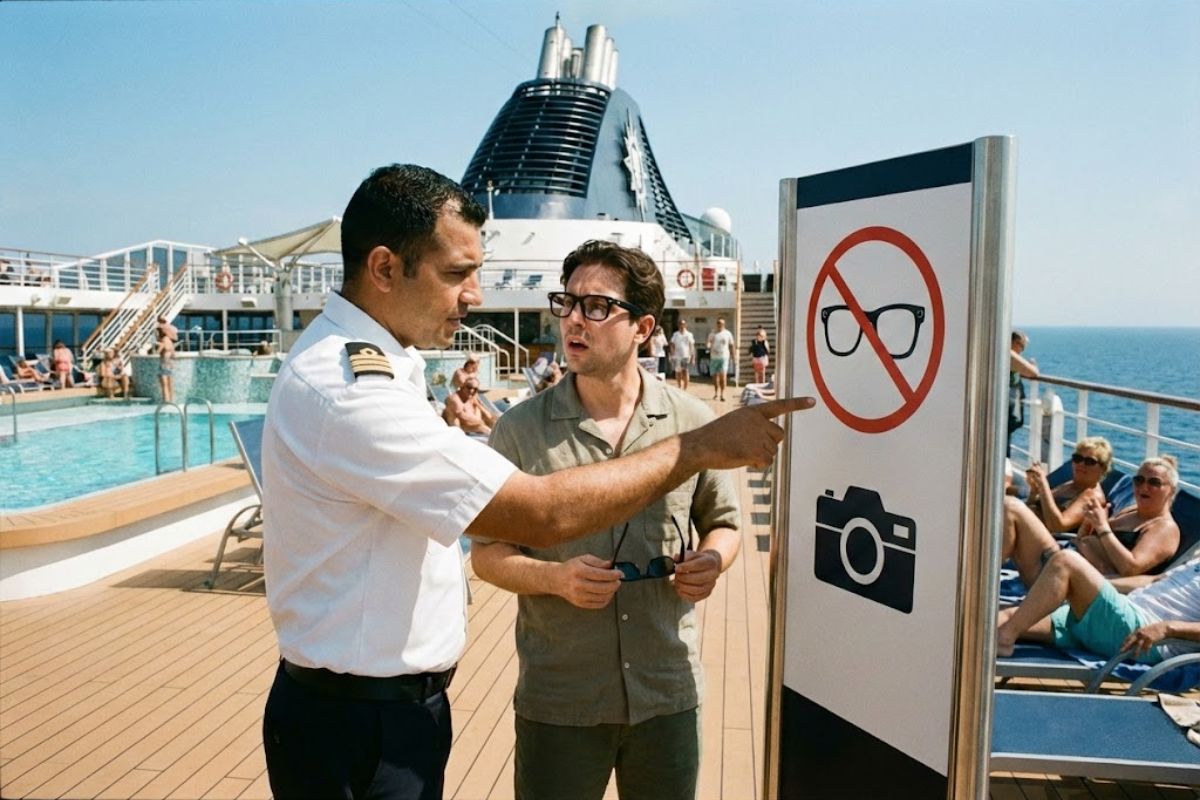
Updated on July 16, 2025, MSC Cruises’ conduct policy prohibits the use of smart glasses in pools and public areas, restricts these gadgets to cabins, and cites privacy laws to prevent discreet recordings of guests and inappropriate exposure on social media during cruises worldwide.
On July 16, 2025, MSC Cruises updated its guest conduct policy and prohibits the use of smart glasses in pools and other public areas of the ships, justifying the change as a way to reinforce the privacy and safety of passengers and crew. The rule affects models such as Ray Ban Meta and other wearable devices capable of recording or transmitting data discreetly.
The company confirms that glasses can be brought on board, but may only be used in cabins, on land, or in non-public spaces. The same rule authorizes security staff to intervene and even confiscate the device in the case of inappropriate use, especially when there is suspicion of covert recording of third parties.
How the New Rule Works Onboard
According to the updated conduct policy, MSC considers that any electronic device worn on the body capable of recording or transmitting data without others noticing falls into the list of prohibited items in public areas.
-
The Arctic is shrinking and in March 2026 recorded only 14.3 million km² of ice at the peak of winter, one of the lowest levels since 1979, reducing the planet’s ability to reflect heat and accelerating global warming.

-
The waste that can double a household’s water bill is not in the faucet or the shower; it happens hidden within the walls and can go unnoticed for months, according to sanitation experts.

-
Darkness can surpass light in an optical phenomenon confirmed by scientists, which expands the understanding of relativity and reveals new behaviors of waves in the universe.

-
A Brazilian scientist created a pen that touches human tissue and identifies cancer cells in seconds using a drop of water and artificial intelligence, and Lívia Eberlin’s invention has already been used in over 400 surgeries in the United States and Brazil.


This includes not only smart glasses but also other gadgets that may function as cameras, microphones, or data transmitters without clear indication that they are in use.
In spaces such as pools, decks, bars, and hallways, passengers must keep these devices turned off or stored.
In cabins, on land, or in other areas classified as non-public, use is allowed as long as general cruise rules are followed.
The company emphasizes that smart glasses are still permitted upon boarding, what changes is the way and the location in which they can be used.
Privacy, LGPD, and the Risk of Covert Recording
Cruise ships are legally considered private spaces for collective use. According to attorney Patrícia Peck, a digital law specialist, this detail changes the discussion about technology onboard.
The problem is not the gadget itself, but the potential to capture images of third parties without express consent and publish everything online in seconds.
The specialist reminds that the General Data Protection Law and the Constitution itself require transparency about the collection and use of personal data, which includes images.
In practice, anyone filming other people with a nearly imperceptible device, such as smart glasses, should inform beforehand that they are recording and explain the purpose of that recording, something difficult to ensure in crowded areas of a ship.
Patrícia Peck also cites Article 20 of the Civil Code, which prohibits the use of someone’s image without permission when it harms honor or has a commercial purpose.
On a cruise, the indiscriminate capture of images by other passengers may be understood as an abuse of rights, especially if the content is exploited on social media, monetized, or associated with embarrassing situations.
Trend Beyond Ships: Clubs and Parties on Alert
As smart glasses and other wearables gain popularity, different private spaces are reevaluating the use of these devices.
The specialist points out that clubs, nightclubs, and other entertainment venues are already starting to discuss similar restrictions, precisely to prevent customers from being turned into content without notice and without control over their own image.
In this scenario, MSC’s decision is seen as part of a trend to tighten rules before technology gets out of control, especially in environments where people are dressed in swimwear, during moments of leisure, and greater vulnerability.
The company is trying to anticipate conflicts that could lead to lawsuits, repeated complaints, or image crises on social media.
Onboard Security and Exceptions for Surveillance
Despite the restrictions on passengers, the attorney highlights that there is an important difference between surveillance for security purposes and recordings made by guests.
Cameras on the ship itself, positioned in visible locations and intended for protection, are usually treated as an exception to consent, since the purpose is not public exposure, but incident monitoring.
However, when a passenger uses smart glasses or another device to record everything in a nearly invisible way, the boundary between personal memory and inappropriate exposure becomes much more nebulous.
MSC is trying to limit exactly this type of situation, making it clear that, if there is inappropriate use, security teams can intervene, guide the guest, and even confiscate the device.
In the official statement, the company emphasizes that the measure exists “exclusively” to protect the privacy and safety of guests and crew.
The complete conduct policy can be accessed on the company’s website, which includes lists of prohibited items and specific guidelines for electronic devices worn on the body.
What Changes in Practice for Those Boarding with Technology
In practice, passengers who purchased smart glasses to record every moment of the trip will need to change the way they use the device onboard.
Instead of filming spontaneously in pools and leisure areas, use will be restricted to private environments or outside the ship.
For digital influencers and content creators, this means planning recordings better, using other more visible equipment, such as smartphones and traditional cameras, always with attention to the privacy of third parties.
And you, do you think MSC made the right decision by prohibiting the use of smart glasses in public areas of cruises, or has the measure gone too far and overly limits the experience of passengers?







Seja o primeiro a reagir!