





 Portuguese
  English
  Spanish
  4 min of reading
  1 comment





A 90-Year-Old French Woman Discovered That The Small Painting Hanging Over Her Stove Was A Rare Work By The Medieval Italian Genius Cimabue, Valued At Over R$ 100 Million And Now Part Of The Louvre Museum’s Collection.
An elderly woman of 90, a resident of the town of Compiègne in northern France, had been living for decades with a true relic hanging in her kitchen without knowing it. The small painting, measuring 25 by 20 centimeters, positioned above the stove, was identified as an authentic work by Cimabue, a Florentine master considered one of the founders of Western painting and a medieval Italian genius of the 13th century.
According to the G1 portal, the discovery, made during a routine evaluation of the house in 2019, led to the sale of the work for 24 million euros (over R$ 100 million at the time’s exchange rate) and turned the case into one of the most valuable artistic finds of the century. The panel, titled “The Mocking Christ”, had been treated as a simple decorative piece for decades.
A Hidden Masterpiece In A Common Kitchen
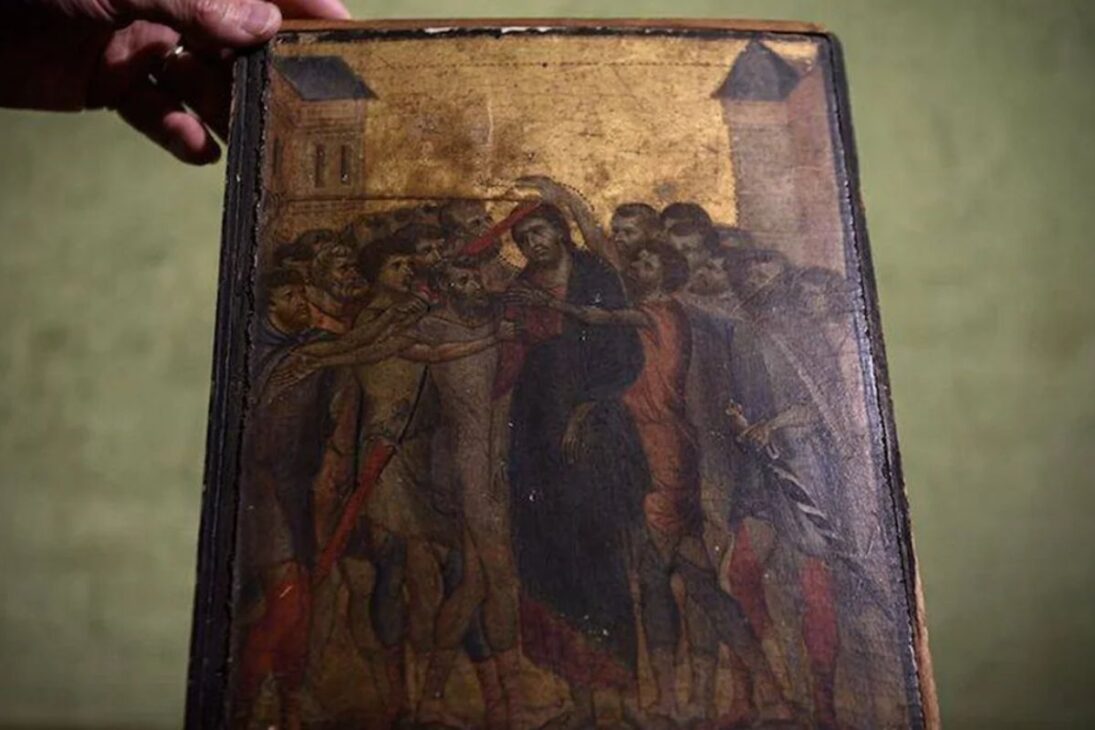
The painting was found by chance when the elderly woman’s family decided to sell the house. Local auctioneers almost discarded the painting, believing it to be a worthless reproduction.
-
With more than 635,000 doctors, Brazil sees competition increasing in large cities, and recent graduates are competing for shifts at an accelerated pace while the countryside still faces shortages.

-
The world’s first octopus farm wants to open in the Canary Islands and is already provoking an international reaction: the plan aims to produce 3,000 tons per year.

-
Drought may be creating stronger superbugs in the soil and helping antibiotic resistance reach hospitals, warns a study highlighting a problem that could grow alongside extreme weather.

-
The biggest scam in history: Napoleon’s France deceived the United States by selling them a territory that was Spanish.


However, art expert Éric Turquin was called in to evaluate the piece and immediately identified characteristics typical of Cimabue, one of the most influential artists of the transition between Byzantine style and the Italian Renaissance.
Executed with tempera on poplar wood, the painting depicts the mocking of Christ by a crowd.
Tests with infrared light revealed traces and proportions identical to those of other known works by Cimabue, confirming its authenticity.
The panel was part of a larger set, a diptich composed of eight scenes from the Passion of Christ, painted around 1280.
Connection With Other Works By The Italian Master
“The Mocking Christ” has well-known sister pieces: the scenes “The Virgin with the Child Enthroned and Four Angels,” displayed at the National Gallery in London, and “The Flagellation of Christ,” at the Frick Collection in New York.
The technical comparison between these pieces and the painting discovered in France was fundamental in confirming that the panel was part of the same set.
The discovery reinforced the importance of Cimabue as the artist who broke away from Byzantine rigidity and inaugurated a new visual language, more human and three-dimensional, paving the way for names like Giotto, his pupil, and later for the masters of the Renaissance.
From The Stove To The Louvre: The Auction And The Historical Recognition
The auction house Senlis put the painting up for sale in October 2019, with an initial estimate of 4 to 6 million euros.
The final value, however, exceeded all expectations: it was sold for 24 million euros, a world record for a work from the pre-Renaissance period.
After the sale, the French government declared the painting a National Treasure, blocking its export for 30 months.
This decision allowed time for the Louvre Museum to gather resources and finalize the purchase in 2023, officially integrating “The Mocking Christ” into the institution’s collection. The museum plans a major exhibition in 2025 to celebrate the arrival of the work.
The Legacy And Impact Of The Discovery
The elderly woman passed away shortly after the auction, leaving her inheritance to three children, who faced lengthy tax negotiations to regularize the sale.
The story of the painting mobilized the global artistic community, both for its historical value and its symbolism: a treasure forgotten in a simple kitchen, preserved by chance for centuries.
The discovery also rekindled interest in Cimabue, whose works are extremely rare.
Only about 15 paintings are known in the world, and each one is considered a landmark in the evolution of European art.
The episode reinforces the value of technical insight and chance as a reminder that the past can still surprise even in the most unlikely places.
The story of the French elderly woman who lived with a painting by Cimabue over her stove is a symbol of how the medieval Italian genius continues to influence the present both through art and the way it sparks the imagination of those who rediscover it.
A work forgotten in a kitchen has become part of the world artistic heritage, reinforcing the timeless power of human creation.
And you, do you believe there are still hidden treasures in ordinary homes around the world? What would you do if you discovered a multimillion-dollar work on your wall? Share your thoughts in the comments; stories like this show that art can be closer than we imagine.









I must say this article is extremely well written, insightful, and packed with valuable knowledge that shows the author’s deep expertise on the subject, and I truly appreciate the time and effort that has gone into creating such high-quality content because it is not only helpful but also inspiring for readers like me who are always looking for trustworthy resources online. Keep up the good work and write more. i am a follower.