





 Portuguese
  English
  Spanish
  7 min of reading
  0 comments


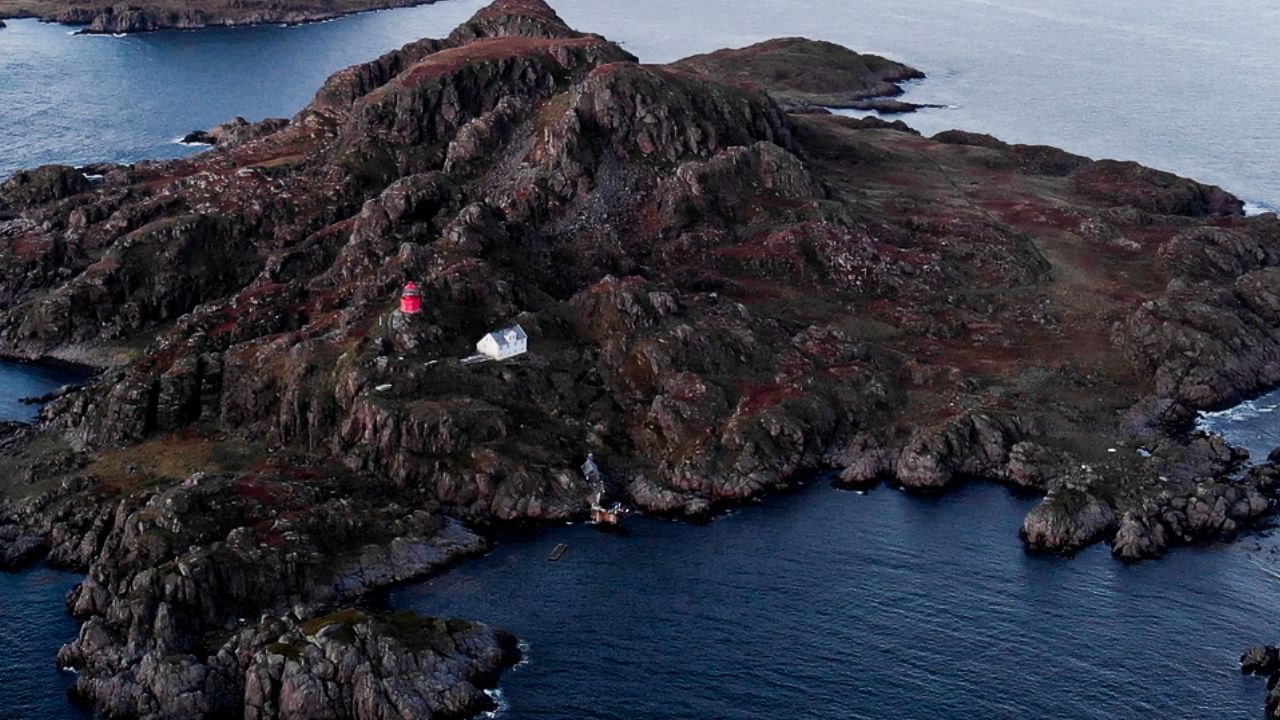
The Popular Myth Speaks of a Solitary Man, but the True Story in the Arctic of Norway Is About the Vision of a Formidable Woman.
The image of a solitary lighthouse keeper, living for 15 years on a remote island in Norway, is a powerful myth. However, the reality at the Litløy Lighthouse (Litløy Fyr) in the Arctic archipelago of Vesterålen is even more fascinating. The only permanent resident is not the man from the legend, but rather Ellen Marie Hansteensen, who has lived there for almost two decades, transforming the outpost.
This is not a story of escape, but of reconstruction. Hansteensen exchanged a “busy life” in journalism and international peacekeeping forces for the tranquility of the Norwegian Sea. She bought the abandoned lighthouse in 2006 with the aim of restoring it and opening it to the public, a project that challenges notions of isolation and redefines the purpose of historical relics, as documented by various sources, including the Wikipedia page about the lighthouse and articles about the NRK series.
From the Front Lines to the Shoreline
Ellen Marie Hansteensen’s decision to become the only inhabitant of an Arctic island was not a whim, but the logical conclusion of a life lived at extremes. Before Litløya, her world was defined by what she describes as a “busy life” (hektiske livet), an euphemism for a high-risk career with relentless intensity. As a freelance journalist and, more notably, working with international peacekeeping forces in the Middle East, her existence was immersed in the epicenter of global conflict and crisis.
-
Friends have been building a small “town” for 30 years to grow old together, with compact houses, a common area, nature surrounding it, and a collective life project designed for friendship, coexistence, and simplicity.

-
This small town in Germany created its own currency 24 years ago, today it circulates millions per year, is accepted in over 300 stores, and the German government allowed all of this to happen under one condition.

-
Curitiba is shrinking and is expected to lose 97,000 residents by 2050, while inland cities in Paraná such as Sarandi, Araucária, and Toledo are experiencing accelerated growth that is changing the entire state’s map.

-
Tourists were poisoned on Everest in a million-dollar fraud scheme involving helicopters that diverted over $19 million and shocked international authorities.


While the specific details of her peace mission remain public, the context of her work during the post-Oslo Accords era suggests involvement in volatile environments, possibly in observation missions such as the Temporary International Presence in Hebron (TIPH). This type of work demands total immersion in the complexities and traumas of conflict resolution, a life dictated by the erratic rhythm of human events, news cycles, and political deadlines. It was a life of constant reaction to the chaos generated by man.
Eventually, a turning point came. Hansteensen “broke away from the busy life she lived and sought tranquility” (braut med det hektiske livet ho levde og søkte stilla). This quest was not simply for silence, but for a fundamental change in the very structure of her existence. It was a conscious choice to exchange a reactive way of life, governed by human unpredictability, for a proactive way of life, coordinated with the natural order. She did not just change jobs; she changed the metronome of her life, from the irregular beat of human conflict to the constant and cyclical pulse of the Arctic environment, governed by the seasons, tides, and climate.
An opportunity arose between 2005 and 2006 when the Norwegian Coastal Administration put 20 lighthouses along the coast up for sale. The municipality of Bø, to which Litløya belongs, received the offer to purchase the Litløy Lighthouse but declined, opening the door to private buyers. In 2006, Hansteensen acquired the property. Her goal, however, was not total isolation. On the contrary, her purchase was made with a clear and legally enshrined intention: to make the lighthouse accessible to the public, transforming her personal sanctuary into a shared destination.
The Soul of the Island in Norway
To understand Hansteensen’s choice, one must first understand the place. The island of Litløya is not a blank canvas; it is a palimpsest of history. Its geology is ancient, marked by the Trollhola cave, 40 meters deep and formed about 100,000 years ago. The island has been a vital center for coastal communities, continuously inhabited since the Stone Age by fishermen and sailors, reaching its peak prosperity between 1850 and the early 20th century.
The heart of this community was the Litløy Lighthouse, built in 1912. It was a busy station, harboring several families. Its significance was undeniable: in the 1960s, its light was the second most powerful in all of Norway, a crucial guiding lighthouse for navigation. Even during World War II, the island maintained a peaceful coexistence between locals and the small German garrison.
However, technological advancement marked the decline of the island. The motorization of boats and modern conveniences on the mainland led to a drastic decrease in population by the late 1950s. The lighthouse’s light was automated in the 1980s and 1990s, and on June 26, 2003, after 91 years of service, the station was finally deactivated, leaving the island in silence. When Hansteensen arrived, she found the island uninhabited by humans, but dominated by the “chatter of seagulls” and other seabirds.
Timeline of the Litløy Lighthouse in Norway
The table below summarizes the long and rich history of the island and its lighthouse, providing a chronological context for its transformation.
| Year(s) | Event | Significance |
| c. 100,000 B.C. | Formation of the Trollhola cave | Establishes the geological antiquity of the island. |
| 1912 | Completion of the Litløy Lighthouse construction | Marks the peak of the island’s importance as a maritime community. |
| World War II | German occupation | A notable period of peaceful coexistence between occupants and locals. |
| Late 1950s | Depopulation of private residents | Modernization leads to the abandonment of the island by its civilian population. |
| 1959 | Electrification of the lighthouse | Modernization of light technology. |
| 1960s | Second most powerful light in Norway | Highlights the strategic importance of the lighthouse for navigation. |
| c. 1985–1991 | Light automation | Makes the constant presence of lighthouse keepers to operate the light obsolete. |
| 2003 | Station fully deactivated | End of 91 years of continuous operation; the island becomes uninhabited. |
| 2006 | Purchase by Ellen Marie Hansteensen | Beginning of a new era for the lighthouse as a private project with a public mission. |
| 2011 | Highlight in NRK documentary | The program “Der ingen skulle tru at nokon kunne bu” brings national attention to the story. |
| 2017 | Award for Women Entrepreneurs | Recognition of Hansteensen’s success in transforming the lighthouse. |
| 2021 | Grant for major restoration | Funding from the Norwegian Cultural Foundation allows for historical restoration. |
The Architecture of a Dream
Hansteensen’s vision for Litløy Fyr was ambitious: to transform a historic and abandoned complex into a sustainable and welcoming destination. This monumental task required more than just a dream; it demanded immense resilience, technical skill, and relentless physical work. The fundamental reality of Litløya is its self-sufficiency. Life here is “off the grid”, meaning all energy is produced locally and all drinking water is collected from rain. This independence comes at a price: the need for in-depth technical knowledge and constant maintenance, making life “more time-consuming” and dependent on manual labor.
The restoration project has been a meticulous endeavor. With the support of architects and a substantial grant from the Norwegian Cultural Foundation in 2021, the goal was not to modernize, but rather to carefully restore the historic buildings. The work is so physically demanding that calls for volunteers on the Workaway platform repeatedly seek “strong” and “skilled” individuals. Hansteensen herself is described as “resilient” and “highly technical,” acting not only as the owner but also as the engineer, project manager, and primary worker on the island.
The ultimate aim of all this effort is hospitality. Hansteensen is transforming the lighthouse into a “special place for guests,” with the keeper’s house offering accommodations and the lighthouse tower being converted into a unique hotel suite, featuring luxurious touches such as a glass ceiling to admire the Northern Lights. The success has already garnered international awards. In this process, Hansteensen has redefined the role of the lighthouse keeper for the 21st century: with automation rendering the light obsolete, she has become a “curator of history” and an entrepreneur, creating a sustainable business model to keep the spirit of the place alive.
A Curated Solitude
The life of Ellen Marie Hansteensen in Litløya, Norway, is built on a fascinating paradox: she sought quiet and isolation but created a destination that attracts people from all over the world. Her solitude is not that of a hermit, but rather a “curated solitude”: a state of isolation that functions not as an end in itself, but as a means to a deeper and more controlled type of connection. Although she is the only permanent resident, her world is regularly punctuated by the presence of volunteers from all over the globe, guests, and film crews, transforming the remote island into an unlikely international meeting point.
The crucial difference from her previous life lies in control. In her past work, interactions were chaotic; in Litløya, she is the host, and people enter her world at her invitation and on her terms. She has not shunned human contact; she has reinvented it. Her isolation has paradoxically become the rare asset she shares. However, she lives in a constant duality: the ocean surrounding her is both a “mode of transportation” connecting her to the world and a “prison” confining her to the island during storms.
Ellen Marie Hansteensen is the modern embodiment of the lighthouse keeper. With technology rendering the physical light obsolete, she does not guard ships from the rocks; she preserves something more fragile in the contemporary world: a piece of cultural history, a sustainable life philosophy, and a space for genuine human connection. She took an obsolete structure, destined for ruin, and infused it with a new vibrant purpose, becoming the guardian not only of the light but of the history, soul, and future of the island.
Ellen Hansteensen’s journey from chaos to tranquility is extreme. Could you exchange modern life for such an “off the grid” challenge in Norway? Which part of her routine impressed you the most? Share your thoughts in the comments.









-

-

3 pessoas reagiram a isso.