





 Portuguese
  English
  Spanish
  4 min of reading
  0 comments


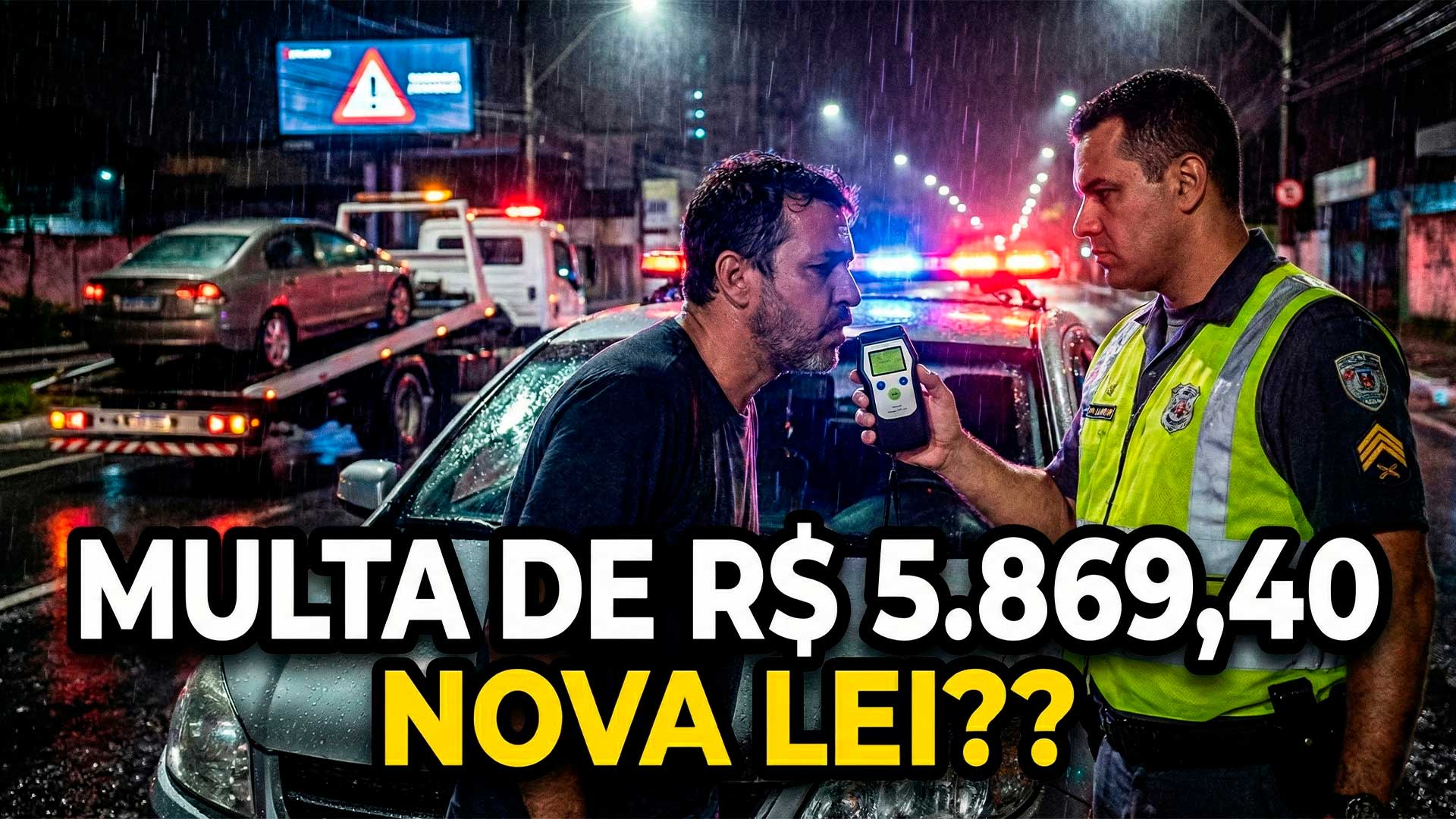
What Matters in 2025 Under the Dry Law, Fine That Can Exceed R$ 5 Thousand, Suspended Driver License, Risk of Revocation and Criminal Classification in Specific Cases
In 2025, the idea of a “new law” creating a fine above R$ 5 thousand and imprisonment for those who drive after drinking circulated again on social media.
In practice, the values and the risk of criminal prosecution are already provided for in the Brazilian Traffic Code (CTB) and in CONTRAN regulations, and remain valid in 2025.
What changes for many people is the perception of rigor. The enforcement has been tightened in operations and campaigns, which increases the number of drivers penalized.
-
The noise law will no longer be in effect at 10 PM starting in June with a new rule valid during the 2026 World Cup.

-
The Chamber opens a debate on driver’s licenses at 16 years old as part of a reform that includes around 270 proposals to change the Brazilian Traffic Code and may redesign rules for licensing, enforcement, and circulation in the country.

-
The new Civil Code could revolutionize marriages in Brazil with “express divorce” and changes that could exclude spouses from inheritance.
-
Banco do Brasil sues famous influencer for million-dollar debt and intensifies debate on delinquency, risks of seizure, and direct impact on Gkay’s credibility.


The central point is simple. Driving under the influence of alcohol is a serious violation, and in specific situations, it becomes a crime, with penalties provided by law.
What Really “Presses” in 2025 and Why the Term “New Law” Confuses
Brazilian legislation already adopts zero tolerance for alcohol and driving. The CTB treats the subject as a public safety priority because it involves a direct risk of death and serious injuries.
Therefore, when headlines talk about a “change coming into effect in 2025,” they are often describing rules that already exist but that not everyone is aware of.
The practical effect appears when the driver realizes too late that the punishment is not just financial. It can involve suspension, revocation, and, depending on the case, criminal prosecution.
Fine of R$ 2,934.70 and Suspension for 12 Months: When the Infraction is Administrative
The classic administrative infraction is driving under the influence of alcohol. The penalty includes a fine of R$ 2,934.70 and suspension of the right to drive for 12 months.
In addition to the fine and suspension, the procedure usually includes immediate measures upon approach. These include the collection of the driver’s license and retention of the vehicle until the situation is regularized.
Many people still believe that refusing the test “solves” the issue. It does not. The refusal of the breathalyzer is an independent infraction and receives equivalent penalties in the administrative sphere.
Another important point is the technical cut of the breathalyzer. The regulation considers ranges and criteria for verification and does not depend solely on the “smell of alcohol” perceived by the officer.
Even without an accident, the citation opens the path for administrative proceedings. And this can become a big problem for those who rely on their driver’s license for work.
From 0.34 mg/L in the Breathalyzer: When It Becomes a Crime and There Can Be Imprisonment
There is a limit where the situation is no longer merely administrative and enters the criminal domain. The crime is characterized when the test indicates 0.34 mg/L or more in exhaled air, within the legal criteria.
In this scenario, the CTB provides for penalties of detention from six months to three years, along with fines and sanctions related to the right to drive. In practice, this means a real risk of arrest in the approach and the opening of police proceedings.
The rule is not limited to the breathalyzer reading. There can also be characterization by other means provided by regulation, such as blood tests or signs of impairment of psychomotor ability.
Even when there is a crime, the administrative part does not “disappear.” The driver may respond simultaneously in both administrative and criminal spheres, each with its own procedures.
Recidivism and Revocation of the CNH: Why the Fine Exceeds R$ 5 Thousand and Can Lead to 2 Years Without Driving
The amount exceeding R$ 5 thousand appears mainly in cases of recidivism. If the driver reoffends within 12 months, the fine doubles and reaches R$ 5,869.40.
Recidivism also increases the risk of harsher measures against the driver’s license. In cases provided for in the CTB, it can lead to revocation of the CNH, which is different from suspension.
In revocation, the consequence is serious. The driver is prohibited from driving and can only apply for rehabilitation after two years, fulfilling the requirements of the procedure and taking mandatory tests.
This is the point that often surprises. Many people only calculate the fine but ignore that being unable to drive can affect income, routine, and even employment.
CNH Expired for More Than 30 Days: Serious Infraction Still Ignored by Many
Driving with an expired CNH for more than 30 days is a serious infraction. The fine is R$ 293.47, with seven points on the record.
In addition to the cost and points, there are administrative measures upon approach. And, depending on the situation, the driver may be without the vehicle until a licensed driver is presented.
More Enforcement, Fewer Tragedies: The Argument Behind the Harshening
The federal government has reinforced campaigns and actions related to the Dry Law, focusing on reducing deaths and injuries in traffic. In official statements, the topic is linked to increased enforcement and indicators of decreases in citations for driving under the influence in recent series.
For the driver, the message is clear. The cost is not just “paying a fine,” because it may include temporary or long-term loss of the right to drive and criminal risk.
There is also a debate about proportionality. Some argue that the punishment is the only real brake for behavior that kills, while others say there is a lack of focus on education and safe transportation as alternatives.
And you, do you think it is fair that the fine exceeds R$ 5 thousand for recidivism and that the case can become a crime with imprisonment? Comment on what should change: the enforcement, the penalties, or the structure to prevent people from needing to drive after drinking.










-

-

-

7 pessoas reagiram a isso.