





 Portuguese
  English
  Spanish
 5 min of reading
  0 comments


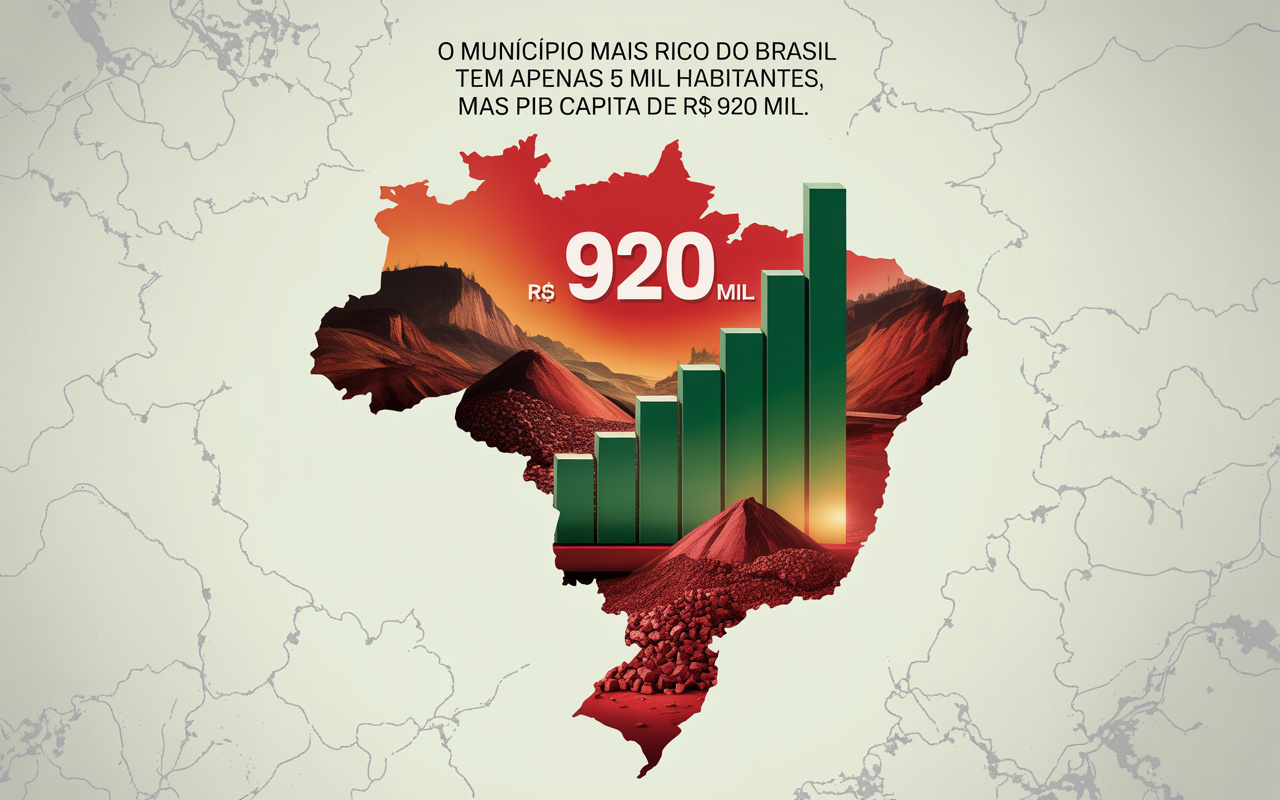
Catas Altas (MG), with only 5,000 inhabitants, is the richest municipality in Brazil. With a per capita GDP of R$ 920,000 thanks to iron ore, it surpasses entire countries in income, but it still faces social and infrastructure challenges.
When it comes to wealth, many envision large capitals, illuminated skyscrapers, or industrial hubs in São Paulo and Rio de Janeiro. However, the richest municipality in Brazil is not in any metropolis. The title belongs to Catas Altas, in Minas Gerais, a town with about 5,000 inhabitants, which, in 2021, registered a per capita GDP of R$ 920,833.97, according to official data from the Brazilian Institute of Geography and Statistics (IBGE).
This astronomical figure places the small mining town ahead of Brazilian capitals and even European countries in terms of income per person. A contrast that stands out, especially because, despite the grand numbers, the everyday life of the population is far from resembling a tropical Switzerland.
Where is Catas Altas and Why is it So Rich?
Catas Altas is located in the central region of Minas Gerais, about 120 km from Belo Horizonte, amidst the mountains of Serra do Caraça. The municipality, which preserves part of its colonial charm, is considered small even by Minas standards.
-
Chocolate prices soar nearly 15% and become a luxury item for Easter 2026, with increases surpassing inflation and changes in Brazilian consumption habits.

-
The Federal Revenue issues a good alert for Brazilian taxpayers: 60.9% are already using the pre-filled tax return, automatic refunds via Pix reach millions, and the government plans for a fully automated income tax in the coming years.

-
India announces a plan of $3.06 billion to bring aviation to forgotten regions: 100 new airports, $1.07 billion in subsidies, and regional routes guaranteed for 10 years, from 2026 to 2036, away from the centers.
-
Brazil blocked a proposal from the United States at the WTO that would make the exemption from tariffs on digital products like streaming and ebooks permanent, favoring American tech giants at the expense of developing countries.




The secret of its fortune lies not in commerce or tourism, but rather in the subsoil: Catas Altas is home to one of the largest iron ore extraction areas in the country. Companies like Vale operate in the region, ensuring billion-dollar sums that, when divided by the small number of residents, cause the per capita GDP to soar.
Per Capita GDP: When Math Misleads
At first glance, the wealth of Catas Altas is impressive: R$ 920,000 per inhabitant in 2021, according to IBGE. But this number needs to be interpreted cautiously.
The per capita GDP is the result of dividing the Gross Domestic Product (the sum of all wealth produced in a territory) by the number of inhabitants. In the case of Catas Altas, the GDP is inflated by mineral extraction, but the small population causes the average to spike.
In other words: this does not mean that each resident has nearly R$ 1 million in the bank, but rather that the city produces, proportionally, one of the largest amounts of wealth on the planet relative to its demographic size.
Comparison with Countries and Capitals
To understand the scale, just compare with other places:
- The per capita GDP of Brazil in 2021 was R$ 40,688, according to IBGE.
- In countries like Portugal, the per capita income is around R$ 130,000 annually.
- In the United States, the figure is about R$ 370,000 per person.
- Catas Altas, alone, reaches almost R$ 1 million per inhabitant — more than double the American average and over 20 times the Brazilian average.
The Contrast Between the Numbers and Reality
Despite holding the title of “richest municipality in Brazil”, Catas Altas faces common issues found in small interior towns.
Not all residents enjoy the direct benefits of this wealth, as most of it is concentrated in mining companies and tax revenues.
Local residents report that investments in urban infrastructure, sanitation, and recreational areas are still lacking. The challenge for municipal administration is to transform astronomical numbers into tangible quality of life.
How Does Revenue Collection Work?
A large part of the money that boosts the GDP comes from the Financial Compensation for Mineral Exploration (CFEM), a kind of royalty paid by mining companies to the municipality.
This collection ensures a robust cash flow for the city hall, which can invest in health, education, and public works. However, as the economy is highly dependent on mining, there is a risk of vulnerability in the future if the activity decreases or is interrupted.
Other Cities with Mineral Wealth at the Top
Catas Altas is not alone on the podium. Other small municipalities with a strong mining presence also appear among the richest in Brazil:
- Canaã dos Carajás (PA), with a per capita GDP of R$ 886,000, also boosted by mineral extraction.
- São Gonçalo do Rio Abaixo (MG), another mining municipality with high per capita income for the same reason.
This list shows that, in Brazil, “per capita wealth” is not necessarily linked to technological innovation hubs or financial centers, but rather to the abundance of natural resources.
The Other Side of the Coin: The Risks of Mineral Dependence
Experts in economics and urbanism warn that almost exclusive dependence on mining can be a long-term problem. With the depletion of reserves or international price crises for iron ore, revenue may plummet, leaving municipalities like Catas Altas without alternatives.
Additionally, there are significant environmental impacts: degradation of natural areas, risk of accidents like those in Mariana and Brumadinho, and pressures on water resources. The challenge is to balance financial prosperity with environmental and social sustainability.
Pride and Responsibility
Despite the contrasts, Catas Altas has become a symbol of how Brazil is a country of paradoxes. A town of only 5,000 inhabitants can surpass rich capitals and even developed countries in per capita income, but still faces typical problems of the countryside.
For many residents, there is pride in seeing their hometown recognized nationally as the “richest in Brazil.” However, this also brings greater accountability on public managers, who must prove that the wealth from the subsoil can be transformed into quality of life above ground.
The case of Catas Altas encapsulates Brazilian contradictions well: a country that produces massive wealth, but where the fruits do not always reach everyone equally.
While the municipality sets records in per capita GDP, millions of Brazilians still live in poverty. The mining town thus becomes a symbol not only of abundance but also of the challenges of turning wealth into well-being.






-

-

-

-

-

-

72 pessoas reagiram a isso.