





 Portuguese
  English
  Spanish
  5 min of reading
  0 comments


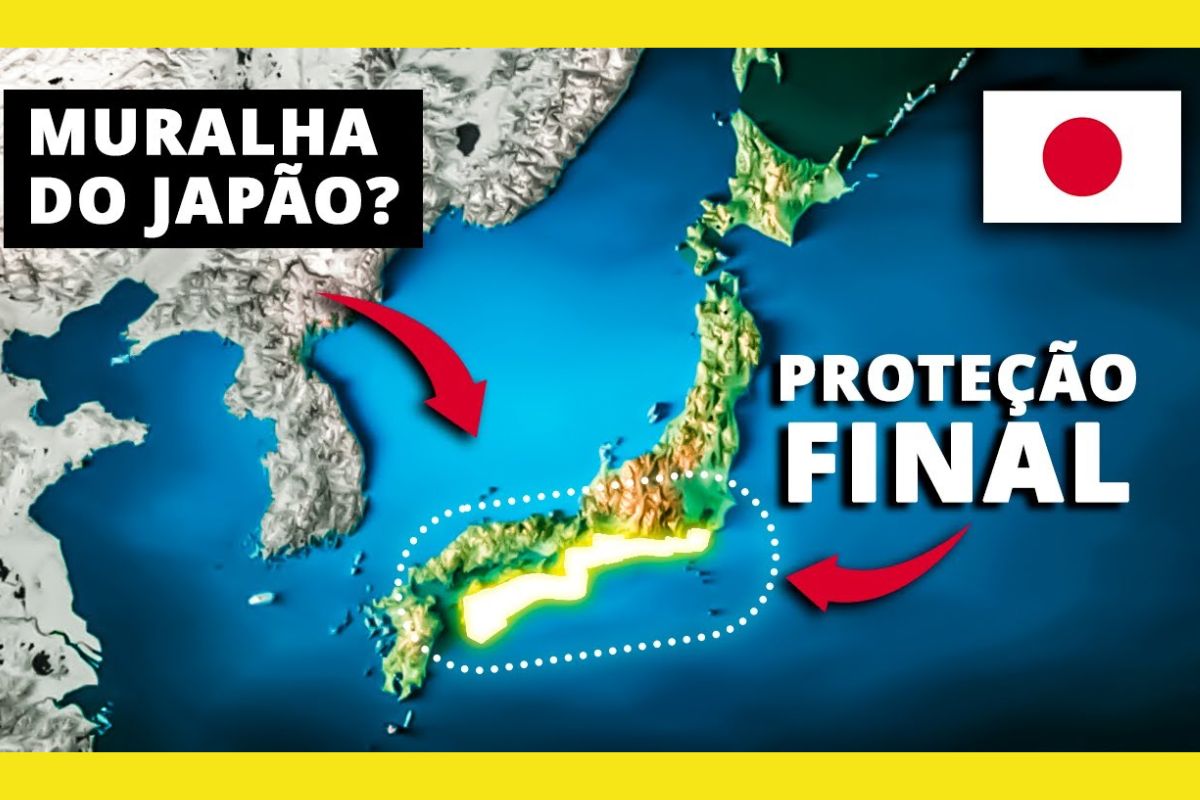
400-Km Coastal Project Crosses Iwate, Miyagi, and Fukushima; Japan’s Wall Raises Barriers Up to 15 Meters to Reduce the Impact of Future Tsunamis.
The Japan Wall emerges as a direct response to the 2011 disaster and stands as the largest defensive structure built since the Great Wall of China. With a length of 400 km, an average height of 12 m (reaching 15 m at critical points), and an estimated cost of US$ 12.7 billion, the work spans three provinces: Iwate, Miyagi, and Fukushima to protect 300 communities along the northeast coast.
The project began in 2011 and is scheduled for completion by 2030. The scale is impressive: 30 million m³ of concrete, more than 50,000 workers, and work fronts 24 hours a day. Some sections are already completed, changing the coastal landscape and opening an intense debate between security, economy, and local way of life.
Why the Japan Wall is Necessary
Friday, March 11, 2011 went down in history: magnitude 9.1, the strongest quake ever recorded in the country. The epicenter, 72 km off the coast and 30 km deep, triggered a tsunami with waves reaching 40 m at some points.
-
More than one million North Americans were ordered to close their windows and stay indoors because the air in the southern United States became so toxic that pollution levels reached 18 times above the World Health Organization’s safety limit.

-
China has accumulated up to 1.4 billion barrels of oil in strategic reserves, invested 25 years in renewable energy, and purchased 80% of cheap Iranian oil: how Beijing has prepared for decades for the crisis that is now shaking the world.

-
A single lake holds 20% of the planet’s non-frozen freshwater and is also the deepest and oldest on Earth.
-
How 5,000 Indian dabbawalas manage to deliver around 200,000 lunchboxes a day in Mumbai for over 130 years using bicycles, crowded trains, and a manual system that continues to operate with impressive accuracy.


Alarms sounded three minutes after the quake, but for part of the coastline, the 20 minutes available for evacuation were not enough.
The impact was devastating: 18,500 lives lost, 470,000 homeless, 120,000 buildings destroyed, and 280,000 severely damaged. Saltwater contaminated 560 km² of farmland, and the economic cost of the event reached US$ 235 billion.
Fukushima Daiichi synthesized the systemic risk: 5.7 m walls were overtopped by a 14 m wave, flooding generators in the basement and leading three reactors to collapse.
What Will Be Built and Where the Wall Operates
The Japan Wall is a continuous coastal defense system with a foundation plunging up to 20 m underground to withstand extreme impacts.
There is no promise to stop the water; the technical goal is to reduce wave energy in critical ranges to save lives and mitigate destruction.
Strategic sections feature automated gates that remain open in daily life for fishing work and close in about 5 minutes when the tsunami alarm is triggered.
The concrete has a special composition, developed to resist marine corrosion and ensure durability of 100 years with low maintenance.
Seismic sensors on the ocean floor feed the alert system, triggering sirens and automatic closures, without human intervention. It is high-risk engineering, designed for the worst-case scenario.
How the Barrier Reduces the Impact of Tsunamis
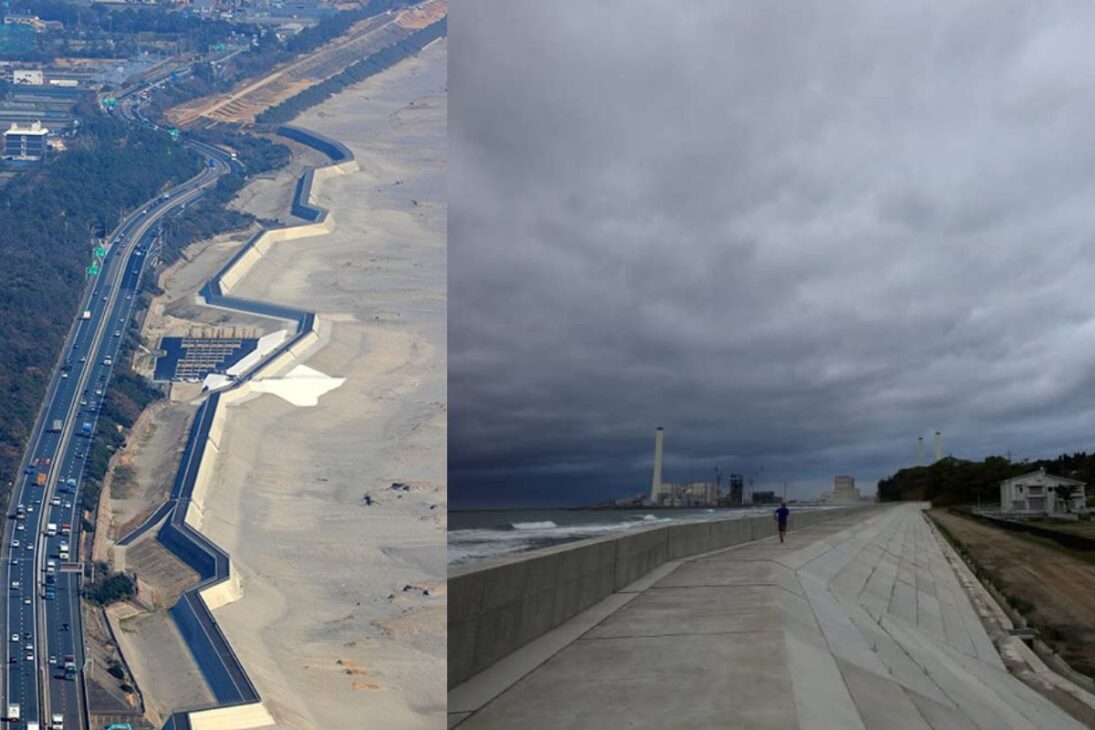
In deep water, the wave travels at ~800 km/h with a little over 1 m in height. As it approaches the coast, the base slows down and the energy goes up, multiplying the height.
When a 15 m wave encounters a 12 m wall, part overflows but slower and with less force. This loss of energy is the difference between evacuating safely and suffering widespread drag of people, cars, and buildings.
The logic is layered defenses: underwater breakwaters (where they exist), + Japan Wall, + elevated shelters, and quick evacuation routes. Kamaishi, for example, has the world’s largest underwater breakwater; in 2011, it reduced the wave height by ~40%, but was not enough alone. That’s why the country combined solutions to enhance resilience.
The Past Teaches: Timeline of Tragedies and Lessons
The coast of Sanriku records extreme tsunamis. In 1896, a moderate quake (M 7.2) did not alarm the population; 35 minutes later, a 38 m wave killed 22,000 people.
In 1933, M 8.4 in the early morning; the hesitation to gather belongings cost 3,000 lives. Hence the proverb: “When the earth shakes, don’t wait. Run to higher ground.”
In 2011, even with annual simulations and alert systems, the scale of the event exceeded all historic towers.
The Japan Wall is the institutional response to a stubborn statistic: the country sits on four tectonic plates and has recorded tsunamis since 684 A.D..
The goal is to buy time and reduce damage, knowing that the next event is a matter of when, not if.
The Invisible Cost: Landscape, Tourism, and Way of Life
Protection incurs social costs. In sections where the wall completely blocks the view of the sea, residents claim to lose climate and cultural references related to fishing.
Children grow up without seeing the ocean from their school or home windows, and tourism has dropped by up to 40% in areas with visible barriers, closing hotels and restaurants.
There are protests and petitions for adjustments; communities demand solutions that reconcile security and landscape.
The government, however, maintains the plan focused on massive risk reduction: calculations indicate the potential to save 80,000 lives in a major future tsunami.
It is a choice of public policy under extreme uncertainty, prioritizing collective security.
Why Alternatives Were Not Enough
Coastal pine forests were planted for decades to slow down the water; studies after 2011 indicated a speed reduction of ~10%, insufficient against giant waves. 3 to 5 m walls built in the 20th century were pulverized in seconds.
Elevating entire neighborhoods with artificial hills is slower and more expensive, and provides inferior protection at the waterline. Breakwaters help but do not replace the barrier.
The technical conclusion was clear: layers must be added, and works accelerated, which is why the Japan Wall has been advancing since 2011.
Execution, Timeline, and Operation


With works in multiple lots along the coast, teams are working 24/7 to meet the 2030 deadline.
Completed sections are already operating with smart gates, sirens, evacuation plans, and shelters above 15 m. Maintenance is integrated into municipal protocols, and annual drills continue as a key element: infrastructure saves time; training saves lives.
The long-lasting concrete, deep foundations, and automation aim to minimize future costs in a structure with a projected lifespan of a century.
It is an upfront investment to reduce human and economic losses in inevitable events.
The Japan Wall does not promise invincibility, but rather a drastic reduction in risk.
Between the sea and the city, the country chose a mattress of concrete and sensors that buys precious minutes enough to avoid a large-scale repeat of 2011.
The dilemma is real: protect lives and rebuild economies, without disconnecting communities from the ocean that gave them identity.
Ultimately, the project is a social pact with the future: pay now to lose less later knowing that “later” will come.
And you, do you think the Japan Wall is right to prioritize maximum protection even with an impact on the landscape, or should it seek less invasive solutions?






-

-

-

5 pessoas reagiram a isso.