





 Portuguese
  English
  Spanish
  5 min of reading
  2 comments


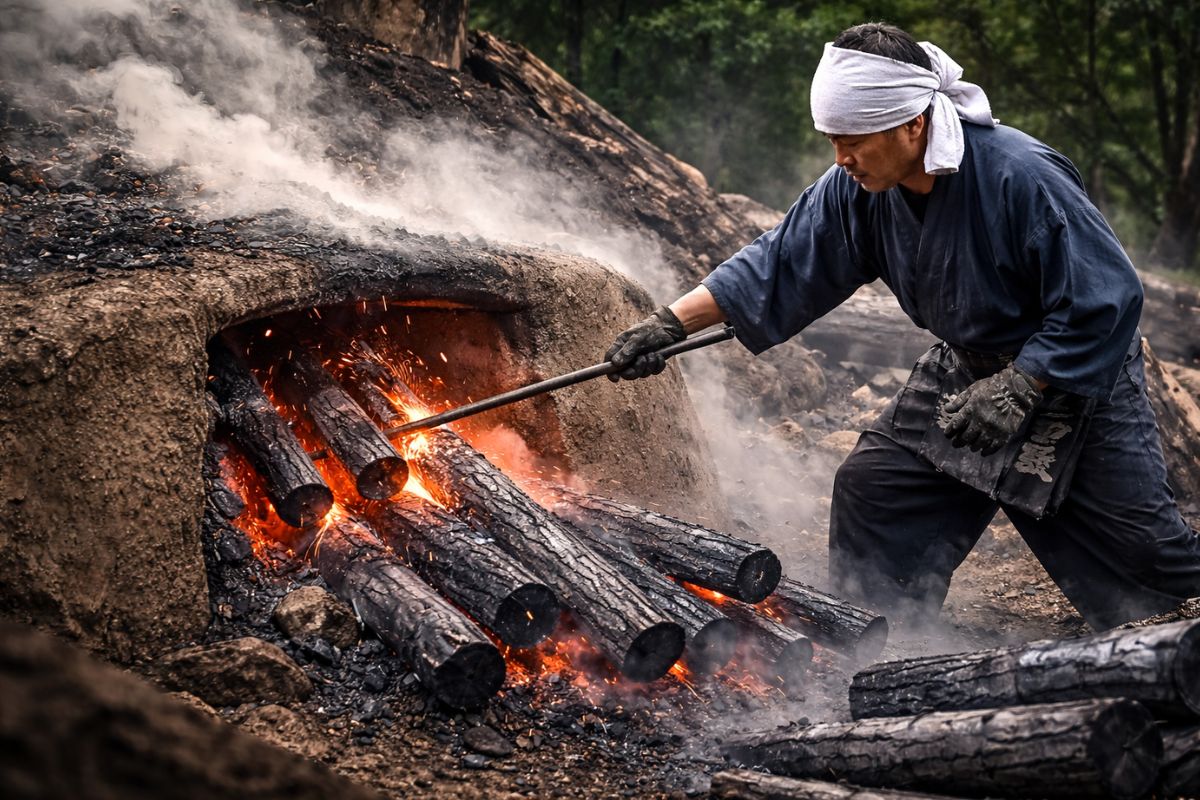


Charcoal Made In Japanese Style Exposes What A Silent Oven Reveals About Wood, Temperature And Carbonization: 7 Days, 5 Tons And 11 Notes, But The Detail That Decides Quality Still Depends On A Human Gesture In The End.
In Asuke Yashiki, in the city of Toyota, in Aichi Prefecture, charcoal is born from a process that seems simple on the outside, but demands fine control of wood, oven, and temperature. The goal is to obtain a hard, compact, and stable material, capable of burning for a long time and producing little smoke.
The work is done by a craftsman specialized in charcoal, who buys wood from landowners and lumberjacks nearby and transforms heavy logs into standardized pieces. The routine combines logistics, measurement, and sensory experience, because carbonization does not depend solely on time: it depends on the exact point at which the oven changes inside.
Where Wood Is Born And Why Thinning Defines Charcoal

The chain starts outside the workplace.
-
A rare storm transformed part of the Gulf into an unlikely scene of hail, extreme rain, and tornado risk in the middle of the desert, with volumes that exceeded the annual average in a single day.

-
Brazil catches the world’s attention with ships powered by ethanol and biodiesel that have lower emissions, an unprecedented certification with advantages in chartering, and a revolution in cabotage.

-
A couple who only has Sundays free has built a hand-dug pool, a hamburger joint, a dance hall, and a playground in their own home without hiring a mason, and even with breaks due to accidents and the pandemic, the work has never truly stopped.
-
Furniture made with aluminum and glass does not warp and has become an alternative to replace MDF in Brazil.

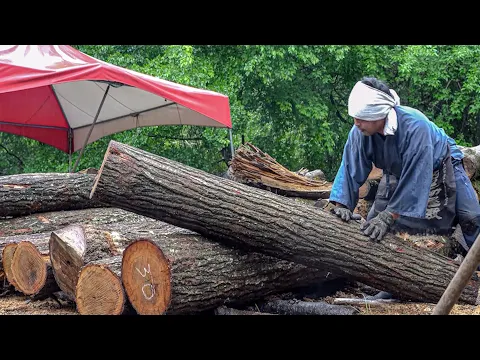
The wood destined for charcoal is purchased from landowners or lumberjacks in the region, with a preference for hardwood, such as oak.
Part of this material comes from trees removed during thinning, a practice used to reduce competition for light and nutrients and keep the forest healthy, with renewal of the understory and a lower risk of degradation.
The logistics reveal the first number that weighs in the process.
Each load of wood for charcoal can exceed 100 kg per unit of material, and the density of hardwood increases the transportation effort to the workplace and for storage.
Proper thinning changes the charcoal even before the oven, because moisture, ventilation, and storage time interfere with carbonization and the yield of the charcoal.
The 5,000 Kg Oven And The Assembly That Prevents Carbonization Failures

When the wood arrives at the oven, the pace changes.
The craftsman divides the material into appropriate sizes using custom-made equipment designed to maintain uniform thicknesses.
Decades ago, this step was done by hand, and the difference is not just in effort: uniformity reduces carbonization irregularities, because pieces with very different thicknesses heat at different speeds inside the oven.
The loading is a precision operation.
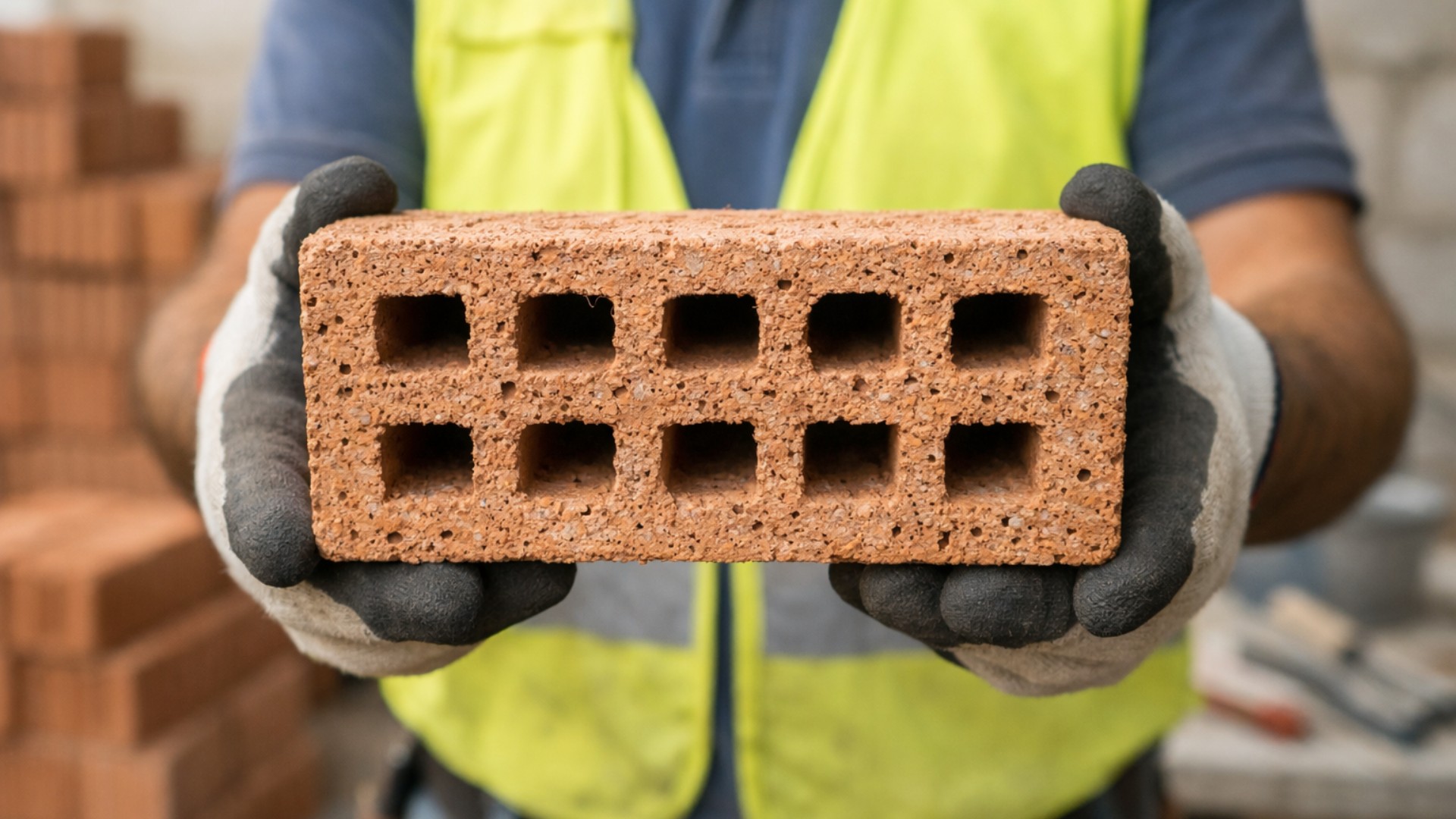
The oven, made of brick and red clay, measures about 2.2 m in length by 2.0 m in width and reaches a maximum height of 1.8 m, with an approximate capacity of 5,000 kg of charcoal in a batch.
In spring, as cherry blossoms fall outside, the wood is organized in order and aligned vertically to avoid gaps, since voids generate cold zones, temperature variations, and defects that appear in the final charcoal.
Temperature, Smoke And Time: The Point At Which The Fire Goes Out And Carbonization Continues
After assembly, the oven is closed, and the fire is lit in the front.
The temperature rises throughout the day and begins the decomposition of the organic matter in the wood, releasing smoke.
The craftsman measures the internal temperature and interprets the smell of the smoke to predict what is happening inside, because carbonization is not visible: it needs to be inferred from physical signs and the history of each oven.
The moment to extinguish the fire is a critical decision.
When the oven’s temperature rises sufficiently, the fire in front is extinguished, but carbonization continues inside the oven.
In the cycle described in Aichi, the ignition took one day, followed by six days of carbonization, totaling seven days of controlled burning; the smell of smoke serves as a reading instrument, and the mistake is costly: if the temperature is low, the charcoal tends to be less hard and less compact, and if it’s too high, it increases ash production and reduces charcoal yield.
Cooling In The Oven And Removal: Why Charcoal Needs To Wait 4 To 5 Days

Ending the flame does not end the process.
After carbonization, the oven remains closed while the charcoal cools internally for four to five days.
This interval reduces the risk of fractures, decreases the chance of accidental ignition upon opening, and stabilizes the charcoal’s structure, which can still react with oxygen if removal is rushed.
Upon removal, the craftsman observes that the charcoal closest to the front tends to be extinguished, while quality usually increases as one moves deeper into the oven.
The inspection is tactile and olfactory: hardness, smell, and appearance help to separate batches that had more consistent temperature and carbonization.
Opening too soon can ruin days of carbonization, because the charcoal is still vulnerable to air entry and sharp variations inside the oven.
11 Degrees, Cut Of 10 To 12 Cm And Signs Of Quality In Charcoal
The classification follows a detailed standard. Charcoal is separated into 11 grades, assessed by hardness, smell, and cross-sectional reading after cutting.
Larger pieces are cut into segments of 10 to 12 cm to standardize use and transportation, and the section reveals if the carbonization reached the desired point, with a fibrous structure and more evident shine in high-quality batches.
The operational characteristics explain why this sorting exists.
High-quality charcoal has a longer burning time and produces little smoke, making it suitable for preparing foods that require constant heat.
In Aichi, a practical reference is the use of charcoal for grilling gohei mochi, where heat stability matters as much as flavor.
The deeper one goes into the oven, the greater the chance of finding charcoal with shine and uniform texture, a direct consequence of more stable temperature and carbonization less subject to air entry.
Operational Honesty And Kodawari: The Method That Appears When The Oven Closes
The technical dimension does not eliminate the human factor, and the craftsman makes this explicit as a work rule.
For him, making charcoal requires honesty with the process itself: there is temptation to speed up steps, to put wood in the oven with half the time, or to relax on uniformity in cutting, but these choices return as defects in carbonization and as a scarcity of good charcoal in the final batch.
The concept of kodawari, understood as rigorous commitment, appears in every decision.
Splitting wood with care, organizing the load without gaps, closing the oven whenever the charcoal is burning, and resisting shortcuts are actions that protect the temperature inside the oven and sustain the repeatability of the charcoal.
In the end, the difference between a common batch and a high-quality batch arises from discipline, not just technique.
The production of charcoal in Aichi shows that tradition can be measurable.
There are dimensions of ovens, capacity in kilos, days of carbonization, and days of cooling, but there is also interpretation of smoke, temperature management, and a classification that translates the result into 11 grades.
The charcoal that reaches the bag is not a coincidence; it is the product of physical control and human consistency.
To stimulate a real debate, it is worth leaving theory and going to the kitchen. Have you ever tested high-quality charcoal and noticed a difference in burning time or smoke quantity? If you could choose, would you prioritize wood, oven temperature, or the 7-day carbonization standard as the main criterion, and why?







Muito boa a matéria e me fez questionar se temos esse cuidado e técnica nas carvoarias daqui, porque nosso carvão faz tanta fumaça e há pedaços que se desmancham qdo os pegamos! Realmente, não há atividade trivial, tudo exige conhecimento e domínio técnico, sem o que a qualidade do produto fica prejudicada!
Eu gostei deste blog