





 Portuguese
  English
  Spanish
  6 min of reading
  1 comment


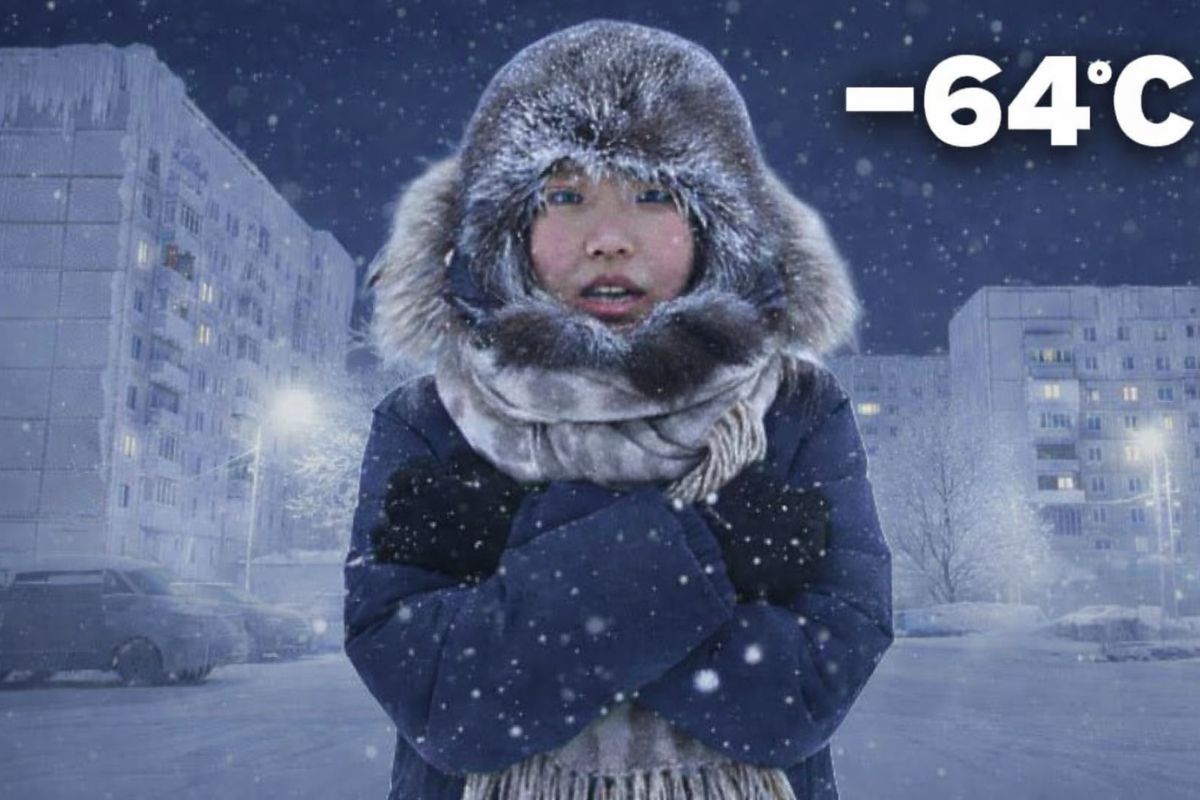


In Yakutsk, In The Extreme East Of Russia, The Cold Defies Logic: Heating Must Be Continuous, Doors Become Multiple Barriers, And Going Out To Buy Milk Requires Planning. Between −45 °C And −60 °C, Vehicles Stay Running, Metal Breaks, And A Few Minutes Expose The Body To Real Risk On The Street, Always.
Yakutsk is not just a very cold place on the map. It is an environment where every simple task requires strategy, because the weather turns small oversights into immediate risk, and forces the entire city to function like an organism that cannot “shut down.”
On days of extreme temperatures, going out to solve something basic can mean putting on heavy layers, organizing time for exposure and choosing routes with stops in heated places. What is routine in other cities becomes a sequence of survival decisions in Yakutsk.
24-Hour Heating And The City That Cannot Fail

Heating in Yakutsk is not comfort; it is critical infrastructure. In apartments, radiators operate at maximum all day long and can become so hot that they burn the skin. It is heat at the limit to avoid losing everything outside, because the cold does not tighten; it dominates.
-
Trump wanted to spend $400 million on the White House, but the courts prohibited the million-dollar construction.

-
How the Egyptians erected giant structures like pyramids, temples, and obelisks without modern technology, cranes, or engines still amazes the world and reveals the power of engineering based on ramps, levers, ropes, and colossal organization.

-
The induction stove you know may be numbered: a new invisible technology hides the stove under the stone countertop, heats only the pot, and promises to cook up to 50% faster while using less energy.

-
Garlic with pure honey undergoes a natural fermentation that transforms the two ingredients into a versatile condiment for marinades, sauces, and roasted vegetables, and it can also be used as a natural treatment in your garden.

There is a terrifying detail in this equation: if the central heating system fails for just a few hours, the consequence is not just discomfort.
The threat is collective. There is talk of a scenario where around 400,000 people would need to be evacuated urgently to avoid freezing inside their homes, even during sleep, when the body doesn’t even realize it is losing heat too quickly.
Outside, The Cold Changes Matter And The Rules Of Time

In Yakutsk, extreme cold does not “feel” cold; it alters how things behave. Metal becomes brittle, glass and cars can freeze in less than an hour, and even the ground turns into a trap.
Outdoor stairs receive thick carpeting not for aesthetics but because the stone can become as smooth as ice, making a simple trip back and forth a risk of falling.
The cruelest rule is the body’s clock. When the temperature drops below −45 °C, there is a practical exposure window: about 15 minutes outdoors before needing to enter a warm place.
After that, freezing can happen without “dramatic warning”: first numbness, then loss of sensation, and then the damage that only appears once it has already occurred.
Dressing Is Engineering: Layers, Weight, And The Cost Of Protection

In Yakutsk, winter clothing is equipment. A local 22-year-old starts her day weighing just over 47 kg and before leaving adds about 11 kg in layers: thermal base, thick knits, double socks, trousers, padded jackets, vests, heavy coats, and gloves that are not optional. It is almost a quarter of her own weight transformed into protection.

On her feet, there is a point that illustrates how the “common” does not work: traditional reindeer-skin boots appear as a viable alternative because other materials can harden, break, or lose utility in extreme cold.
On her head, fur hats serve a direct purpose, protecting ears that can suffer freezing, and extreme cold can even inflame facial nerves and cause temporary paralysis. In Yakutsk, the wardrobe is not vanity; it is a system.
Block Milk, Food Outside, And The Luxury Of “Fresh”

When the air outside is more efficient than a freezer, Yakutsk creates habits that seem improbable in any other city.
The kitchen can fill up, so some food is stored outdoors, taking advantage of the cold as storage. And there is an image that summarizes this reality: milk sold frozen, in solid blocks, directly from farms, at the outdoor market.

At the same time, fresh food can become a logistical luxury. Fruits and items that need to travel long distances arrive more expensive and less accessible. Eating “healthy” in extreme winter can weigh on the budget, not for fashion, but for geography and temperature.
The result is a city where the menu is also planning, and buying basics can cost as much as a full dinner in other places.
Car Running, “Square” Tires, And The Daily Battle To Keep The Engine Alive
The streets in Yakutsk do not forgive machines. In intense cold, tires can lose air and become “square” because the rubber hardens and loses its shape, making the car bounce, unstable, and dangerous. For many people, carrying a compressor in the vehicle is not excessive; it is routine.
The engine then becomes an obsession: to avoid freezing, cars typically stay running almost all the time. Fuel costs around US$ 3.50 per gallon, and this means that the vehicle consumes money even when parked.
There are solutions like an insulated portable “garage,” a huge padded blanket with a timer to turn on and off automatically. However, this blanket can weigh nearly 20 kg, and dragging it every time you park is not only annoying; it’s physically exhausting.
Multiple Doors, Exposed Pipes, And Architecture That Becomes A Shield


Entering a home in Yakutsk has something of a ritual. In buildings, there may be a set of doors, as if the construction creates chambers to prevent the cold air from invading the interior. Each door is a thermal trench, a layer between the habitable world and the hostile world.
There is also the logic of frozen underground. With the soil as solid ice, pipelines and structures do not follow the pattern of other cities: they run above the ground, like visible veins because the ground is not an “easy place” to dig and maintain. Yakutsk does not just survive in the cold; it has been designed to exist despite it.
Yakutsk Does Not “Stop”: Work, School, And Social Life In Extreme Weather

The most intriguing thing about Yakutsk is that the city keeps going. Busy streets, people out shopping, friends meeting, children playing outside with parents nearby. The cold becomes a trained normality, a culture of adaptation in which complaining does not change the thermometer, so the answer is to put on another layer and move on.
There are limits, of course. Schools only close when the temperature drops to −50 °C, which shows how what would be an “emergency” in many places is treated as part of the calendar.
Even small gestures, like answering the phone, become problematic: screens do not respond well with thick gloves, and taking your hand out for just a few seconds can cause quick numbness and sharp pain.
How Much Does It Cost To Survive: When The Most Expensive Item Is Clothing
In Yakutsk, the most expensive item in daily life may not be technology, travel, or luxury. It can be the winter gear.
A specific coat for arctic weather can appear for around US$ 550, but there are fur pieces that become luxury and start at around US$ 2,000, reaching much higher prices for premium models. From the outside, such numbers may seem exaggerated, but inside the price blurs with the chance of going out and coming back whole.
For someone earning about US$ 1,000 a month, putting together a complete winter set can cost several months’ salary.
Thus, the purchase is not impulsive: it is about saving, planning, and durability. Clothing is an investment that needs to last many years because there is no “cheap second option” when the air tries to freeze your skin.
Yakutsk teaches a lesson that cannot be summed up in a motivational phrase. In extreme cold, there is no constant improvisation. There is protocol, habit, and margin of safety.
The city works because it has learned to treat heating, clothing, mobility, and food as parts of the same system, where a small failure can escalate quickly.
Now I want to hear from you directly: what detail of Yakutsk truly scared you, the car that cannot turn off, the minutes limit on the street, or the total dependence on heating? And if you had to choose one “protocol” to adopt in your life for a week, what would it be?







Escolhia passar alguns dias em iakutsk nos meses junho, julho ou agosto, para minha melhor comodidade.