





 Portuguese
  English
  Spanish
  7 min of reading
  2 comments


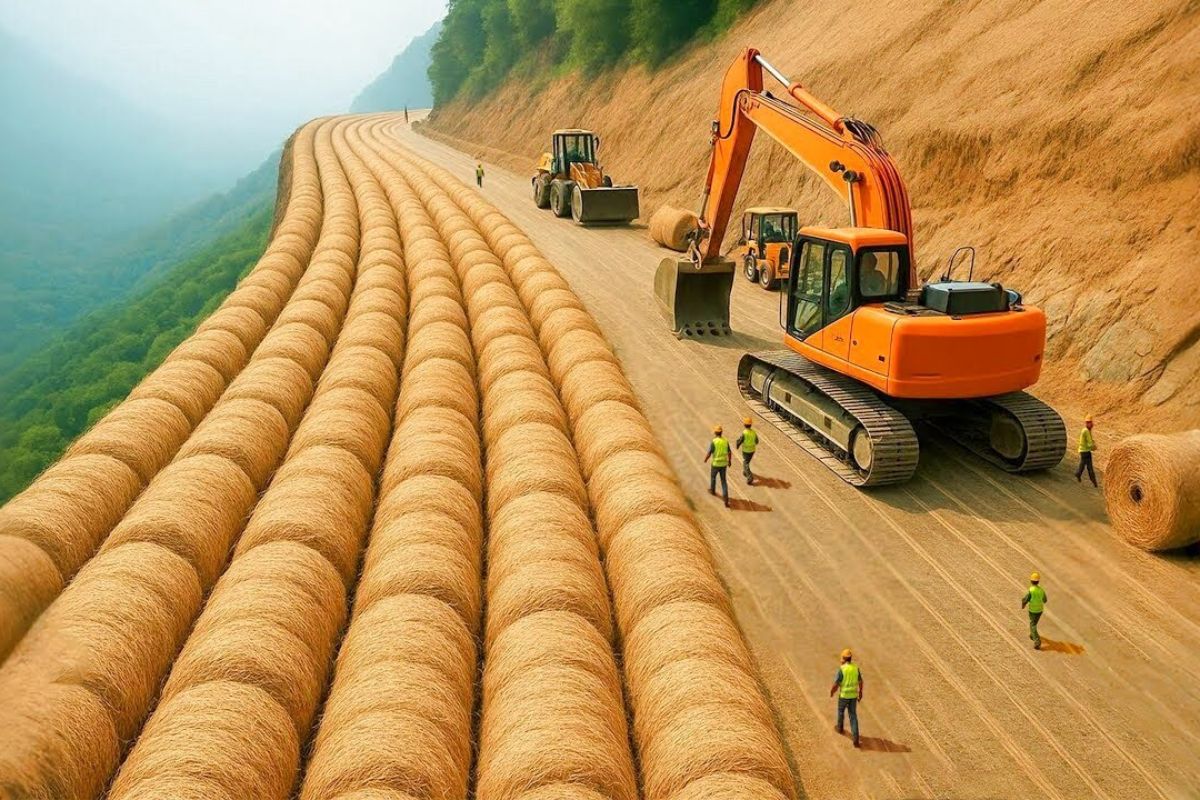


The South Of India Uses Coconut Shells And Coconut Fiber To Create Geotextile That Stabilizes Soil, Reduces Erosion, And Supports Durable Roads. The Method Faces Monsoons, Heat, And Unstable Base With Drainage, Compaction, And Well-Applied Layers. With Low Cost And Local Production, It Becomes Real Ecological Infrastructure.
India is finding a smart way to pave where the climate often destroys everything. In the tropical regions of the south of the country, coconut shells that were once discarded have become raw material for stronger roads, with erosion control and greater soil stability.
The logic is simple and powerful. The fiber extracted from coconut shells becomes a natural geotextile that holds the base in place, distributes load, and allows water to pass. The result is an ecological, inexpensive, and durable road, made to withstand monsoons followed by extreme heat.
Why Do Roads Break So Fast In Southern India

In the southern states of India, the climate imposes an aggressive cycle. In two consecutive monsoon seasons, heavy rain causes runoff and washes away the soil base.
-
Remains with battle wounds of over 100 soldiers from the Roman Empire are found beneath a football field in Vienna, leaving everyone surprised.
-
Elon Musk notes Brazil and lowers the price of his internet, Starlink, promising to connect all corners of the country with affordable plans, 10,000 satellites, and 1 million active users in the national territory!

-
Man creates an infinite source of FREE electricity at home with a PVC wind turbine using a repurposed motor.
-
An aquatic seed consumed for centuries in Asia is going viral in the West after studies highlighted its antioxidant compounds and potential anti-inflammatory properties. It pops like popcorn, has low fat content, and is already being called the new functional snack.

Shortly after, summer arrives with intense heat, and the road begins to crack and disintegrate due to constant expansion and contraction.
This pattern particularly punishes local roads, built on weak and erodible soil. When the base gives way, the surface loses support, and deterioration accelerates.
It was at this point that engineers began to look at an abundant and naturally resilient material: coconut shells, rich in durable fibers.
The Solution That Arises From Coconut: Coconut Fiber Geotextile
The change occurs when coconut shells stop being waste and become a structural element of the project.
The fiber from the coconut is transformed into geotextile, a 100% natural fabric made entirely of fibers, designed to act as soil reinforcement.
In practice, the natural geotextile performs several functions at once:
- Stabilizing the soil, reducing movement during heavy rain.
- Distributing compression loads, decreasing sinking in weak terrains.
- Protecting against erosion, especially on slopes, banks, and critical points.
- Allowing drainage, preserving soil structure and preventing waterlogging.
It is a layer that works “underneath,” but defines the road’s performance for years.
And, being natural, it fits into the proposal of low-cost ecological pavements.
Where Scale Enters: Billions Of Coconuts And A Local Production Chain
The south of India concentrates the country’s coconut production with over 19 billion coconuts harvested each year.
This abundance creates a perfect scenario to transform coconut shells into industrial input, keeping the supply chain close to where infrastructure is most needed.
The coconuts are harvested one year after they form, when the shell is already mature enough for fiber extraction.
Workers climb coconut trees up to 10 m high with a machete and cut entire bunches to drop to the ground.
In very tall palm trees or difficult terrains, long poles of up to 10 m allow cutting from the ground more safely.
After that, the peeling process begins. The coconut is opened, and the shell is separated from the pulp using a wooden or metal spike.
An experienced worker can peel between 500 and 1000 coconuts a day.
This fibrous shell represents about 35% to 45% of the total weight of the coconut, precisely the part where the useful fibers are located.
From Shell To Thread: How Coconut Shells Become Usable Fiber
After peeling, coconut shells go to the processing unit. There, they are spread out and left to dry in the sun for two to four weeks.
This stage reduces the moisture from about 65% to approximately 15%, softening the shell and making fiber separation easier.
With the dried shell, the process gains industrial speed:
- The shells are dumped into a feeding hopper that sends the material to conveyor belts.
- A conveyor belt maintains a constant flow to the decorticating unit.
- In the decorticator, rotating blades and cutting rollers break the shells and release the fibers.
- The fibers pass through a rotary sieve that removes dust and fine particles.
- The long, clean threads return to the sun to dry for three to seven days, reducing moisture from 15% to less than 5%.
This final drying stabilizes the fibers and helps maintain the quality of the material for the next step: transforming loose fibers into consistent, strong, and weaveable filaments.
Pre-Twisting And Weaving: The Geotextile Takes Shape
With moisture below 5%, the fibers enter a pre-twisting session. Spinning machines work continuously to form stable bundles, with a capacity of up to 3 tons of fiber per day.
The fibers are sorted by length and twisted into uniform filaments to avoid breaking during weaving.
In the weaving area, the process becomes visible as a product. The bundles arrive in rolls and are fed into the loom:
The longitudinal filaments are stretched in parallel rows, forming the fabric’s backbone.
Transverse threads are interwoven with needles and guide bars, creating the typical pattern of coconut fiber geotextile.
The loom maintains a constant rhythm and uniform spacing, balancing drainage and soil retention.
The result is a fabric with a rough natural texture and high strength, designed for soil reinforcement and erosion control.
Before leaving, the rolls are inspected for uniformity, thickness, and integrity, and then rolled into ready-to-use coils for construction.
How Much It Yields And How Much It Costs: Productivity Of Coconut Fiber Geotextile
The numbers help to understand why the solution went from the lab to the road. According to the described productivity, 100 kg of coconut fiber produces about 250 to 300 m of geotextile fabric with a width of 1 m.
The cost per meter ranges from 1.20 to 1.80, varying with thickness.
In regions where traditional roads deteriorate quickly and require constant repairs, this cost becomes both a technical and economic argument.
In Practice, How The Geotextile Enters The Road Construction
In construction, the goal is to prevent the soil from “escaping” when water arrives while simultaneously creating a solid base for the layers above.
The step-by-step follows a logic of preparation, positioning, and locking:
Geotextile rolls arrive in trucks and are unloaded manually or with lifting equipment.
The team uses compactors to smooth and compact the soil, removing irregularities.
The geotextile is unrolled along the alignment, maintaining full contact with the soil, without wrinkles.
It is secured with stakes, pins, or steel anchors to prevent displacement.
The natural coconut fiber geotextile stabilizes the soil, reduces sinking, and distributes pressure. This is especially useful on slopes, riverbanks, and areas prone to erosion.
Layers That Hold Everything: Gravel, Compaction, And Stable Base
After the geotextile is firmly in place, the construction enters the layering phase.
The first cover is usually a layer of gravel, which helps lock the fabric in place and distribute weight. A roller compacts and creates a smooth and stable base of 10 to 15 cm.
Next, a layer of soil is added to even out and protect the geotextile from direct pressure.
Then, an additional layer of crushed stone increases load capacity and improves drainage. Another compaction cycle fixes the stones in place and consolidates the base.
From there, the steps move closer to a standard asphalt road: the asphalt is spread and compacted in multiple passes until achieving the desired finish and quality.
The gain appears in performance. With the soil stabilized and protected against erosion, the road becomes more durable, less cracked, and has a longer lifespan, even facing monsoons and intense heat.
Why Coconut Shells Become Infrastructure And Not Just Recycling
The differentiating factor of this solution is that coconut shells do not enter as a symbolic additive, but as a structural element.
The fiber becomes a geotextile that alters soil behavior, directly addressing the root problem: the base that gives way, erodes, and causes surface failures.
In practical terms, it is a form of engineering that combines:
- Abundant and local material
- Relatively straightforward industrial process
- Simple application in construction
- Clear benefits in drainage, stability, and erosion
When these pieces fit together, what was waste becomes infrastructure.
The Whole Coconut Becomes A Chain, But The Road Is The Most Visible Impact
In addition to being used in roads, the same productive ecosystem of the coconut appears in other described processes, such as processed and packaged coconut water, cold-pressed coconut oil, cooked and packaged coconut milk, and dried and packaged crystallized coconut.
It is a chain where almost nothing is wasted.
However, for communities, the road construction has an immediate effect: a road that withstands heavy rain, heat, and unstable soil changes transportation, access, and daily routine.
When coconut shells become pavement, the impact shifts from being solely environmental to logistical, economic, and everyday.
In the end, the question remains that divides opinions and sparks debate: do you think roads made with coconut shells can become the standard in tropical regions or will they remain limited to isolated projects?






Deveriam!!!Nós temos tudo aí!!!Falta usar a boa vontade e acreditar num futuro melhor!!!!
Bela matéria, bem explicada, e demostra como o ser humano busca soluções para tudo mesmo.