





 Portuguese
  English
  Spanish
  4 min of reading
  1 comment


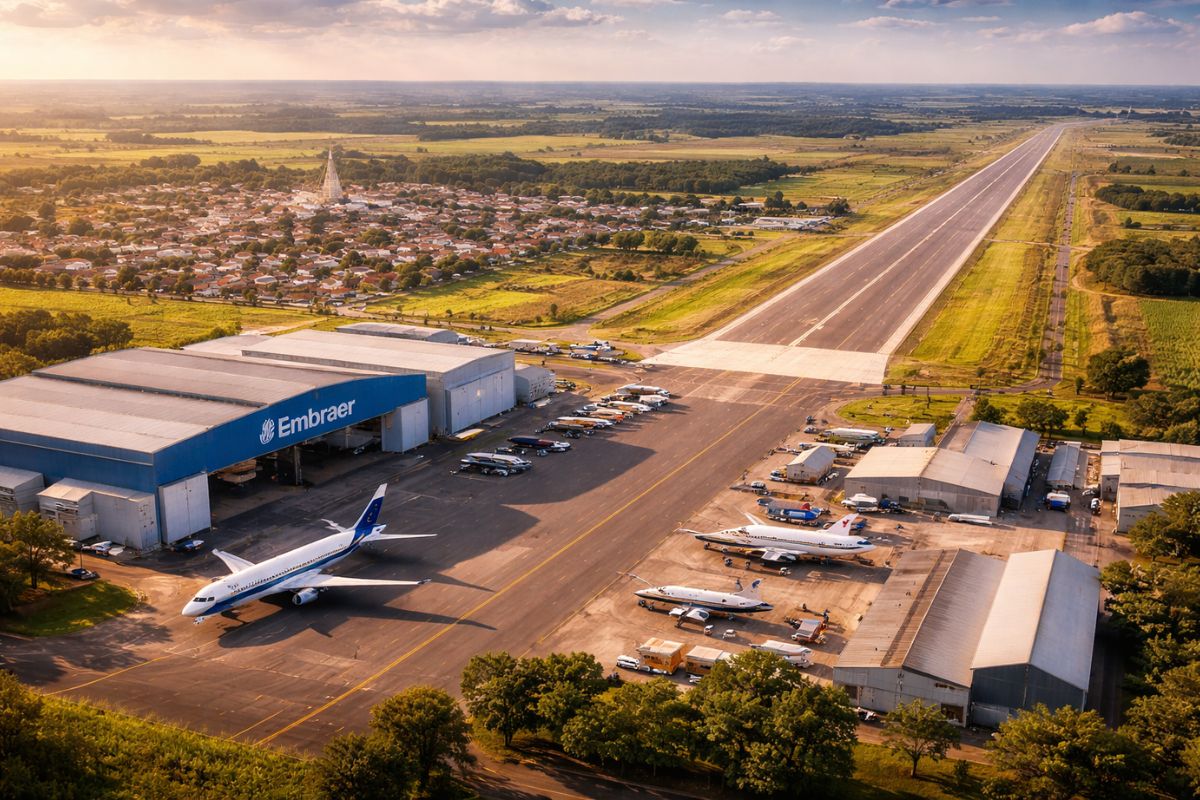


Best City to Live in Brazil Becomes an Exception: Gavião Peixoto Has an Airport Runway of 4,966 Meters, Embraer Base, IPS Score, and a Technical Data Point That Explains Why a Small Municipality Ranks Above Capitals in 2026
The best city to live in Brazil, according to IPS, is neither a capital nor a tourist hub: it is Gavião Peixoto, in the interior of São Paulo, with just over 4,700 inhabitants. The standout data point is a 4,966-meter airport runway, linked to Embraer and development and testing activities.
The effect is twofold. On one hand, IPS highlights a combination of public policies and social indicators that raised the local score to 74.49, ahead of neighboring municipalities and even larger centers. On the other hand, the presence of an industrial base with an almost 5-kilometer airport runway creates a technical perspective on logistics, safety, and productive specialization.
Where is Gavião Peixoto and What Did IPS Measure

Gavião Peixoto is located in the interior of São Paulo and is recognized as the best city to live in Brazil in the IPS report.
-
The Argentine government celebrates the lowest poverty rate in 7 years, but experts warn that the methodology has changed, real wages have fallen, unemployment has risen, and the number of people on the streets of Buenos Aires has increased by 57% since Milei took office.

-
7.8 magnitude earthquake in Indonesia frightens the population, triggers tsunami alert, and hits an island with over 200,000 inhabitants this Thursday.

-
Google will finally let you change that embarrassing Gmail address you created in your teenage years without losing any accounts, logins, or old emails: the feature is already available in the United States.

-
Heading to Brazil in a Bonanza F33 single-engine aircraft: a couple departs from Florida on a visual flight, makes technical stops in the Caribbean to refuel and organize paperwork, and begins the staged crossing until they reach the country.


The mentioned survey considers 57 indicators, grouped into basic human needs, foundations of well-being, and opportunities, including individual rights and higher education, to compose the final score.
The announced number, 74.49, does not arise in isolation and gains meaning when compared to the second place in the same reference, Gabriel Monteiro, with 71.29.
The difference of a few points may conceal significant jumps in public services, urban coverage, and planning capacity, factors that IPS tries to capture in multiple layers simultaneously.
Why Is There a 4,966-Meter Airport Runway There

The 4,966-meter airport runway in Gavião Peixoto is attributed to Embraer’s operation, which is based in the region for the development, testing, and production of military aircraft.
In practical terms, the airport runway is not a tourist symbol; it is an engineering infrastructure for trials, internal certification, and validation routines.
An airport runway this long is typically explained by safety margins and specific operational requirements, such as tests at different weights, speeds, and takeoff and landing profiles.
When the goal is testing and not just transporting passengers, the design of the airport runway tends to prioritize predictability, redundancy, and space for controlled maneuvers, reducing variables in critical scenarios.
What It Means to Be the 2nd Largest Airport Runway in the World
The milestone that puts Gavião Peixoto in the spotlight is its position as the second largest airport runway in the world, at 4,966 meters.
The first mentioned place is Ulyanovsk Vostochny Airport in Russia, with 5,000 meters, which puts the difference at 34 meters, a small detail on paper but significant when the debate is about operational capacity.
The cited list also includes Upington in South Africa, with 4,900 meters, Denver in the United States with 4,876 meters, and Hamad in Qatar with 4,850 meters, as well as Erbil, Robert Gabriel Mugabe, N’djili, Hosea Kutako, and Al Maktoum.
This overview shows that very long runways often respond to physical limits, climate, altitude, logistical strategies, or specific operations, and not merely the size of the city.
Quality of Life, Income, and the Economic Component Behind the Ranking
The same source that ranks Gavião Peixoto as the best city to live in Brazil also highlights an average income of R$ 6,279.20, noted as the best salary average in the state of São Paulo.
In a small municipality, variations in occupational structure and the job base can elevate the average more quickly than in large metropolises.
This scenario relates to the presence of Embraer and the existence of the airport runway, as high-complexity activities tend to drive qualification and formal income.
When employment revolves around engineering, testing, and production, the surrounding service chain shifts, and revenue and consumption patterns can be displaced, creating visible effects in indicators captured by IPS.
What the Ranking Doesn’t Clearly Show
The title of best city to live in Brazil may give the impression that everything is homogeneous, but rankings like IPS measure average results and may conceal income concentration or sectoral dependence.
In Gavião Peixoto, the public narrative relies on policies and services, but the economic reading indicates that Embraer and the airport runway also function as anchors for part of the local dynamics.
Another point is the scale.
With just over 4,700 inhabitants, relatively small changes, such as job openings, supplier hiring, or infrastructure investments, can alter indicators rapidly.
The risk is to confuse performance with shielding: a small city can rise in the IPS and still be exposed to market shocks, industrial decisions, and investment cycles.
Gavião Peixoto has become a symbol of contrast by simultaneously holding the label of best city to live in Brazil according to IPS and having a 4,966-meter airport runway associated with Embraer.
What may seem like a mere map curiosity, in practice, points to a city organized around public services, income, and an aerospace infrastructure that rarely appears in municipalities of this size.
If quality of life becomes a headline, the technical detail becomes the filter of the discussion: those who look only at the ranking see comfort and management, those who look at the airport runway see industrial strategy and a specific type of employment.
Would you live in a city with an Embraer base and an airport runway of this size, or would that change your idea of the best city to live in Brazil, and why?









A matéria é interessante, porém, para que seja realmente completa e fiel à realidade, precisa ir além de índices de avaliação à distância.
Seria fundamental que o jornalista responsável viesse conhecer de perto a realidade da cidade, vivenciar o dia a dia da população e verificar como a situação realmente se apresenta.
Falamos de problemas que vão desde o mau estado de conservação do transporte público, falta de medicamentos, má gestão do dinheiro público, até uma área industrial que hoje é utilizada como depósito de lixo. Sem contar outros possíveis delitos que deveriam ser devidamente investigados.
Causa indignação perceber que um município com arrecadação tão alta não consegue se desenvolver de forma adequada, deixando de oferecer serviços básicos e estrutura digna à população.