





 Portuguese
  English
  Spanish
  5 min of reading
  5 comments


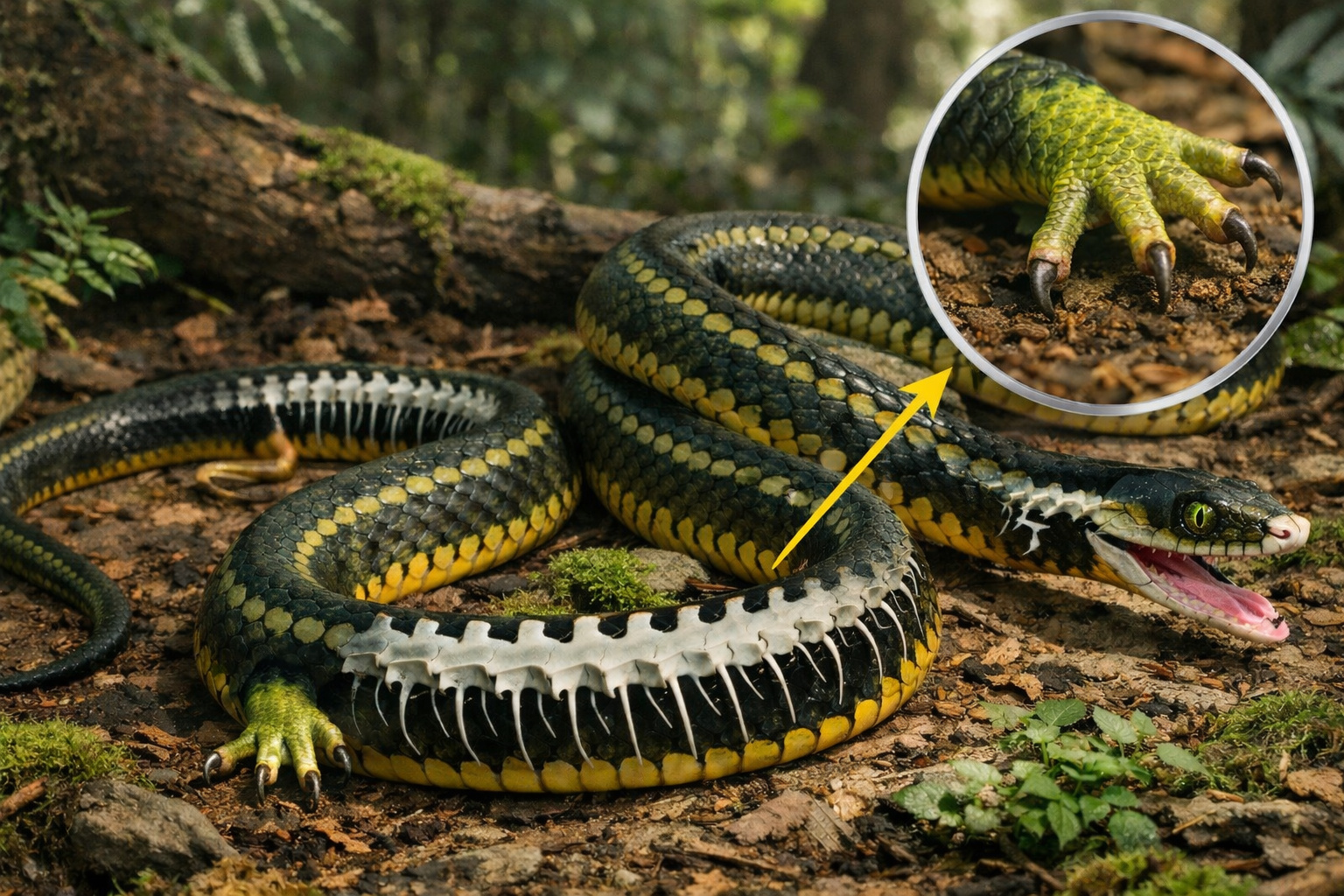


Fossil Snake Najash Rionegrina Preserves Hind Limbs and Transitional Features of the Cretaceous, Revealing Hidden Phases of Snake Evolution.
When thinking about the origin of modern snakes, the common image is of an animal always without legs, silently sliding through its environments. However, paleontology has shown that this perception is far from true. In the Late Cretaceous, around 95 million years ago, an elongated-bodied animal with hind limbs walked through the arid ecosystems of present-day Argentine Patagonia. Its name, Najash rionegrina, pays tribute to the biblical “nahash” — a snake with legs — and to the location of its discovery. This species has become one of the most important pieces to understand the evolutionary transition of snakes from tetrapod ancestors.
The impact of this fossil’s scientific significance comes not only from the eccentricity of a “snake with legs,” but also from its preservation quality. In 2019, new specimens described in the journal Science Advances revealed a nearly complete skull, something extremely rare. This cranial anatomy added data that was previously impossible to obtain, allowing researchers to reconstruct how snakes lost limbs, altered their bite, remodeled their spine, and developed the flexible feeding mode that now defines them.
The study involved Argentine and international researchers and connected field findings with high-resolution tomography. The result was a more consistent reconstruction of the evolutionary tree of snakes, countering classic hypotheses and opening debates about when and why snakes became fully limbless.
-
A simple stitch in wood with nylon thread can reduce adhesives, speed up production, and make sheets up to 4 times stronger and 14 times more difficult to break.
-
The gigantic steel shell built to contain Chernobyl for a century has been pierced by a drone, exposing a critical system and creating a hole that could cost over 500 million euros to repair.

-
Brazilian Navy reaches a new level by taking over an airport with a 1,600-meter runway used by 1,800 military personnel and autonomous attack drone testing.

-
The Himalayas continue to grow to this day, with tectonic plates advancing 5 cm per year, mountains rising up to 10 mm annually, and the 2015 earthquake that killed 9,000 people may have increased the risk of an even larger seismic mega-event.


The Cretaceous of Patagonia and the Paleoecological Scenario of Najash
The fossils of Najash rionegrina were found in the Candeleros Formation, in the province of Río Negro, an area that in the Late Cretaceous was dominated by dunes, temporary water bodies, and sparse vegetation. Instead of dense forests or aquatic environments — as old hypotheses about the emergence of snakes suggested — the scenario of Najash was a semi-arid system of dry land.

This is crucial because for decades, there have been two main lines of debate about the origin of snakes:
- Aquatic Hypothesis: snakes would have evolved from marine burrowing lizards.
- Terrestrial Fossorial Hypothesis: snakes would have emerged from terrestrial burrowing lizards.
The discovery of Najash strengthened the second perspective. Its relatively well-developed hind limbs suggest that the animal was not marine, nor did it dig excessively. Instead, it walked and moved along the surface, although it had an elongated body adapted for slithering.
For paleontologists, the message is clear: losing limbs was not a one-step leap, but a gradual process linked to body transition.
The Skull That Changed the Debate About Snake Evolution
One of the most important discoveries associated with Najash was the preserved three-dimensional skull. Before this, the cranial record of basal snakes was extremely fragmented, and evolutionary hypotheses depended on comparisons with modern lizards.
The skull of Najash revealed an intermediate condition: it had articulations and bone elements reminiscent of lizards, but with modifications pointing to the cranial flexibility typical of modern snakes, allowing them to open their mouths widely to swallow large prey.
Among the features that caught researchers’ attention were:
- The presence of a reduced (or vestigial) jugal bone,
- The positioning of the quadrate — a bone that in modern snakes articulates the jaw with great mobility,
- The presence of a partially movable palate.
These traits suggest that the flexible cranial “engineering” of snakes did not arise only after the loss of limbs, but evolved in parallel. It is a more complex view of evolution, moving away from linear narratives and embracing branched and multifunctional processes.
The Role of Hind Limbs: Vestiges or Function?
The hind limbs of Najash were not mere residual bones. They had a pelvic girdle and joints, indicating some functionality. It is not possible to determine with certainty how the animal used these structures, but hypotheses include lateral body support, assistance during mating, stabilization during slow movement, interaction with the ground, or with prey.

The existence of functional limbs in a Cretaceous snake reinforces a key concept of evolution: structures do not disappear abruptly. When they cease to be advantageous, they begin to lose complexity, bone density, and, much later, disappear entirely.
This pattern is observed in whales (with vestigial pelvic bones), birds (with reduced tails), and axolotls (which retain larval characteristics), always remembering that evolution has no fixed direction, only adaptation to context.
The Place of Najash in the Snake Genealogical Tree
With the preserved skull, researchers were able to position Najash with greater precision in phylogenetic analyses. It appears outside the group of modern snakes (Alethinophidia), but more derived than typical lizards, occupying a position that links scaly lizards and fully limbless snakes.
This position clarifies two points:
- The origin of snakes is not exclusively linked to marine environments.
- The process of losing limbs was gradual, starting with the forelimbs.
Comparative paleontology had already recorded marine snakes with hind limbs, such as Pachyrhachis and Haasiophis, linked to the ancient Tethys Sea. Najash shows that terrestrial species also had this condition, meaning that evolution did not follow a single route.
It is more accurate to think of basal snakes experimenting with different niches — marine, fossorial, terrestrial — until specific lineages thrived.
Science, Imagination, and the Limits of Knowledge
The story of Najash shows how a well-preserved fossil can become a key interpretative tool for enormous topics. For decades, paleontologists reconstructed the evolution of snakes with few fragments. Each new specimen, tomography, and phylogeny adjusts this puzzle.
This case is also a good reminder that solid theories can be revised. The marine hypothesis, which dominated part of the 20th century, is now losing ground in the face of anatomical, stratigraphic, and environmental data.
What We Still Don’t Know
Despite the advancements, some questions remain open:
- When exactly did snakes lose their forelimbs?
- What was the dominant ecological niche of the first serpentine forms?
- Is the loss of limbs linked to burrowing or to surface locomotion?
- How many independent lineages experienced intermediate stages?
These answers depend on more fossils, tomographic analyses, and integration with genetic data from modern snakes.
The Lesson That Remains
The image of a “snake with legs” may seem strange, but it is important to understand that current organisms are just the last chapter of much longer stories. Species like Najash rionegrina reveal the gradual nature of evolution and remind us that characteristics that now seem fixed — like the absence of limbs in snakes — were once very different.
Paleontology is not just unearthing bones; it is unearthing possibilities. And each fossil like Najash rescues a part of what the planet once was and what organisms have been capable of being.









Excelente artículo…
Could it be a long salamander
The Bible is right again. Snakes do walk on earth till God punish it to crawl.
Si yono se cual es el asombro en la biblia,y la serpiente del jardín del Eden caminaba por el castigo se empezó a arrastrar.