





 Portuguese
  English
  Spanish
  3 min of reading
  0 comments


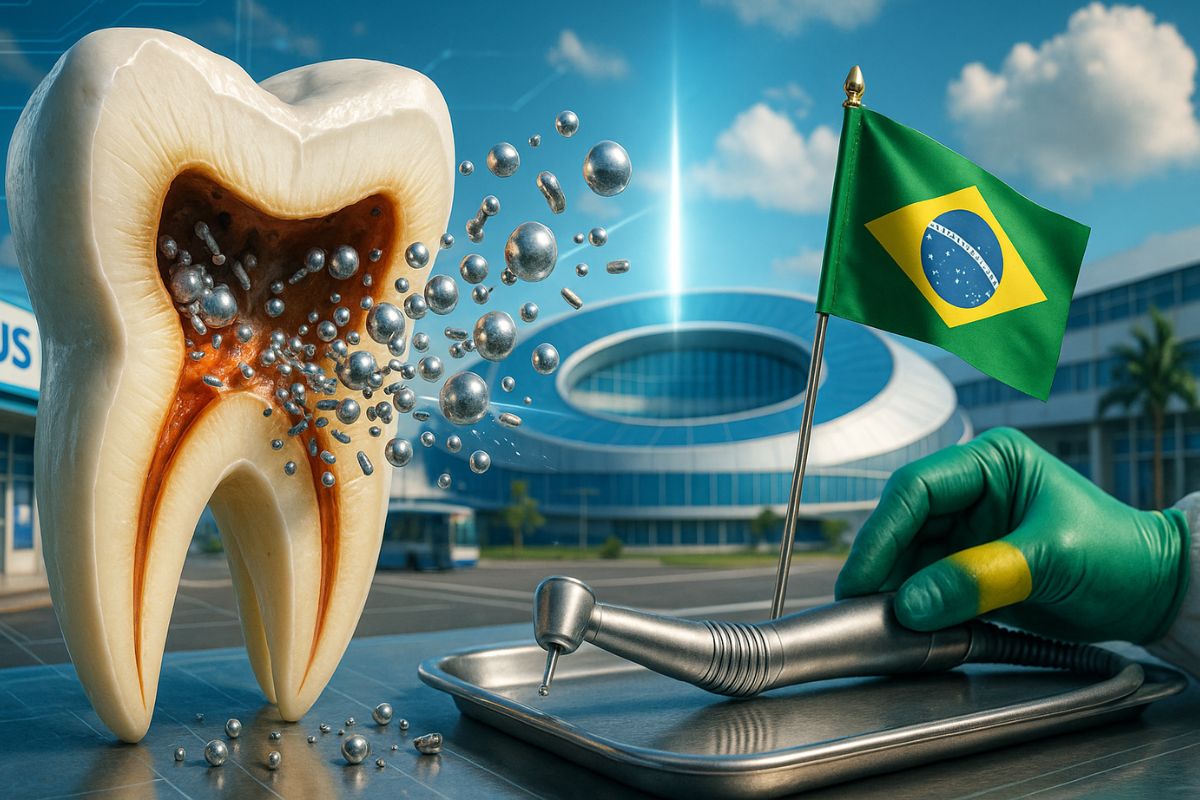
Brazilian Nanotechnology Advances in Dentistry by Applying Silver Nanoparticles in Cavity Treatment, Preserving Enamel, Elevating Minimally Invasive Dentistry, and Indicating the End of the Dental Drill in Eligible Cases, Focusing on Comfort, Precision, and Clinical Safety
Brazilian nanotechnology integrates research and innovation to offer cavity treatment with silver nanoparticles, acting directly on the biofilm and reducing the need for mechanical wear. The proposal combines localized antimicrobial control, enamel preservation, and standardization of protocol.
In parallel, the approach reinforces minimally invasive dentistry, with gains in comfort and adherence, and points to the retirement of the dental drill when clinical criteria are met. The goal is to broaden access, reduce trauma, and improve outcomes.
How Silver Nanoparticles Enable Cavity Treatment
Silver nanoparticles penetrate the mineral structure and bind to cariogenic bacteria, favoring the rupture of membranes and the disorganization of the biofilm.
-
After a submarine disappeared beneath the “Doomsday Glacier,” scientists announce a new monstrous machine capable of operating at 3,000 meters depth to return to the heart of the ice and investigate a threat that could raise sea levels worldwide.

-
NASA has set a date for the beginning of the end of Earth, and it won’t be an asteroid or an explosion: the planet will slowly lose its oxygen over the course of 1 billion years because the Sun is getting hotter every day.

-
Archaeologists have discovered a colossal submerged wall in the Atlantic, dating back 7,000 years and weighing 3,300 tons, regarded as the largest prehistoric submerged structure ever found in France.

-
Scientists have discovered a gigantic magnetic anomaly hidden beneath the soil of Australia that mirrors the shape of the entire continent and holds geological records of two and a half billion years that could change what we know about the Earth.


This targeted mechanism interrupts lesion progression, preserving more healthy tissue than conventional methods.
By concentrating the antimicrobial action at the focus of the cavity, cavity treatment becomes more controlled and replicable.
The practical result is compatible with minimally invasive dentistry, in which less tissue is removed and functional recovery is prioritized.
Why the Method Reduces the Use of the Dental Drill
The dental drill is associated with noise, vibration, and drilling.
With the cavity treatment based on silver nanoparticles, many cases require less rotary instrumentation, reducing pain and post-operative hypersensitivity.
This paradigm shift values minimally invasive dentistry and enamel conservation.
In practice, Brazilian nanotechnology paves the way for more silent, quick, and predictable protocols, providing a better experience for the patient.
Clinical Protocols and Proper Indication
Clinical adoption requires clear indication criteria: stage of the cavity, extent of the lesion, plaque control, and feasibility of sealing.
In suitable cases, cavity treatment with silver nanoparticles allows for consistent and monitorable results.
To maintain safety, the clinical team defines concentration, contact time, and application frequency.
This care strengthens minimally invasive dentistry, avoiding excesses and prioritizing structural preservation and comfort.
Validation, Safety, and Scalability
Pre-clinical trials guide fine-tuning of formulation and protocol, while clinical studies compare cavity treatment with silver nanoparticles to traditional techniques.
Critical items include biocompatibility, stability in the oral environment, and recurrence assessment.
With positive validation, Brazilian nanotechnology can scale in private clinics and public services.
This benefits minimally invasive dentistry, reduces the demand for the dental drill, and broadens access to painless and conservative procedures.
The combination of Brazilian nanotechnology, silver nanoparticles, and minimally invasive dentistry consolidates a more conservative and comfortable cavity treatment, with less dependence on the dental drill.
If adopted with criteria, the model improves experience, efficiency, and outcomes.
Would you recommend this cavity treatment to someone afraid of the dental drill or do you prefer the traditional technique? Share your thoughts in the comments.







Seja o primeiro a reagir!