





 English
  Francês
  Alemão
  Italiano
  Japonês
  Norueguês
  Portuguese
  Spanish
  4 min of reading
  0 comments


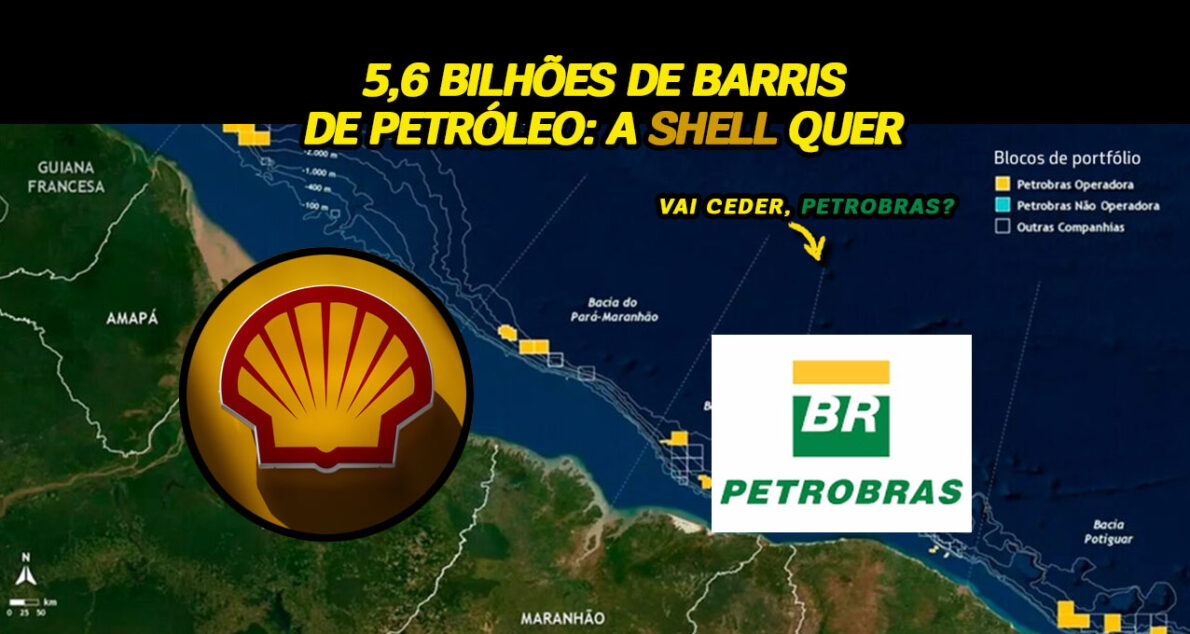
Shell Wants to Expand Its Operations in Brazil, Targeting the Equatorial Margin, the New Pre-salt, While Petrobras Struggles to Overcome Environmental Challenges. This Decision Could Define the Country’s Energy Future.
While all eyes are on Petrobras, which is fighting for the exploration of new areas, another giant is preparing to take a decisive step.
Shell, the Anglo-Dutch multinational, is eagerly awaiting a signal from the government to position itself in one of Brazil’s biggest economic bets: the exploration of the Equatorial Margin.
According to information from the newspaper Valor Econômico, Shell is already eyeing potential operations in the oil areas of the Equatorial Margin, especially in the Amazon River Mouth Basin, located in Amapá.
-
Petrobras finds high-quality oil in the pre-salt at 113 km from RJ and reignites expectations about strategic reserves in the Campos Basin.
-
Chinese giant worth nearly R$ 4 billion that manufactures cables for electric cars, solar energy, and robotics wants to open a factory in SC.
-
Many employers do not know, but the law guarantees domestic workers a 25% increase in salary during trips, 50% for overtime, 20% for night shifts, and 17 additional benefits that can lead to labor lawsuits if not paid.

-
Gasoline prices soar and the question arises: is ethanol more advantageous? The 70% rule reveals the limit with gasoline.

The company already holds assets in the Potiguar Basin, which is located in Rio Grande do Norte, but the final decision to expand its operations depends on federal government authorization.
The expected green light, however, may take time, as Petrobras is still undergoing licensing for drilling a crucial well in the Amazon River Mouth, after facing environmental resistance.
According to Cristiano Pinto da Costa, the president of Shell in Brazil, the exploration of the Equatorial Margin will be a strategic decision that will impact the country’s energy future. However, the environmental issue divides opinions within the government.
The Brazilian Institute of Environment and Renewable Natural Resources (Ibama) initially denied the licensing for Petrobras to drill in the region, citing environmental concerns. Nevertheless, the state-owned company appealed the decision and is trying to overturn the veto with new studies.
The Environmental Dilemma and Political Pressures
Within the government, the situation is complex. There is a faction that supports Ibama’s decision to protect the region, fearing the environmental impacts of uncontrolled exploration.
However, another group argues that Brazil cannot miss the chance to discover the true economic potential of the Equatorial Margin, especially when considering future projections for oil production in the country.
According to the Energy Research Company (EPE), national oil production will peak in 2030, and if new reserves are not explored, the sector could face a significant decline in the following years. To avoid this scenario, many experts believe that the Equatorial Margin could be the “savior” of Brazilian oil production, attracting billion-dollar investments.
Shell’s Position: Security and Energy Transition
In a recent interview, Cristiano Costa emphasized that, besides economic interest, Shell is committed to environmental issues. “The oil and gas industry has a track record of over 15 years of safe pre-salt exploration. We will continue to follow all the guidelines from Ibama,” he stated.
This commitment to safety and the environment has been one of the pillars of the company’s operations, which is also seeking to diversify its investments in projects linked to the energy transition.
Among the projects cited by Shell is second-generation ethanol, in partnership with Raízen, a joint venture between Shell and Cosan. The plan is to build new plants that transform sugarcane bagasse into fuel, increasing the capacity for sustainable ethanol production in Brazil.
The Impact of Auctions and the Dispute for the Future of Oil
Another crucial point for Shell’s advancement in the Equatorial Margin is the regular auctions of oil areas promoted by the government. The president of Shell highlighted that the regularity of these auctions is fundamental for the predictability of investments in the supply chain.
However, the National Agency of Petroleum (ANP) recently postponed the public session for the permanent offering of exploration areas, which may impact the industry’s investment schedule.
For Shell, delays in the auctions can hinder long-term plans. Between conducting an auction and starting oil production, the estimated time is seven to ten years, making predictability essential for the planning of industry giants.
The Uncertain Future: Taxation and New Challenges
While closely observing Petrobras and the government’s moves, Shell is also facing an internal challenge: the high tax burden of the oil sector in Brazil.
For every three barrels of oil extracted in the country, two are allocated to paying taxes and fees, according to the company’s president in Brazil. The executive argues that the industry should be excluded from the “selective tax,” which adds an extra fee on activities deemed harmful to the environment.
With this complex scenario, the question that remains is: how far is the Brazilian government willing to go to balance environmental preservation and economic development? The answer could define not only Petrobras’s future but also Shell’s role in exploring new oil frontiers.
Investment in Energy Transition: Beyond Oil
Alongside discussions about oil exploration, Shell continues to invest in its energy transition strategy. The company has already announced plans to invest up to US$ 15 billion in low-carbon solutions by 2025.
Diversifying the portfolio includes not only second-generation ethanol but also developing sustainable aviation fuels, known as SAF (Sustainable Aviation Fuel), which have the potential to decarbonize the aviation sector.
Thus, while Shell awaits the release of licenses to explore the Equatorial Margin, it also positions itself as one of the global leaders in the transition to a low-carbon economy.
What about you? Do you believe that Brazil should focus on exploring the Equatorial Margin or prioritize the environmental preservation of this sensitive area? Leave your opinion in the comments!







Seja o primeiro a reagir!