





 English
  Francês
  Alemão
  Italiano
  Japonês
  Norueguês
  Portuguese
  Spanish
  3 min of reading
  0 comments


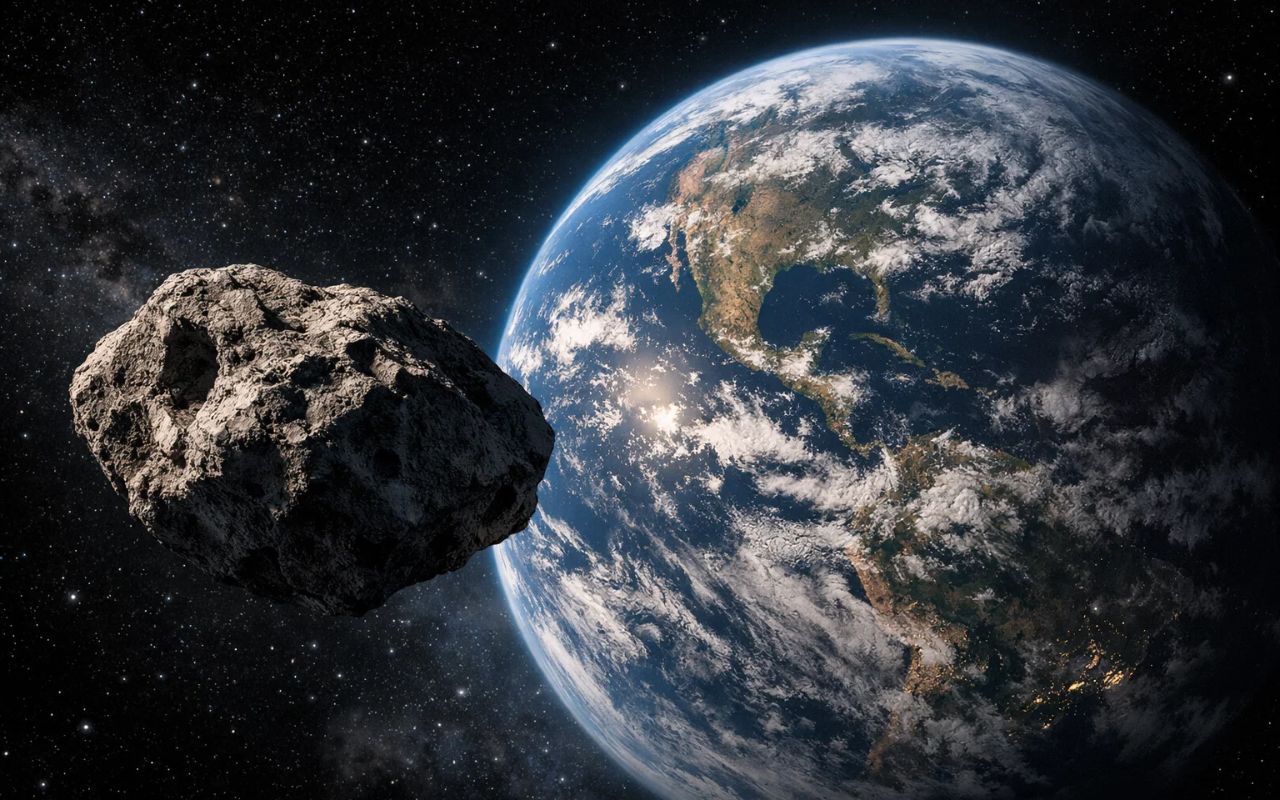
Asteroid 2026 FM3 approaches Earth this Tuesday (24), but NASA assures there is no impact risk and monitors trajectory.
An asteroid identified as 2026 FM3 will make a close approach to Earth this Tuesday (24), at 11:07 PM (Brasilia time), according to NASA.
The object, which is similar in size to a car, was detected just a few days earlier by an astronomical project in the United States.
Despite the proximity, scientists assure that there is no risk of collision, as the space rock will pass at a safe distance from the planet. The observation reinforces the importance of the constant monitoring of these celestial bodies.
-
Seen from space, a colossal ‘Y’ cuts through the largest desert in China, blending a jade-filled river, red and white mountains, and revealing the absurd scale of the transformation of the Taklamakan surrounded by a green wall with billions of trees.

-
The Pacific Ocean reveals what the cliffs of Big Sur have hidden for millennia: Pfeiffer Beach, in California, features swirling purple sand formed by garnet crystals and displays a stone arch that is illuminated by the sun in winter for just a few days each year.

-
Aursjøvegen in Norway is a 100-kilometer gravel road that crosses chasms and dark tunnels carved into the rock at an altitude of 947 meters in the fjords and is only open for four months a year.

-
With about 4,000 m², the building constructed in a traditional neighborhood in France looks like a rainbow, has a colorful facade, mixes vibrant glass, and creates one of the most unusual visuals in Bordeaux.


Asteroid 2026 FM3 passes near Earth without risk, NASA says
According to NASA, the asteroid 2026 FM3 will pass about 237 thousand kilometers from Earth, which is just over half the distance between the planet and the Moon. Although it seems close, this interval is considered safe within astronomical standards.
In addition, the object travels at an impressive speed of over 18 thousand km/h. Even so, it poses no threat, as its trajectory has already been analyzed with precision.
A few hours after this passage, the asteroid will head towards the Moon, maintaining an even greater distance, posing no risk to either celestial body.
NASA explains asteroid size and impact on Earth
The asteroid 2026 FM3 measures between 4 and 8 meters in diameter, being classified as small in spatial terms. For comparison, experts consider only objects larger than 140 meters to be dangerous.
Therefore, NASA does not include this type of rock on the list of threats to Earth. Even in a hypothetical impact scenario, the Earth’s atmosphere would act as a natural shield.
Thus, the most likely outcome would be the complete burning of the object before it reaches the ground. This phenomenon usually generates what we know as “shooting stars.”

Studies show that the asteroid 2026 FM3 follows an almost circular orbit around the Sun. During this journey, it crosses the orbit of Earth twice a year.
The complete cycle of this movement lasts approximately 354 days. This means that the object has made several close passes to the planet over the decades.
The closest recorded approach occurred in 1965, when the asteroid came within just over 49 thousand kilometers of Earth, a distance considered small in space.
NASA’s asteroid monitoring grows every year
Currently, NASA is tracking over 41 thousand near-Earth objects (NEOs). These bodies include asteroids and comets that pass relatively close to the planet.
With advancements in technology, this number is expected to grow. New telescopes, such as those recently installed in Chile, are expanding the capacity to detect objects in the Solar System.
In addition, modern systems allow for precise calculations of each asteroid‘s trajectory, ensuring greater safety and predictability.
The passage of the asteroid 2026 FM3 highlights the relevance of continuous observation of space. Each approach provides important data to understand the behavior of these objects.
According to NASA, there is no forecast of large asteroid impacts on Earth in the next 100 years. Nevertheless, studies continue to prevent possible future risks.
Additionally, space agencies conduct simulations and develop technologies to deflect dangerous objects if necessary.

Earth remains safe despite asteroid approach
Even with the increase in the number of discoveries, experts emphasize that there is no cause for concern. The vast majority of monitored asteroids pose no real risk.
In the case of asteroid 2026 FM3, its small size and already known trajectory ensure total safety for Earth.
Therefore, events like this should be seen as scientific opportunities. They help to expand knowledge about the universe and strengthen planetary defense strategies conducted by NASA.
Source: Olhar Digital









Seja o primeiro a reagir!