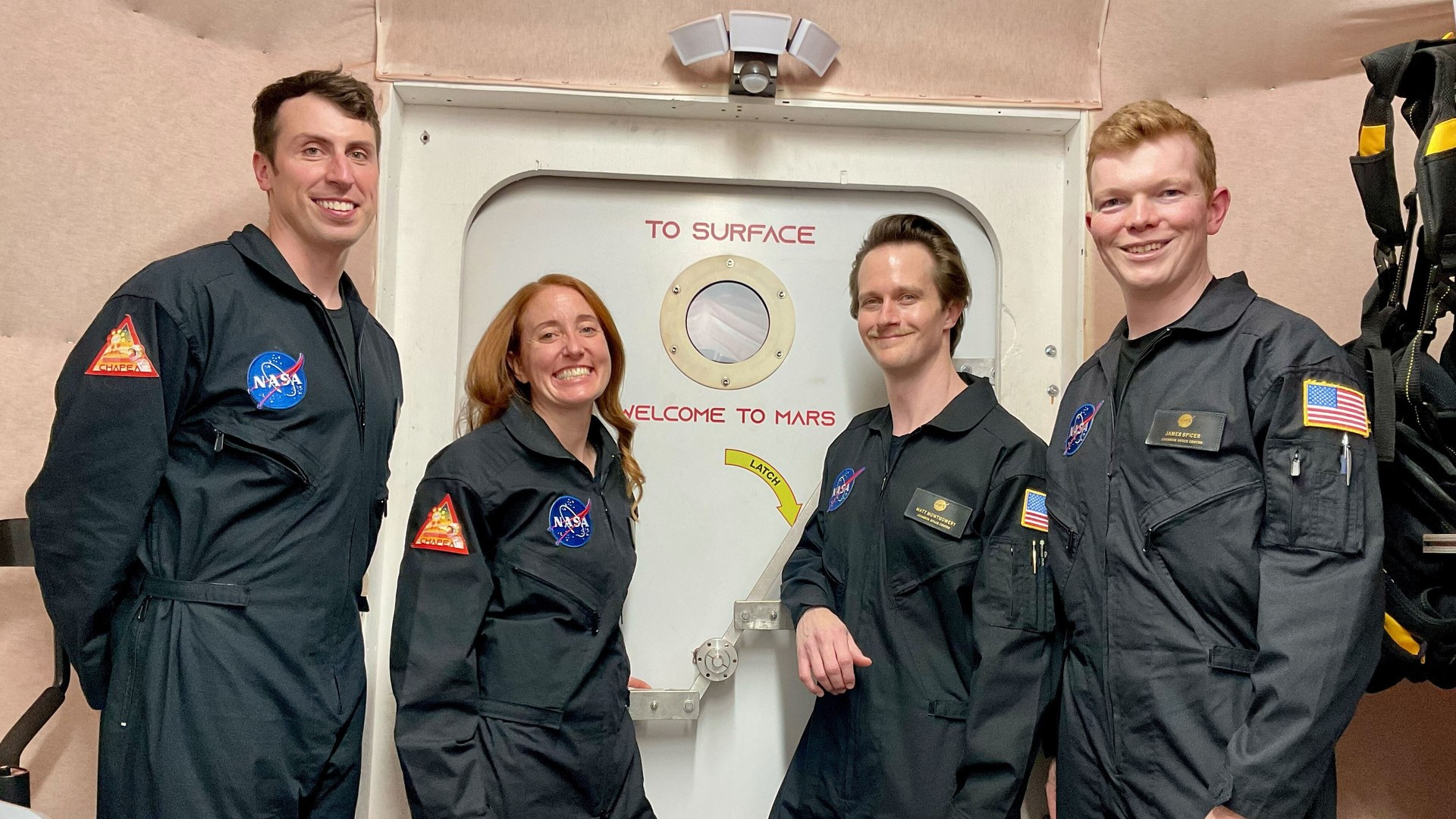

Commander Ross Elder, medical officer Ellen Ellis, science officer Matthew Montgomery and flight engineer James Spicer walked out of NASA’s CHAPEA habitat in Houston on October 31, ending a 378-day simulated mission to Mars.
The four volunteers had been sealed inside the habitat at NASA’s Johnson Space Center since October 19, 2025. NASA scheduled the exit for 3 p.m. Eastern time and streamed the ceremony live.
The door opened on the second crew of the Crew Health and Performance Exploration Analog, or CHAPEA, a series of year-long missions that copy daily life on the surface of Mars without leaving Texas.
For the four of them, it was the first step outside in more than a year. NASA said media would be able to capture the moment the crew left the building.
-
NASA JPL researcher Yang Liu and a team of scientists dated Teghaza 001, a 798.5-gram meteorite picked up in the Sahara in 2022, to at least 4.1 billion years, one of the oldest pieces of Mars ever found on Earth

-
Archaeologists led by Pompeii director Gabriel Zuchtriegel found a wardrobe left untouched since AD 79, holding 38 bronze coins, a necklace of at least 24 childhood charms and the bones of two young mice
-
Astronomer Matthew Holman spotted a possible dwarf planet up to 1,500 km wide beyond Pluto in Vera C. Rubin Observatory data, an object that hid among millions of stars for more than 10 years
-
Mission scientists at ESA saw the 151-metre asteroid Dimorphos as a separate dot for the first time from 1,280 km away, four years after NASA’s DART probe slammed into it at 6.1 km per second


A 1,700-square-foot house printed for Mars
The crew lived in a structure of about 1,700 square feet, built with a 3D printer instead of bricks or panels. NASA calls it a model of what a future surface habitat could look like.
The walls were printed by ICON’s Vulcan construction system. The layout separates the areas where the crew sleeps and eats from the areas where they work and run experiments.
NASA argues that printing shelters on another planet could avoid launching large amounts of building material from Earth, which the agency describes as cost prohibitive for long missions.
The habitat sits inside a hangar at Johnson. Its door to the outside world is labeled “To Surface,” and a sign beside it reads “Welcome to Mars.”
378 days, the same as the first crew
The mission length was not random. The first CHAPEA crew lived in the same habitat from June 25, 2023, to July 6, 2024, in a mission NASA also planned for 378 days.
NASA describes CHAPEA as a series of missions that simulate year-long stays on the Martian surface, the kind of stay a real expedition could require before the trip home.
The second crew passed day 200 in May and marked one full year on October 19, 2026, when NASA published a progress update from inside the habitat.
Marswalks on red sand inside a building
The crew only left the living quarters for simulated “Marswalks.” They put on spacesuits and walked into an area next to the habitat filled with red sand.
Even then, they stayed inside the building that houses CHAPEA. The isolation never broke, and the walks followed the same procedures a real surface crew would use.
Their routine also included robotic operations, habitat maintenance, physical exercise and growing crops, all at what NASA called a high tempo for the full length of the mission.

Messages that took up to 22 minutes
The hardest part of the job was not physical. NASA built 22-minute communication delays into the mission, to mimic the distance a real crew on Mars would have to deal with.
The crew only spoke with their families by email, with the same Mars-style delay. A quick question to mission control could take most of an hour to get an answer.
The crew also went through a simulated two-week communication blackout, which they described in one of the audio logs NASA released during the mission.
NASA says the data will help it design decision support for crews facing delays of up to 45 minutes each way, a scenario the agency expects on future long-duration missions.
Stress was part of the experiment
Researchers deliberately added problems. The crew dealt with limited resources, long isolation and equipment failures, the kinds of setbacks that could hit a real expedition far from help.
“These crewmembers will help provide foundational data for mission planning and vehicle design,” principal investigator Grace Douglas said when the mission began in October 2025.
The goal, she said, is to understand which resources, methods and technologies best support health and performance within the constraints of living on Mars.
Two weeks of tests after the door opened
Leaving the habitat did not end the work. NASA said the four would begin two weeks of post-mission evaluations and debriefs with agency scientists after reuniting with their families.
Science teams had already prepared to process the health and performance data collected over the year, according to NASA’s update on the one-year mark.
“We are extremely proud of the crew for their commitment and achievements over the last year on such a fast-paced, highly demanding mission,” Douglas said in that update.
Food, exercise and the Deep Space Network
NASA lists practical uses for the results. The data can help optimize the food system, plan crew time and manage bandwidth on the agency’s Deep Space Network.
It could also show how limited food and exercise systems affect a crew’s ability to carry out surface spacewalks, one of the main objectives of any Mars mission.
Flight doctors and psychologists are another audience. NASA says the findings can strengthen medical care and behavioral support for crews that cannot talk to Earth in real time.
From a hangar in Houston to the Moon
“This mission has been incredibly valuable in starting to teach us how to understand requirements for year-long missions,” said Michael Stenger, chief scientist of NASA’s Human Research Program.
Stenger said the lessons will be translated to Moon Base and beyond. NASA also links the data to its Artemis program, which aims to return astronauts to the lunar surface.
The agency is already taking applications for a new Moon and Mars Exploration Analog, another year-long experience that will start no earlier than August 2027, Engadget reported.
Four people, one small house, one long year
NASA calls the four research volunteers. The agency says each CHAPEA crew is formed by four members, with two alternates selected in case someone cannot go in.
Inside, Elder led the mission as commander, Ellis handled medical duties, Montgomery ran the science program and Spicer kept the habitat’s systems working as flight engineer.
What the year on Earth says about Mars
Mars research keeps producing surprises, from the oldest rocks to new clues about water, like the Teghaza 001 meteorite dated to at least 4.1 billion years this week.
CHAPEA studies the people instead of the planet. NASA has not yet published results from the second mission, and the post-mission debriefs are only starting now.
After 378 days in a printed house with delayed emails and red sand outside the door, would these four sign up for the real trip to Mars?