





 Portuguese
  English
  Spanish
  6 min of reading
  0 comments


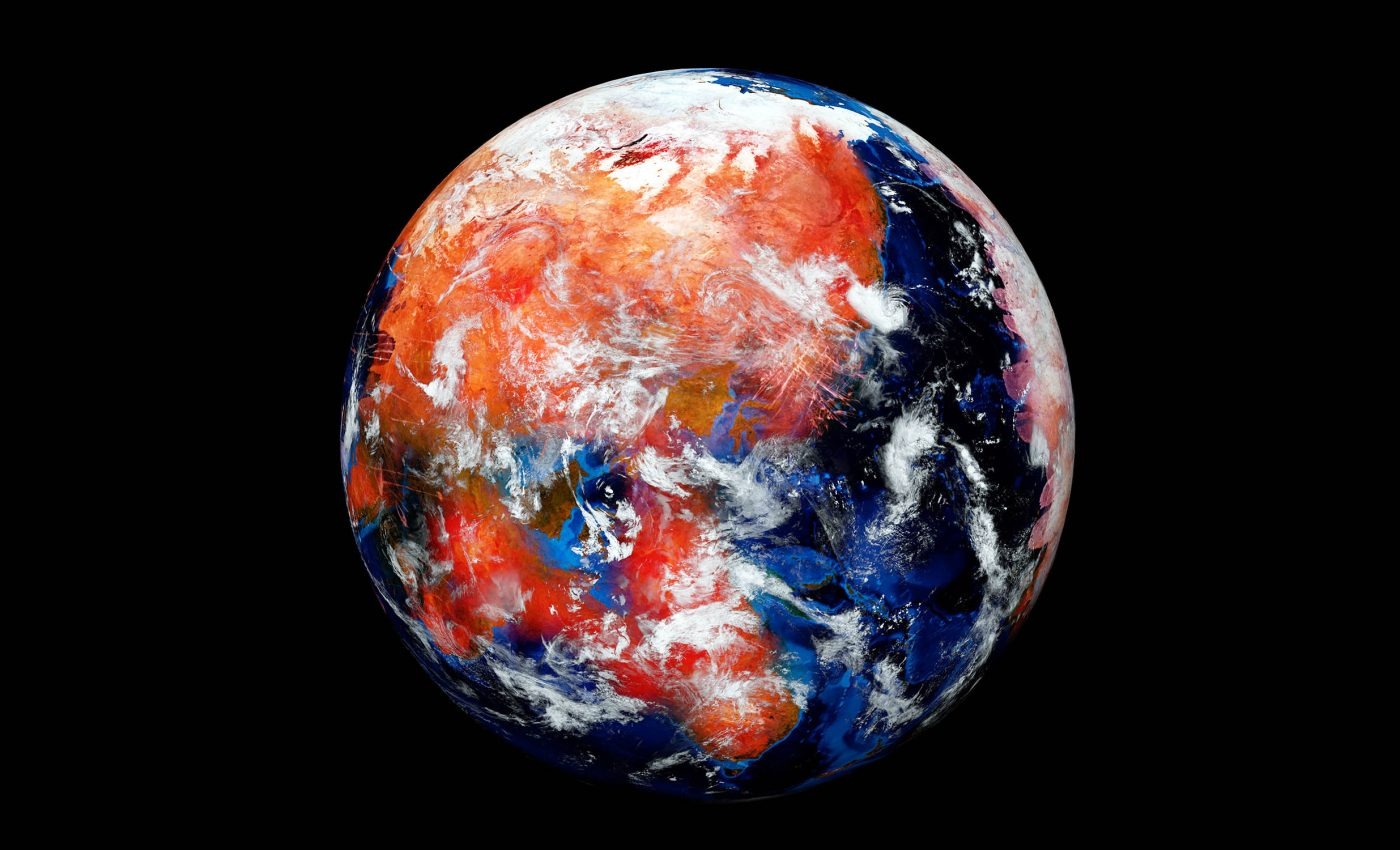
New Data From the MAVEN Mission Show How the Progressive Loss of the Martian Atmosphere, Caused by Solar Wind, Cathodic Sputtering, and Hydrogen Escape, Explains the Transition of Mars From a Planet With Lakes, Rivers, and Possible Seas to the Cold, Rarefied Desert Observed Today
NASA has presented new results from the MAVEN mission showing that Mars has lost its atmosphere over billions of years due to continuous escape into space, a process that explains the transition from a planet with liquid water to a red desert and alters the understanding of its ancient habitability.
The latest data from NASA’s MAVEN mission indicates that the Martian atmosphere has been escaping into space for billions of years, a process directly linked to the transformation of the planet from a humid environment to the arid landscape observed today.
The measurements relate Mars’ watery past to active mechanisms in the upper atmosphere, where energetic particles from the solar wind interact with upper gases, progressively removing the elements that sustained liquid water on the surface.
-
While the world looks at oil, the war with Iran is already disrupting helium supply from Qatar, affecting car and iPhone chips, threatening AI expansion, and putting pressure on aluminum packaging at the highest value in four years.

-
Global warming will expose a treasure hidden under the ice of Antarctica and may spark an international dispute over gold and valuable minerals.

-
A street vendor from Praia Grande built a robot made of scrap from scooters and washing machines that pulls his popcorn cart on the beach, emits sounds, and interacts with customers, becoming an attraction on the coast of São Paulo.

-
The specifications of the Xiaomi 18 Pro Max have been leaked, and the highlight is a dual 200 MP camera with a new 22-nanometer technology that promises to consume less energy and capture details in shadows and bright areas using LOFIC HDR.

This set of observations reinforces the hypothesis that Mars was once a world more similar to Earth, with a denser sky and stable surface water, before losing much of its atmospheric protection.
The work is led by Shannon Curry, a planetary physicist at the University of Colorado Boulder and principal investigator of NASA’s MAVEN mission, which studies how solar wind and radiation remove planetary atmospheres over time.
According to NASA, Mars currently has about half the size of Earth, with a radius of 3,392 kilometers, and has a day lasting about 24.6 hours, a value close to Earth’s.
The planet completes an orbit around the Sun every 687 Earth days, which makes its seasons longer due to the tilted rotation axis, a characteristic similar to that of Earth.
Mars orbits, on average, at a distance of 1.5 astronomical units from the Sun, a standard measure based on the distance between Earth and the Sun, with sunlight taking approximately 13 minutes to reach its upper atmosphere.
These current conditions contrast with geological evidence of a past marked by liquid water, including river valleys, lake basins, and a canyon system over 4,800 kilometers long carved into the Martian crust.
Orbital images analyzed by NASA show that these structures are difficult to explain without long periods of surface water flow under an atmosphere significantly denser than the one that exists today.
In the equatorial region, NASA’s Curiosity rover has drilled sedimentary rocks in Yellowknife Bay, located within Gale Crater, revealing clay-rich siltstone.
These rocks record the existence of a long-lasting lake with neutral pH, low salinity, and the presence of basic chemical ingredients that simple microbes could have utilized.
According to NASA, these features indicate environmental conditions compatible with elementary forms of microbial life, similar to those found in ancient aquatic environments on Earth.
Further north, the Perseverance rover is currently exploring an ancient delta in Jezero Crater, formed by sediments deposited where a river once fed a crater lake in the past.
Scientists selected Jezero as a landing site because deltas often preserve organic molecules and very fine grains, capable of recording traces of possible ancient microbial life.
Together, the records from Gale Crater and Jezero Crater support the scenario that large bodies of stagnant water covered parts of Mars for long periods.
With a thicker atmosphere and greater amounts of water vapor, these lakes and possible small seas would have given the planet a bluish appearance when observed from space.
NASA emphasizes that conditions such as neutral water, moderate salinity, and availability of chemical energy are considered basic for many microbes on Earth, reinforcing astrobiological interest.
Finding this combination in Martian rocks keeps researchers focused on identifying other preserved environmental clues in the vicinity of these ancient aquatic formations.
Geologists interpret the stratified sediments in Gale and Jezero as records of repeated cycles of wet and dry conditions over Martian geological time.
These layers help reconstruct the planet’s climatic transition, from periods with stable surface water to phases where the climate began to progressively dry.
Loss of Magnetic Protection and Exposure to Solar Wind
Early in its history, Mars likely had a global magnetosphere, a region shaped by a magnetic field capable of deflecting charged particles coming from the Sun, according to NASA.
This protection would have limited atmospheric erosion, allowing for the maintenance of a dense atmosphere and favorable conditions for the presence of liquid water on the surface.
When the magnetosphere disappeared over 4 billion years ago, the upper atmosphere became exposed to the full force of the solar wind, intensifying escape processes.
One of the main mechanisms identified is atmospheric sputtering, in which energetic particles collide with atmospheric atoms and launch them into space.
On Mars, this process involves primarily heavy ions from the solar wind, which collide with the upper atmosphere along the lines of the remaining magnetic field.
At the same time, MAVEN observations show that water molecules reaching the upper layers of the atmosphere break apart, releasing hydrogen that escapes into space.
This hydrogen escape occurs more intensely during global dust storms and at certain times of the Martian year, according to NASA data.
A recent study cited by the agency indicates that these variations in hydrogen loss currently dominate the continuous water escape from Mars, influencing its climatic evolution.
Cathodic Sputtering Observed Directly
In a recent analysis, Curry and her colleagues used MAVEN argon measurements to map regions where cathodic sputtering occurs in the Martian atmosphere.
The results show that heavy solar wind ions are actively stripping atoms from the atmosphere, directly confirming a process previously inferred only by isotopic ratios.
“These results establish the role of cathodic sputtering in the loss of Mars’ atmosphere and the determination of Mars’ water history,” said Shannon Curry, according to NASA.
The comment connects subtle processes in the upper atmosphere to extreme climate changes recorded in ancient dry valleys and lakebed surfaces on the planet.
By combining the current rate of atmospheric erosion with models that consider a more intense solar wind from the young Sun, researchers assess that much of the original atmosphere has been removed.
This loss would have reduced surface pressure to levels insufficient for liquid water to remain stable for long periods, accelerating the planet’s desertification.
Thin Atmosphere and Current Extreme Climate
Currently, the Martian atmosphere is extremely thin and primarily composed of carbon dioxide, with small amounts of nitrogen, argon, and oxygen.
With so little atmosphere above the surface, the sky appears hazy and reddish due to suspended dust, as described by NASA.
Radiation from space reaches the surface more intensely than on Earth, as atmospheric and magnetic protection is limited.
Surface temperatures vary widely, with highs approaching 70 degrees Fahrenheit on rare days and lows of about -225 degrees Fahrenheit in polar regions.
Even near the equator at noon, a thermometer close to the ground may indicate around 75 degrees Fahrenheit, while another at head height barely reaches freezing, according to NASA.
Mars no longer has an active global magnetic field crossing its core; only areas of strongly magnetized crust remain in the southern highlands.
These regions are considered relics of a time when the planet’s interior was more active, before the loss of the global magnetosphere.
Implications for Habitability and Future Studies
The history outlined by MAVEN data describes a planet that began with blue lakes and possibly small seas but gradually lost the conditions necessary to maintain them.
NASA assesses that habitability on Mars likely restricted itself to the period before the majority of the atmosphere dispersed, when systems like Gale and Jezero were still active.
The rovers Curiosity and Perseverance, along with the MAVEN probe, seek to determine how long this window of favorable conditions remained open.
They analyze the chemical composition of sedimentary rocks, salts, and the structure of the upper atmosphere to understand the duration and stability of these ancient environments.
If future analyses reveal convincing biosignatures, this would indicate not only that life existed on Mars but also that there was sufficient time for its development.
Understanding how Mars transitioned from a blue world to a red desert also helps researchers assess the ability of exoplanets to maintain atmospheres and surface water.
According to NASA, the Martian case demonstrates that seemingly stable planetary climates can be fragile when the balance between magnetic protection, solar activity, and internal heat is lost, a central lesson for modern planetary science.








-

3 pessoas reagiram a isso.