





 Portuguese
  English
  Spanish
  3 min of reading
  0 comments


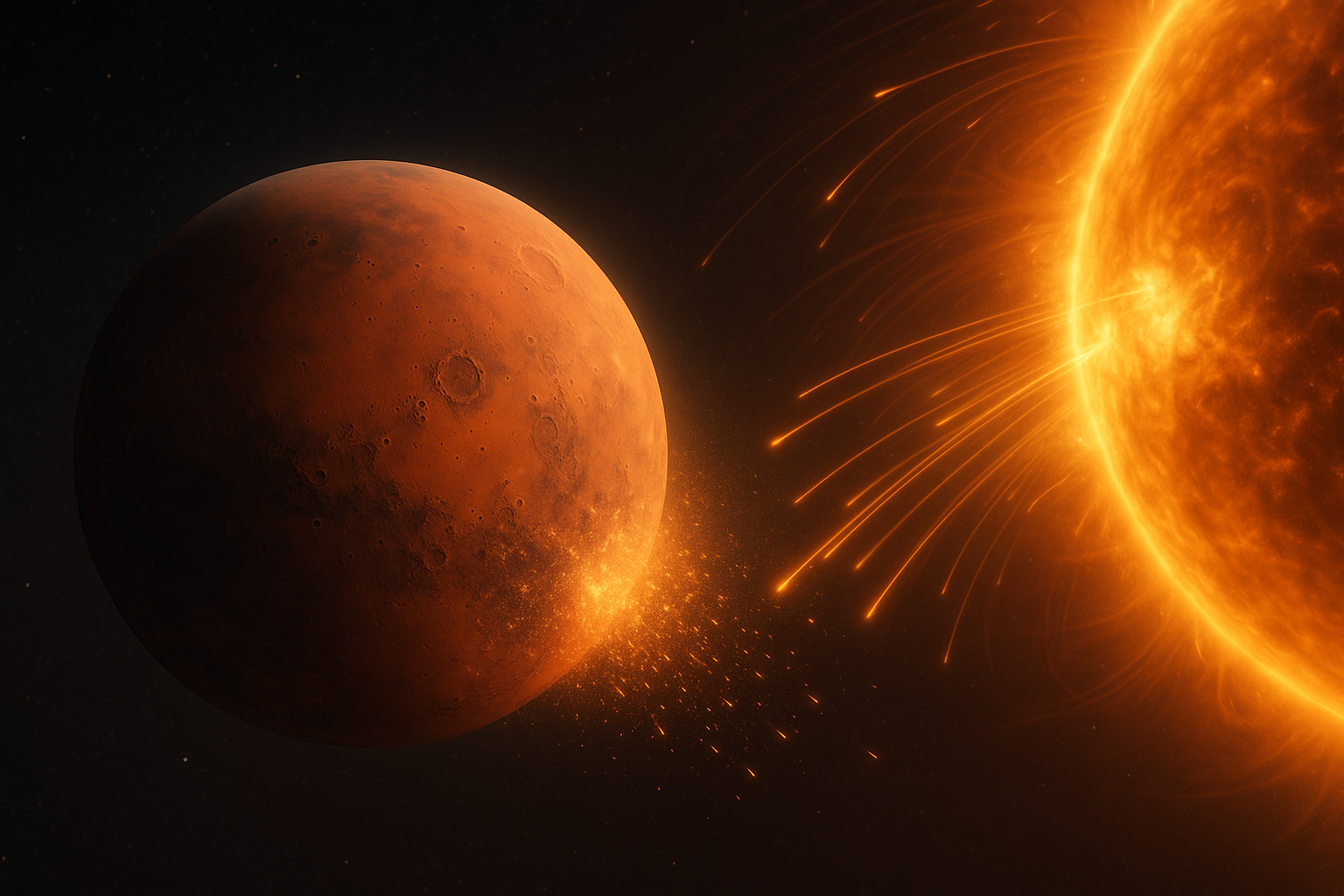
Mars Atmosphere – MAVEN Mission Records Cathodic Sputtering on Mars for the First Time, Explaining How the Planet Lost Its Atmosphere and Ability to Host Liquid Water.
Mars has just revealed one of its oldest mysteries. For the first time, the NASA directly observed the cathodic sputtering process in the atmosphere of the red planet. The discovery was made by the MAVEN mission, after years of detailed observations and analyses.
What Is Cathodic Sputtering
Cathodic sputtering occurs when charged particles from the solar wind hit the Martian atmosphere with high energy.
This violent impact launches atoms and molecules into space. For a long time, scientists suspected that this phenomenon contributed to the loss of Mars’ atmosphere, but they had never been able to capture the event in real-time.
-
Motorola launched the Signature with a gold seal from DxOMark, tying with the iPhone 17 Pro in camera performance, Snapdragon 8 Gen 5 that surpassed 3 million in benchmarks, and a zoom that impresses even at night.

-
Satellites reveal beneath the Sahara a giant river buried for thousands of kilometers: study shows that the largest hot desert on the planet was once traversed by a river system comparable to the largest on Earth.

-
Scientists have captured something never seen in space: newly born stars are creating gigantic rings of light a thousand times larger than the distance between the Earth and the Sun, and this changes everything we knew about stellar birth.

-
Geologists find traces of a continent that disappeared 155 million years ago after separating from Australia and reveal that it did not sink, but broke into fragments scattered across Southeast Asia.

Shannon Curry, the principal investigator of MAVEN at the Laboratory for Atmospheric and Space Physics at the University of Colorado Boulder, explained the dynamics of the process.
“It’s like doing a cannonball in a swimming pool,” she said. In this case, the cannonball would be the heavy ions colliding with the atmosphere and scattering its components.
Previous Clues Had Already Pointed the Way
Before this direct observation, scientists had only indirect evidence of cathodic sputtering. One of those pieces of evidence was the imbalance between the isotopes of argon in the Martian atmosphere.
The lighter isotopes are found at higher altitudes, and their absence suggested that they were being expelled into space.
This imbalance acted like the ashes of a campfire, in Curry’s words. Researchers saw the result of the phenomenon, but had yet to record its occurrence. Now, with the new measurements from MAVEN, they have been able to see the “fire” in action.
The Direct Observation with MAVEN
To capture this event, the team used three instruments from MAVEN: the Solar Wind Ion Analyzer, the Magnetometer, and the Ion and Neutral Gas Mass Spectrometer.
The measurements needed to be taken on both the day side and the night side of Mars, at very low altitudes, which required years of monitoring.
By combining the obtained data, the researchers created the first detailed map relating sputtered argon to the impact of the solar wind.
The map clearly showed the presence of argon atoms at altitudes where energetic particles hit the atmosphere.
The Intensity Surprised Scientists
The results showed that the cathodic sputtering process occurs at a rate four times higher than previously predicted.
The activity also increases during solar storms, making the phenomenon even more intense.
This discovery reinforces the idea that cathodic sputtering played a crucial role in Mars’ atmospheric loss, especially in its early years, when the Sun was much more active.
According to Curry, “these results establish the role of cathodic sputtering in the loss of Mars’ atmosphere and in determining Mars’ water history.”
The discovery fills an important gap in understanding how the planet went from a potentially habitable environment to the cold and dry scenario we see today.
The findings were published this week in Science Advances.








Seja o primeiro a reagir!