





 Portuguese
  English
  Spanish
  5 min of reading
  0 comments


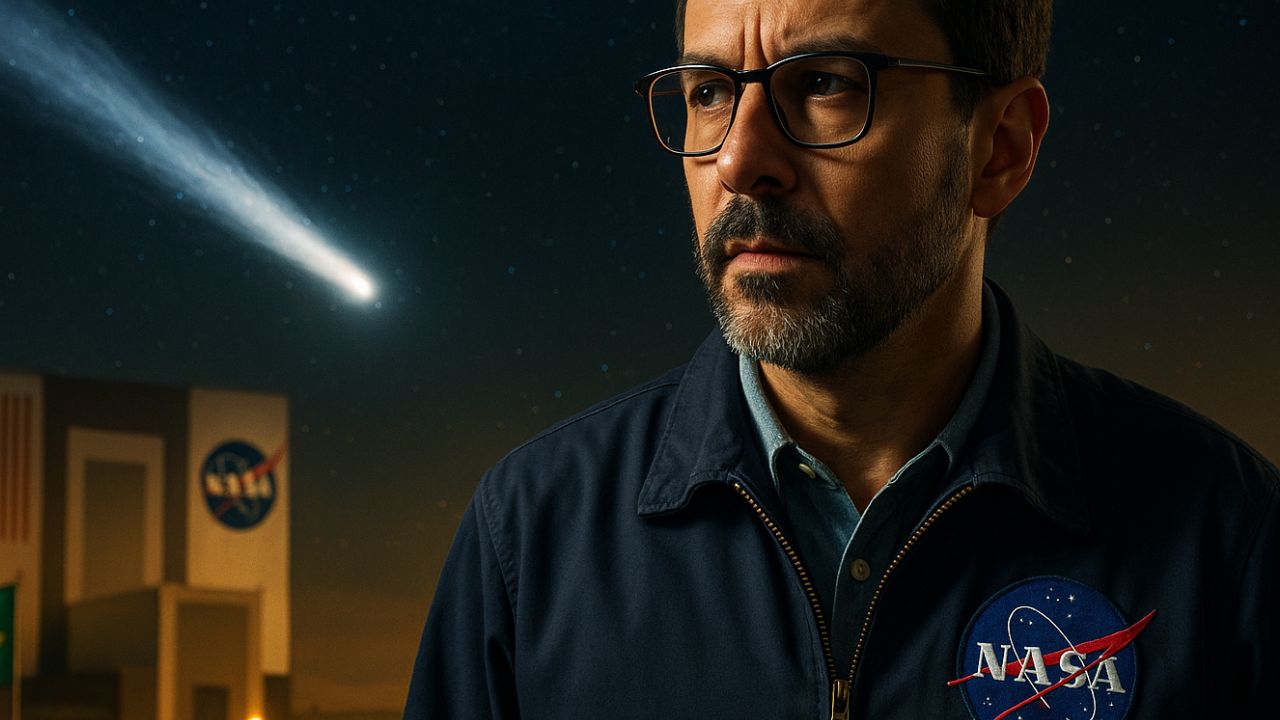
While The Object From Another Solar System Approaches Earth, The Apparent Lack Of Communication From The Space Agency Generates Debates. Understand The True Position Of 3I/ATLAS NASA On The Phenomenon.
According to the Unknown Facts portal, the month of October is crucial for observing 3I/ATLAS, the third interstellar object detected in our Solar System. Its passage has mobilized the scientific community and sparked public curiosity, but one question echoes on social media: why does the American space agency seem so quiet? Amid a barrage of news and speculation, the cautious stance of 3I/ATLAS NASA is interpreted by many as a suspicious silence, raising theories about a possible cover-up of information.
This article dives into the heart of this controversy to understand what is actually happening. We will analyze the difference between the agency’s standard scientific communication and the frenzy of hypotheses dominating the public debate. Is NASA really hiding something about 3I/ATLAS, or is its stance a standard procedure in the face of astronomical events of this magnitude? The answer lies in analyzing the facts, data, and official statements.
The Discovery And The Immediate Uproar
The journey of 3I/ATLAS in our knowledge began in July 2025, when it was identified by the ATLAS (Asteroid Terrestrial-impact Last Alert System) project. Curiously, although the project’s telescopes are operated by the Institute of Astronomy at the University of Hawaii, the initiative was funded by NASA itself. This means the agency has been present from the very beginning, a fact that, according to Unknown Facts, makes its supposed subsequent distancing even more intriguing to the public.
-
Global warming will expose a treasure hidden under the ice of Antarctica and may spark an international dispute over gold and valuable minerals.

-
A street vendor from Praia Grande built a robot made of scrap from scooters and washing machines that pulls his popcorn cart on the beach, emits sounds, and interacts with customers, becoming an attraction on the coast of São Paulo.

-
The specifications of the Xiaomi 18 Pro Max have been leaked, and the highlight is a dual 200 MP camera with a new 22-nanometer technology that promises to consume less energy and capture details in shadows and bright areas using LOFIC HDR.

-
If the trip to the Moon were a hoax, it would be necessary to keep the secret among 400,000 people for more than 50 years and to deceive even the Soviet Union, which was tracking the radio signals coming from the exact direction of the satellite during each Apollo mission.


As only the third interstellar object ever recorded, its discovery was met with enormous enthusiasm. Scientists around the globe saw a unique opportunity to study a celestial body coming from outside our cosmic “neighborhood.” However, it wasn’t long before scientific enthusiasm gave way to bolder theories. The hypothesis of it being an alien spacecraft, something many thought but few dared to say, quickly gained traction, fueled by analyses that strayed from the initial consensus.
The Alien Hypothesis: The Role Of Avi Loeb
In this scenario of speculation, scientist Avi Loeb from Harvard University took a prominent role. Just weeks after the discovery, he published a scientific paper exploring the possibility of 3I/ATLAS being an artificial and technological object. According to Unknown Facts, Loeb raised points that, if confirmed, would indicate that we were dealing with an artifact rather than a comet. One of his main concerns was that the object’s perihelion, its closest point to the Sun, would occur on the opposite side of Earth, preventing detailed observations at the time of its greatest activity.
However, the scientific method itself began to test Loeb’s hypotheses. One of his main premises was that the absence of a comet tail would be a strong indication of artificiality. Shortly thereafter, observations made by the DECam South telescope in Chile confirmed that 3I/ATLAS has a cometary tail, significantly weakening this line of reasoning. Scientist Karen Meech, from the same institute that discovered it, stated that the confirmation was received with relief and enthusiasm by the community, which predominantly already treated it as an interstellar comet.
What Does NASA Really Say About 3I/ATLAS?

Here lies the crux of the matter: NASA is not silent. What exists is a radically different approach from that seen in debate forums and parts of the media. From the beginning, the agency treats 3I/ATLAS as a natural interstellar object, maintaining a cautious discourse strictly based on verifiable data. On its official website, one can find public information about the orbit, size, composition, and behavior of the comet, available for anyone to consult.
What NASA does not do — and this is the source of the perception of “silence” — is enter the realm of speculation. The agency avoids commenting on theories about alien origins or unproven dangers due to a lack of scientific evidence to support them. In a report to the The Guardian, cited by Unknown Facts, NASA’s chief scientist, Tom Statler, was clear: “It [3I/ATLAS] has some interesting properties that are a bit different from the comets in our solar system, but it behaves like a comet. Therefore, the evidence overwhelmingly points to the idea that this object is a natural body.”
Perception Vs. Reality: Why Is The “Silence” Noted?
What seems to be an information concealment is, in fact, a fairly common pattern in scientific communication. The NASA, as an institution, is committed to sharing what is measured, confirmed, and peer-reviewed. Entering debates on extraordinary hypotheses without extraordinary evidence would be irresponsible and could create unnecessary alarmism. The informational noise created by hundreds of daily news articles, opinion pieces, and speculative videos gives the false impression that “everyone” is talking about the most fantastic possibilities, except for the agency that should lead the conversation.
This dissonance creates a vacuum filled with distrust. The truth, however, is that while many debate the “what if,” NASA has its telescopes pointed at the sky, collecting data. The agency prioritizes its own confirmed research, avoiding taking positions based on conditional scenarios. The case of the comet tail is a perfect example: while its absence was used to speculate, the proof of its existence, obtained through observation, resolved the issue factually, exactly as science works.
Scientific Caution Or Excessive Speculation?
The controversy surrounding the silence of 3I/ATLAS NASA reveals more about how we consume information than about a supposed conspiracy. The space agency follows its strict protocol: observe, analyze, and publish only what the data confirms. Meanwhile, popular imagination, fueled by decades of science fiction, longs for a confirmation that science, by its nature, cannot yet provide. What we know is that October will be a decisive month to uncover the secrets of this interstellar visitor.
And you, which side of this debate do you stand on? Do you believe in NASA’s scientific and methodical caution or do you think the bolder hypotheses about 3I/ATLAS deserve more attention from the agency? Leave your real opinion on the case in the comments, we want to understand how you perceive this story.




-

-

-

-

-

-

29 pessoas reagiram a isso.