





 Portuguese
  English
  Spanish
  3 min of reading
  0 comments


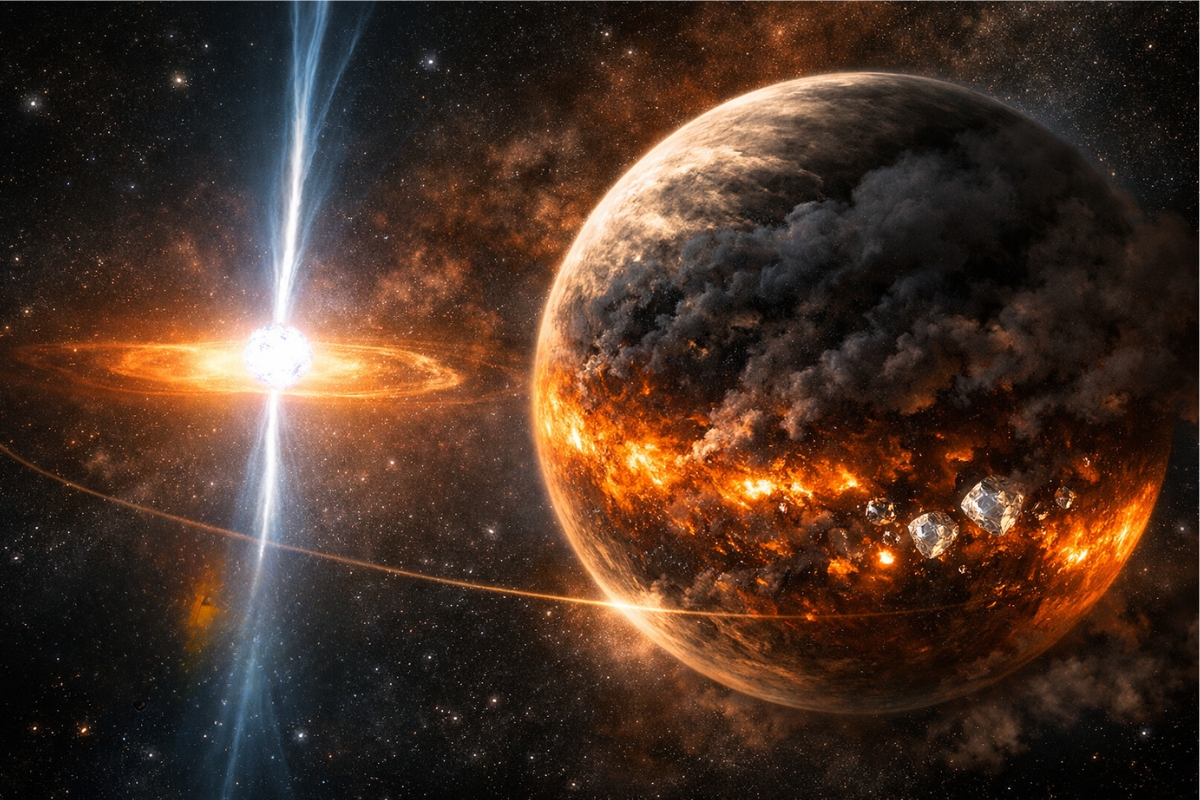
The Analysis of James Webb Revealed an Atmosphere Dominated by Helium and Carbon, an Uncommon Scenario That Puts Current Planetary Formation Models Under Pressure
NASA observed an exoplanet with an atmospheric composition so different that it became a new benchmark for planetary science. The object was named PSR J2322−2650b and appears as a Jupiter-like mass world, orbiting an extreme type of star called a pulsar.
The finding garnered attention because the atmosphere deviates from the pattern seen in more studied exoplanets. Instead of common molecules, signals of molecular carbon emerged along with an environment that could form sooty clouds and even diamonds inside the planet.
What Happened and Why It Attracted Attention
The observation was announced on December 16, 2025 and became a milestone by showing a type of atmosphere that practically does not appear on other analyzed worlds.
-
(VIDEO) Cameras from an astronomical observatory captured two meteors falling over Santa Maria in Rio Grande do Sul with only a one-minute difference and such close trajectories that scientists are now investigating whether the two objects have the same origin.

-
Fireballs shoot across the skies of the USA and meteor explosions draw attention: what is causing this mysterious wave of sightings?

-
Brazil has quietly developed an electric tactical drone that takes off and lands vertically without needing a runway, flies at 140 km/h in a fully autonomous manner, and can operate in forests, conflict zones, and remote areas.

-
Novo drone Guardian debuts in the United States with an 8-mile range, robotic battery swapping, and Starlink connectivity for continuous response.


The system is unusual because the planet orbits a pulsar, a rapidly spinning neutron star that emits beams of radiation. This alters the lighting scenario and allows the planet to be studied with a cleaner infrared spectrum.

Why the Atmosphere Is Considered So Out of the Ordinary
The reading from James Webb found an atmosphere dominated by helium and carbon, with the presence of molecular carbon, including C3 and C2.
This type of carbon appears as dominant when there is almost no oxygen and nitrogen in the environment, a rare combination for planetarily observed atmospheres so far.
Additionally, the scenario includes sooty clouds in the atmosphere and the possibility of carbon condensing in deep layers, forming diamonds.
How the Orbit Works and Why the Planet Has a Lemon-Like Shape
The planet is in an extremely tight orbit, just 1 million miles from the pulsar.
The year of this world is short to the point of seeming unreal, with a complete cycle around the star taking 7.8 hours.
This proximity creates intense gravitational forces and stretches the planet, leaving the body with a shape described as lemon, a direct result of the pulsar’s gravitational tides.
Extreme Temperatures Help Explain the Unusual Chemistry
The estimated temperatures range from 1,200 degrees Fahrenheit in the coldest regions of the night side to 3,700 degrees Fahrenheit in the hottest areas of the day side.
Under such conditions, carbon tends to react with other available elements. Therefore, the dominant presence of molecular carbon points to a very particular chemical scenario, with few atoms competing to bond with carbon.


What May Happen from Now On
The discovery paves the way for testing the limits of planetary formation models, especially in extreme environments like systems with pulsars.
The study was published in The Astrophysical Journal Letters, reinforcing that this type of atmosphere may represent a new category of worlds that have not been seen clearly before.
The exoplanet PSR J2322−2650b came onto the radar as a rare case, with helium and carbon dominating the atmosphere, C3 and C2 appearing in the spectrum, and an orbit so tight that it compresses the year into 7.8 hours.
In practice, this observation adds to the list of worlds that do not follow the classic script and underscores a simple message: the universe produces planets in conditions that are far more varied than models have traditionally predicted.








-

-

-

-

-

-

75 pessoas reagiram a isso.