





 English
  Francês
  Alemão
  Italiano
  Japonês
  Norueguês
  Portuguese
  Spanish
  4 min of reading
  0 comments



NASA image shows square formation of 3 km on Mars; scientists point to erosion, but almost perfect geometry still raises debate
According to images cataloged by the Arizona State University in the Mars Image Explorer and captured by the Mars Orbiter Camera of NASA’s Mars Global Surveyor in 2001, there is a geometric formation on the surface of Mars with angles close to 90 degrees and almost identical sides, about 3 kilometers long, which reignited a global debate in 2025 about its geological and geometric origin.
When the image circulated again on social media in February 2025, figures like Joe Rogan and Elon Musk amplified the discussion. The interest is not only in the appearance of the structure but in the central question that remains open: how can a natural formation exhibit such consistent symmetry on this scale?
Square formation on Mars: what the NASA image really shows on the Martian surface
The image recorded by the Mars Global Surveyor shows a structure located at the top of a crater, with defined contours and a geometry that approaches an almost perfect square.
-
350-year mystery may have been solved: remains of a soldier who inspired the hero of The Three Musketeers found beneath a church in the Netherlands.

-
Starlink breaks the barrier of 10,000 satellites in orbit and takes its expansion to an unprecedented level, with a direct impact on global internet, technological competition, and the race for space.

-
Japan finds an alternative to oil amid rising prices by transforming ocean balance into electricity with a new technology that maintains efficiency even when the sea changes.

-
Millions of bees were taken to the Sahara to curb the advance of the desert, but the heat melted the honeycombs and killed the hives, forcing scientists to find a much simpler solution: soil excavations to retain water and bring life back.


The highlight is not only in the overall shape but in the regularity of the angles and the similar length of the sides. Unlike common rock formations, the structure presents a consistent geometric pattern along its perimeter.
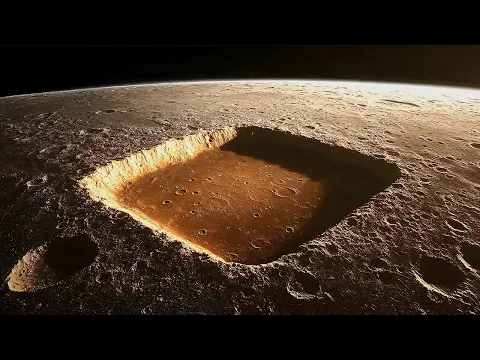

However, the image does not reveal internal details. There is no evidence of walls, compartments, or structural organization typical of artificial constructions. What is observed is an elevated edge that delineates an area with an unusual geometric appearance.
Scale of the structure on Mars exceeds more than 10 times the Pyramid of Cheops
The dimension of the formation reinforces scientific interest. With approximately 3 km on each side, it is about 13 times larger than the base of the Great Pyramid of Giza.
This comparison highlights the exceptional size of the structure. If it were an artificial construction, it would represent something unprecedented in the history of human engineering.

The scale, combined with the geometry, is the main factor that differentiates this formation from other natural structures observed on Mars.
Erosion, tectonic fracturing, and pareidolia: scientific explanations for the Martian formation
The dominant explanation among geologists combines known natural processes. The first is the fracturing of the Martian crust, which can generate geometric patterns when stresses act in perpendicular directions.
The second is differential erosion caused by winds over millions of years. This process can remove more fragile materials and preserve more resistant structures, creating apparent geometric shapes.
The third factor is pareidolia, a psychological phenomenon in which the human brain identifies familiar patterns in random shapes. This effect has been widely documented in other images of Mars.
Why pareidolia does not fully explain the symmetry of the structure on Mars
Although pareidolia explains many misinterpretations, it does not completely resolve the case of the square formation.

The central question is not only visual but geometric. When sides exhibit similar lengths and angles close to right angles, the explanation ceases to be merely perceptual and requires structural analysis.
This point keeps the debate open within the scientific community itself, especially regarding how often natural processes can generate such consistent symmetry on a large scale.
Comparison with the Face on Mars shows limits of image-based interpretations
The so-called “Face on Mars,” photographed in 1976, became a classic example of misinterpretation caused by low resolution and specific lighting.
Subsequent higher-quality images showed that the formation was merely an irregular rocky elevation. This case is often used as a reference to explain other supposed anomalies.
However, the square formation was recorded with significantly higher resolution, which reduces the likelihood of visual distortions caused by technical limitations of the original image.
Elon Musk, Joe Rogan, and the impact of viralization on scientific analysis of the image
The repercussion of the image in 2025 significantly broadened the scope of the debate. The involvement of public figures brought global attention to a record that had existed for over two decades.
This type of exposure alters the dynamics of scientific discussion, putting pressure for clearer answers and increasing public interest in Martian geological phenomena.
Still, most of the scientific community maintains a cautious approach, prioritizing natural explanations until additional evidence is obtained.
Future missions and high-resolution images may clarify the origin of the formation on Mars
The definitive resolution of the issue depends on more detailed data. High-resolution images or more in-depth analyses could identify structural patterns invisible in the current images.
Equipment like the latest orbiters has the capacity to provide more accurate data, but the formation is not among the immediate exploration priorities.
Until new observations are made, the structure remains an example of an unusual geological formation that challenges simplified explanations.
The formation recorded in 2001 continues to be the subject of analysis and debate more than two decades later. The available explanations point to natural processes but do not completely eliminate doubts related to its geometry.
The case illustrates how Mars still holds poorly understood phenomena, reinforcing the need for continuous investigation and more detailed data to fully understand its surface.








-

Uma pessoa reagiu a isso.