






 Portuguese


Photographed during a NASA scientific flyover of the Weddell Sea, Antarctica, the iceberg caught attention due to its unusual geometry; Jeremy Harbeck stated he had never seen two corners so close to right angles, while the agency noted its relatively unweathered edges as a sign of recent detachment from the Larsen C ice shelf.
An iceberg so regularly shaped that it resembles a massive artificially cut block caught the attention of NASA researcher Jeremy Harbeck during a flight over the Weddell Sea, Antarctica. The photograph was taken the week before October 24, 2018, while agency researchers flew over the area to monitor changes in the ice.
The block featured a flat surface, relatively straight edges, and two corners approaching right angles. Despite its unusual appearance, NASA pointed to a natural explanation: these characteristics suggested that the iceberg had recently detached from a larger mass of ice and likely originated from the Larsen C ice shelf.
Iceberg Draws Attention Even from Researcher Familiar with Ice Observations

Jeremy Harbeck had observed many icebergs with relatively straight edges during his work, but that block in the Weddell Sea stood out for its combination of shapes.
-
Archaeologists Excited and “Absolutely Confident” They’ve Found Site Where Jesus “Performed Miracles,” After 10 Years of Excavations Reveal Coins, Lamps, and Roman Structures

-
At 13, Sophia Dias Fernandes Excels in National Math Olympiad, Taking Her First Flight and Preparing for Advanced Challenges

-
129 Skeletons Unearthed During Construction at Soccer Field in Vienna Reveal Hasty Burials After Clash Nearly 2,000 Years Ago
-
Five Brazilian Students Create AI Platform to Help Classmate with Intellectual Disability Adapt School Activities, Competing for State-Level Sebrae Challenge to Reach Finals in Brasília and Win Trip to Italy


The researcher stated he found the structure particularly interesting because he had never seen an iceberg with two corners so close to right angles. It was precisely this regularity that led to the photograph gaining attention.
Two Nearly Right Angles Gave the Block an Artificial Appearance
The most impressive aspect of the image lies in its geometry. Viewed from above, the block resembles a massive rectangular plate placed on the ocean, with two well-defined ends.
This appearance may give the impression that the ice was cut by some machinery, but there is no indication of human intervention in this case. The shape results from natural processes related to the fracturing and detachment of ice.
Flat Surface Also Helps Explain the Shape
Beyond the corners, NASA emphasized the almost flat surface of the block. This combination is characteristic of structures known as tabular icebergs, which can occur when large chunks detach from ice shelves.
They are named this way precisely because they resemble enormous floating plates or tables. Therefore, the existence of a relatively flat and straight iceberg is not in itself an anomaly.
Tabular Icebergs Are Not Rare in Antarctica

Large ice shelves can develop fractures and release extensive blocks into the ocean. When the separation occurs relatively cleanly, the result can have nearly linear sides.
For this reason, tabular icebergs are part of the natural processes in polar regions. What made the one photographed by NASA stand out was not just its flatness, but its particularly well-defined geometry.
Sharp Edges Indicated Separation Might Be Recent
Icebergs are subjected to continuous ocean action after they break away. Waves, temperature, and other processes progressively wear down their edges.
However, in the block observed in the Weddell Sea, the edges still appeared quite sharp and little eroded. For NASA, this characteristic indicated that the separation from a larger mass likely occurred not long before.
Waves Gradually Erase Geometry Over Time
Such a defined shape does not tend to remain intact indefinitely. After entering the ocean, an iceberg begins to be altered by the environmental conditions to which it is exposed.
Waves wear down the edges and gradually diminish the sharpness of the corners. Thus, a freshly separated block may initially retain much straighter lines than it will after some time in the sea.
Larsen C Ice Shelf Appears as Likely Origin of the Block
NASA indicated that the iceberg likely originated from the Larsen C ice shelf, located in the Antarctic region. This conclusion was presented as the probable origin, not as an absolute certainty established solely by the photograph.
The recent shape of the detachment, the location of the block, and the glaciological context of the region all contributed to this interpretation. Thus, the unusual geometry was linked to the very dynamics of the shelf’s fracturing.
Larsen C is a Massive Ice Structure Connected to the Continent
Ice shelves are floating extensions fed by continental ice. While they remain partially connected to the land, they extend over the ocean and can lose large blocks during calving events.
This process is known as calving. When a fracture reaches sufficient extent, a segment can separate from the shelf and start to float independently.
Rectangular Shape Resulted from the Way the Ice Broke
The key to understanding the iceberg, therefore, lies in the physics of the rupture itself. Large masses of ice accumulate fractures and tensions that can produce relatively regular break lines.
Depending on how these fractures meet, a fragment can break off with almost straight sides and surprisingly defined corners, even without any artificial process shaping the structure.
Photograph Taken During Five-Week Scientific Mission
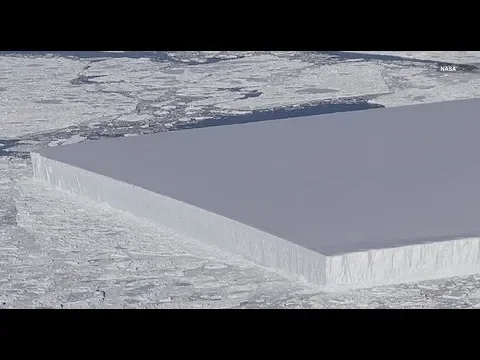

The encounter with the iceberg occurred while researchers were participating in a NASA mission dedicated to measuring changes in ice heights across different glaciers.
The scientific campaign was scheduled to last five weeks. The goal was not to seek out icebergs with curious shapes, but to gather information on changes in ice structures observed during the flyovers.
Flight Departed from Punta Arenas, Chile
The flight on which the block was photographed originated from Punta Arenas, at the southern tip of Chile, a strategic location for aerial operations aimed at Antarctica.
From there, the team flew over polar areas and recorded different formations. It was during one of those passes over the Weddell Sea that Harbeck noticed the unusual geometry in the ocean.
Extraordinary Photo Captured During Routine Scientific Operation
The image gained prominence primarily because it transforms a well-known natural process into a visually striking representation that is hard to ignore. The iceberg resembled a massive geometric slab floating among much more irregular ice shapes.
Even so, its explanation does not require machines, artificial cuts, or any mysterious phenomenon. The very formation of tabular icebergs, coupled with the fact that this block is likely relatively recent, accounts for much of its appearance.
Iceberg Shows How Nature Can Produce Nearly Perfect Lines
The block photographed in the Weddell Sea became famous precisely because it challenges a common expectation: that natural structures must necessarily exhibit irregular outlines. Fractures in the ice can produce surprisingly geometric shapes before the ocean begins to erode them.
In the instance recorded by Jeremy Harbeck, two corners close to right angles, the flat surface, and the minimally eroded edges indicated a likely newly separated iceberg from a larger mass, probably originating in Larsen C. If you only saw the photograph, would you immediately believe that this shape was produced naturally? Share your thoughts in the comments.


