





 Portuguese
  English
  Spanish
  3 min of reading
  0 comments


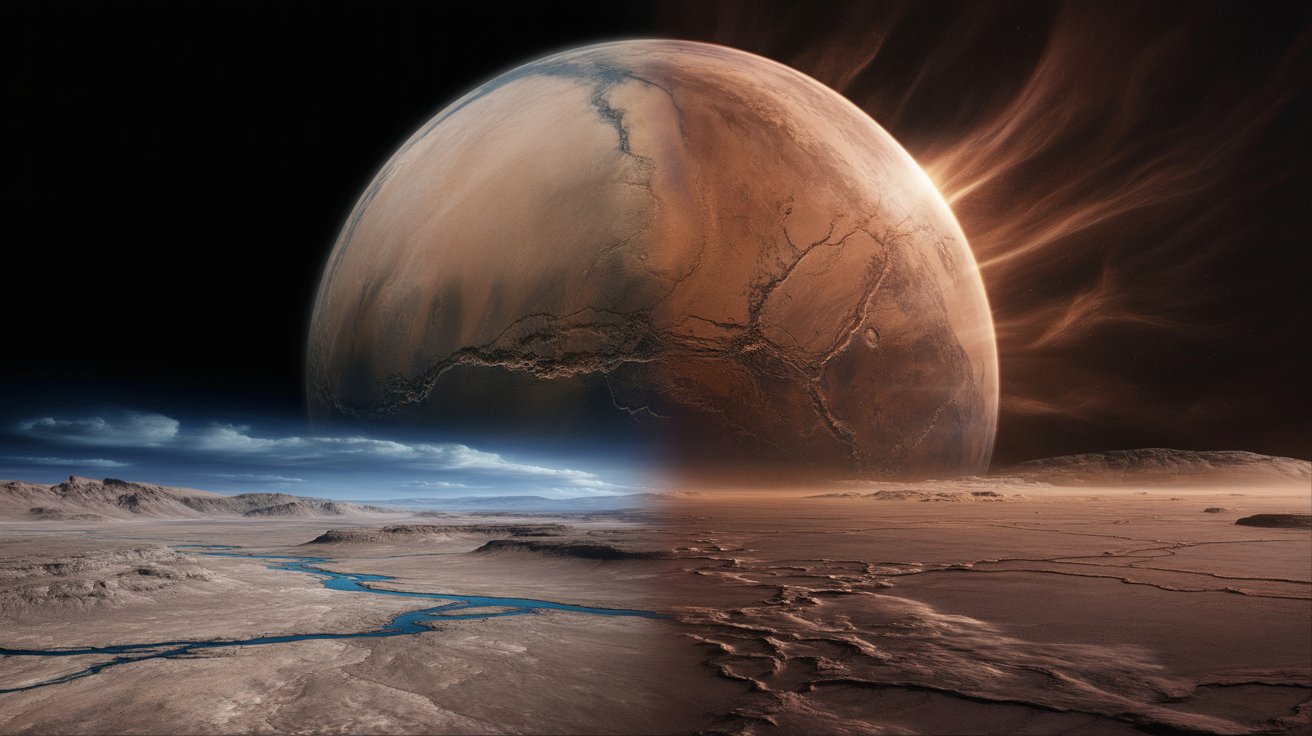
NASA Identified The Phenomenon That Transformed Mars Into A Arid Planet, Revealing That Atmospheric Degradation Caused By Solar Storms Eliminated Its Natural Protection And Led To The Loss Of Liquid Water Billions Of Years Ago, According To A Study Published In Science Advances.
The Discovery Was Made Possible Thanks To The Maven Mission, Which Has Been Monitoring The Martian Atmosphere For A Decade. By Losing Its Magnetic Field, Mars Became Vulnerable To Solar Winds, Which Gradually Stripped Away The Atmosphere And Made The Existence Of Liquid Water Impossible.
The Scientists Observed That This Degradation Intensifies With The Collision Of Heavy Ions, Which Scatter Atoms And Molecules From The Atmosphere As If They Were Particles In An Explosion. This Process Was Compared To A “Cannonball” Dive Into A Pool, Dispersing Everything Around.
Unprecedented Observation By The Maven Mission Enables Visual Verification
The Team Responsible For The Maven Mission, In Partnership With The University Of Colorado, Captured The Phenomenon In Real Time For The First Time. Previously, The Evidence Came From The Proportion Of Argon Isotopes Present In The Martian Atmosphere, Suggesting A Selective Loss Due To Degradation.
-
China accelerates global science and may surpass the United States in 2 years with increased public investment, continuous growth, and direct impact on the global technological competition.

-
Scientific studies indicate that drought may be strengthening a much greater silent threat: more resistant superbugs.
-
Man builds functional 5-meter submarine in his garage using gas cylinders, PVC pipes, and a refrigerator motor, and navigates with the vessel on a lake in Colombia.

-
Millions of people have been eating yam for centuries without knowing that this humble tuber contains a compound called diosgenin, which scientists have now discovered can improve memory and help control blood sugar levels.


With Simultaneous Measurements At Different Altitudes And Regions Of The Planet — Both On The Sunlit And Dark Side —, The Researchers Mapped The Exact Points Where Solar Wind Collides With The Atmosphere And Disperses Gases, Mainly Argon.
Researcher Shannon Curry, The Study Leader, Stated That This Was The First Time The “Fire” Was Seen Directly After Years Of Only Observing The “Ashes” Left By Solar Activity On The Red Planet.
Intensity Of Degradation Is Greater Than Previously Thought
Another Surprising Finding Revealed By The Study Was The Speed Of The Phenomenon, Which Occurs At A Rate Four Times Higher Than Previous Estimates. During Solar Storms, This Speed Increases Considerably, Accelerating The Loss Of The Atmosphere Even More.
The Lack Of A Stable Atmosphere Made The Retention Of Liquid Water On Mars Impossible, Taking The Planet From A Possible Humid And Habitable Environment To Its Current Desert State. This Finding Fills Important Gaps In The Understanding Of Martian Geological And Climatic History.
Furthermore, The Study Contributes To Research On Exoplanets And The Effects Of Space Weather, Helping To Better Understand The Factors That Determine The Habitability Of Worlds Beyond Earth.
The Article Was Published In The Scientific Journal Science Advances And Released By NASA In An Official Statement, With Detailed Information Also Provided By The Maven Mission.
The Discovery Strengthens The Importance Of Magnetic Fields As Essential Shields For Maintaining The Atmosphere And The Presence Of Water, Vital Elements For Life. This Becomes Crucial For The Selection Of Future Targets In Space Missions.
With These Data, Scientists Can Improve The Search For Planets With Favorable Conditions For Life And Develop Atmospheric Protection Strategies In Future Missions.






-

2 pessoas reagiram a isso.