





 Portuguese
  English
  Spanish
  5 min of reading
  0 comments


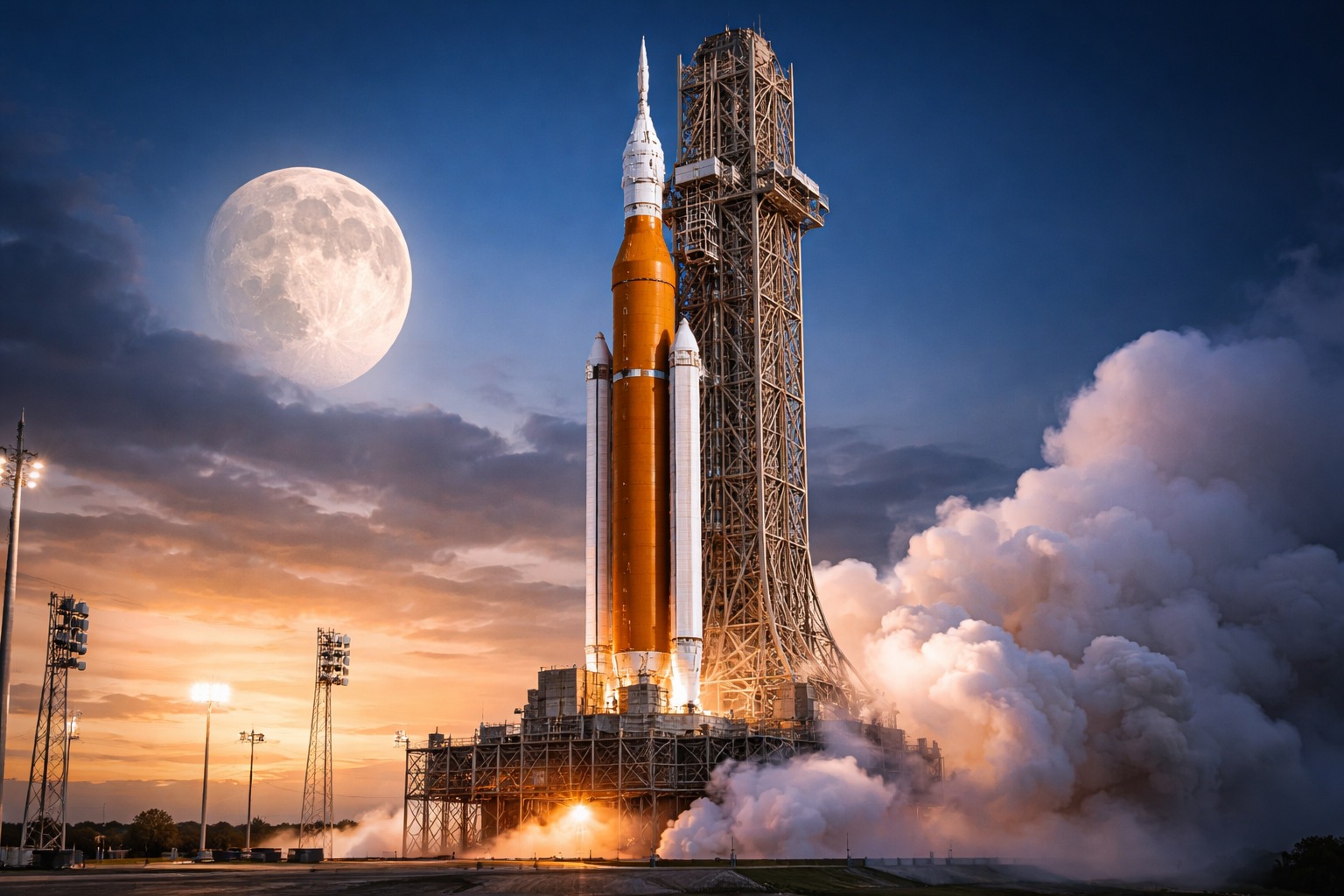
With Hydrogen Leak Above 16%, SLS Test is Ended Earlier Than Planned at Kennedy Space Center as NASA Prepares New WDR, Reviews Safety Limits, and Keeps Artemis II Launch Window Open Starting March 3
NASA is facing a new fueling issue with the SLS rocket ahead of the upcoming Artemis II test, following a hydrogen leak exceeding 16% and an early end to the test at Kennedy Space Center in Florida.
NASA is looking to avoid further fueling problems ahead of Artemis III while preparing for a second countdown test of Artemis II next week. The mission remains on the launch pad after missing a window earlier this month.
Artemis III is scheduled to be the first crewed mission to land on the Moon since the Apollo program over 50 years ago. Artemis II will be the first crewed flight of the SLS rocket and the Orion spacecraft, lasting nearly 10 days.
-
Motorola launched the Signature with a gold seal from DxOMark, tying with the iPhone 17 Pro in camera performance, Snapdragon 8 Gen 5 that surpassed 3 million in benchmarks, and a zoom that impresses even at night.

-
Satellites reveal beneath the Sahara a giant river buried for thousands of kilometers: study shows that the largest hot desert on the planet was once traversed by a river system comparable to the largest on Earth.

-
Scientists have captured something never seen in space: newly born stars are creating gigantic rings of light a thousand times larger than the distance between the Earth and the Sun, and this changes everything we knew about stellar birth.

-
Geologists find traces of a continent that disappeared 155 million years ago after separating from Australia and reveal that it did not sink, but broke into fragments scattered across Southeast Asia.

The Artemis II mission will take four astronauts around the far side of the Moon and bring them back to Earth. The rocket remains at Kennedy Space Center in Florida while technicians work to resolve the hydrogen leak identified on February 2.
NASA and Recurring Leaks in the SLS
Fuel leaks are no stranger to the Space Launch System. In 2022, the same type of issue delayed the first test flight of the SLS by several months during the Artemis I campaign.
At that time, teams believed they had resolved the issue by changing the method of loading super-cooled liquid hydrogen into the core stage. The same procedure was used on February 2, but the leak reoccurred.
NASA Administrator Jared Isaacman stated that the challenges at the beginning of the Artemis II campaign are not surprising, considering the issues observed in preparing for Artemis I and the long gap between missions.
He expressed being impressed with the NASA team and the contractors working throughout the campaign, although he acknowledged that the situation is not justified.
Origin of the Leak and Confidence Tests
Engineers identified that the fueling issues were related to ground support equipment. The hydrogen leaks originate in the area where the fueling lines connect to the bottom of the core stage.
Two umbilical cables from the tail service mast carry liquid hydrogen and oxygen during the countdown, disconnecting at the moment of launch. The liquid hydrogen feed line has 8-inch and 4-inch diameter pipes.
After the Fueling Test conducted earlier this month, technicians replaced the seals around the two fueling lines. On Thursday, the team conducted a confidence test with partial filling of the core stage.
The test was ended ahead of schedule when a new issue reduced the fuel flow. NASA reported that it will replace a suspect filter before moving on to the next rapid response testing phase.
The termination occurred while entering fast-fill mode, when pressures and flow rates subject the seals to higher stress. Nevertheless, the agency stated that several important goals were met.
Isaacman wrote that the test provided a large amount of data and showed materially lower leak rates compared to previous observations during WDR-1.
New WDR and Attempt for Full Loading
Although not testing seals under the most extreme conditions, officials obtained data considered sufficient to move to the next fuel replenishment test.
In the next WDR, NASA will attempt to fully load the rocket with hydrogen and oxygen, conduct a countdown of less than one minute, and then drain the SLS propellant tanks.
Isaacman stated that there was no failure justifying the premature termination of the test, but that the team observed sufficient data to consider it unnecessary to wait for additional solutions at that moment.
Safety Limits and Hydrogen Concentration
During the first WDR conducted earlier this month, hydrogen gas concentrations in the connection area peaked above 16%, NASA’s safety limit.
This value exceeded any leak rate observed during the Artemis I campaign in 2022. After the incident, NASA raised its safety limit from 4% to 16%, a rule inherited from the Space Shuttle program.
John Honeycutt stated that the decision was based on test data that analyzed the cavity, its characteristics, and the purge. According to him, with 16%, ignition could not be achieved.
Hydrogen is explosive at high concentrations when mixed with air. At the same time, it is notoriously difficult to contain because the molecule is small and can easily escape through leaks.
Liquid hydrogen is cooled to -253 degrees Celsius, presenting challenges for sealing materials. It was found that NASA used the three-year gap between missions to familiarize itself with more significant leaks.
Isaacman stated that this will change before Artemis III and that the vehicle will be protected against cryogenic processes before it reaches the pad, with redesigned loading interfaces.
Costs, Infrastructure, and Timelines for Artemis II
Isaacman took over as NASA Administrator in December and criticized the cost of the SLS program, estimated by the inspector general at over US$ 2 billion per rocket, along with the low flight rate.
In 2024, NASA spent nearly US$ 900 million on ground support infrastructure for the Artemis program. Part of the funds was allocated to building a new pad for the updated version of the SLS.
NASA and Boeing have never built a full-size test model of the core stage. There is no way to fully test the cryogenic interaction until the rocket is fully assembled on the pad.
Current legislation requires NASA to continue using the SLS for Artemis V mission. Isaacman stated that the program’s architecture will continue to evolve as the industry matures.
The next series of launch opportunities for Artemis II begins on March 3. If it does not launch in March, the rocket will have to return to the Vehicle Assembly Building to update the flight termination system.
Additional dates are available in April and May. Isaacman stated that the mission will only launch when it is ready and that astronaut safety will remain NASA’s top priority.








-

-

2 pessoas reagiram a isso.