NASA Develops Ultra-Lightweight and Flexible Antenna Technology for SkyFall Mission Helicopters, Enabling Precise Searches for Ice Beneath Mars’ Surface.
The silence of Mars’ surface conceals vital secrets. For NASA, the greatest challenge of future crewed missions to the “Red Planet” isn’t just how to get there, but how to survive long-term using local resources.
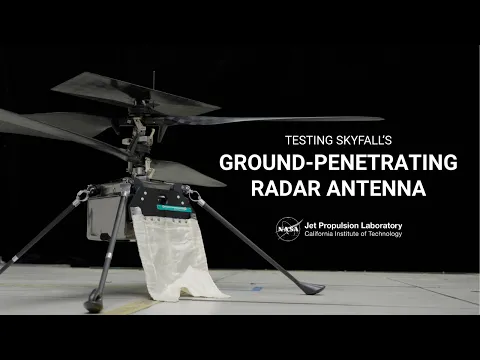
The buried ice beneath the surface is the “holy grail” of that survival. Recently, the agency took a crucial step toward making that search a reality by successfully testing a new antenna that defies the conventional laws of aerospace engineering.
So far, detecting ice on Mars has relied on orbital probes, which provide a broad but low-resolution view of the surface layers.
-
China Breaks Speed Record with Maglev Train Accelerating from 0 to 800 km/h in 5.3 Seconds and Tests Rocket Launch Technology

-
Food Waste Recycling Could Reduce Climate Impact by Up to 99%, but Scientists Find a Hidden Problem in Compost

-
A Small Kiosk with 14 Commercial Refrigerators Inspired Researchers to Create a Duct System That Expels Heat from the Building, Achieving Over 97% Reduction in Overheating and Up to 83% in Cooling Demand in Simulations
-
New Rule Prevents Unsold Clothes from Being Simply Destroyed: Regulation Impacts Up to 594,000 Tons Annually for Large Companies


The SkyFall project, set to launch in late 2028, aims to change that scenario. The plan is to employ a trio of specialized helicopters equipped with ground-penetrating radars to conduct a meticulous “scan” during low-altitude flights.
NASA’s Vivaldi Antenna Design
Engineers at NASA’s Jet Propulsion Laboratory (JPL) faced a technical dilemma: how to install a powerful radar on an extremely lightweight vehicle without compromising its flight or landing capabilities?
In an environment with a thin atmosphere, where every gram is critical, a traditional, rigid, and heavy radar antenna would be unfeasible. Additionally, the narrow space between the aircraft and the ground—about 15 centimeters—posed a constant risk of structural damage with each landing.
The solution emerged from inspired creativity: the “Vivaldi” antenna. With lines that resemble the shape of a violin, the device is designed to be both flat and flexible.
The name, directly referencing composer Antonio Vivaldi, is not just a charming detail; the antenna’s geometry allows it to transmit and receive signals across a wide range of frequencies, between 500 and 2,500 megahertz.
This versatility is what enables clear identification of where dry soil ends and subsurface ice begins.

Extreme Protection
The antenna needed to be longer than the helicopter’s legs to function properly, meaning that with each landing on uneven ground, the equipment physically “folds” against the terrain. To ensure it does not break, NASA applied proven solutions:
- High-strength polyester outer coating;
- Vectran-reinforced layers, the same material used in the airbags of the Spirit and Opportunity rovers;
- Internal structure composed of fiberglass and magnesium springs for shape memory.
This combination guarantees that after each contact with Martian rocks, the antenna returns perfectly to its original position, maintaining the necessary integrity for radar data collection.
The total weight is merely 150 grams — an engineering feat that prioritizes absolute lightness without sacrificing durability.

Test Results and the SkyFall Mission
The robustness of this design was proven in laboratory conditions under severe circumstances. The prototype underwent 200 simulated landing cycles interspersed with brutal thermal shocks, varying up to 94°C to replicate Mars’ extreme environment.
Ultimately, NASA confirmed that the technology not only survived but also maintained the radar signal’s accuracy intact throughout the process.
The SkyFall mission, benefiting from the experience gained through the successful Ingenuity helicopter, aims to facilitate the lives of future explorers. By converting Martian ice into water, oxygen, and rocket fuel, NASA reduces the need for heavy payloads transported from Earth.
Scheduled for launch in 2028 aboard the Freedom rocket, this mission promises to mark the beginning of a new era, where technology, the music of geometric forms, and space exploration converge to ensure that humans can ultimately walk — and live — safely on Martian soil.