





 Portuguese
  English
  Spanish
  4 min of reading
  0 comments


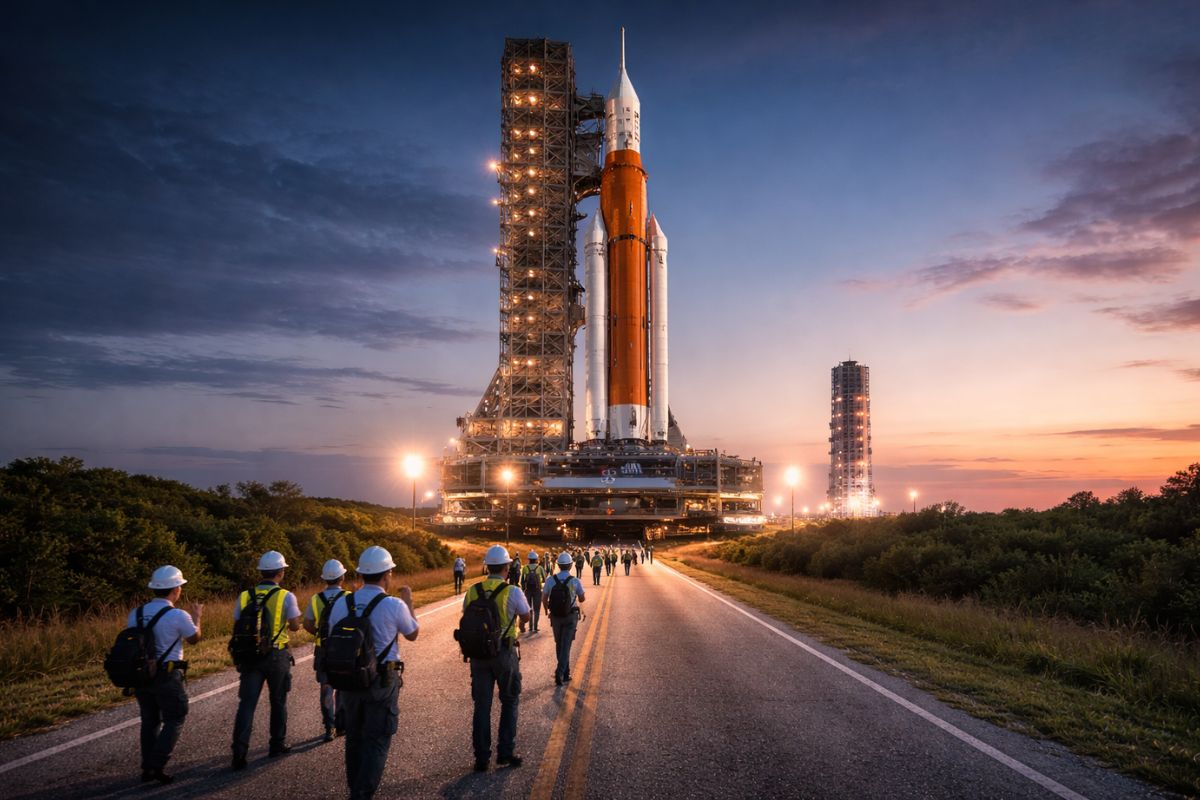
The Giant Space Launch System Rocket, Attached to the Orion Capsule, Began to Leave the Vehicle Assembly Building at Kennedy Space Center on January 17, Crossing 6.4 km to Platform 39B in Up to 12 Hours, in a Convoy of 5 Million Pounds, at Slow Steps on Rollers.
At Kennedy Space Center in Florida, the movement that seems discreet is, in fact, a milestone: NASA has set in motion the giant rocket that will support the Artemis II mission and place astronauts in the vicinity of the Moon for the first time since 1972.
The scene has a contrast that is hard to ignore. While popular imagination associates rockets with explosive speed, the giant rocket begins the final stage of its journey at a walking pace, on a 6.4-kilometer traverse that can take up to 12 hours, as if the entire program is saying that, here, time is part of the project.
The 6.4 km Journey That Begins the Launch Campaign

The movement began on January 17, when the Space Launch System and Orion left the Vehicle Assembly Building en route to Platform 39B.
-
While the world looks at oil, the war with Iran is already disrupting helium supply from Qatar, affecting car and iPhone chips, threatening AI expansion, and putting pressure on aluminum packaging at the highest value in four years.

-
Global warming will expose a treasure hidden under the ice of Antarctica and may spark an international dispute over gold and valuable minerals.

-
A street vendor from Praia Grande built a robot made of scrap from scooters and washing machines that pulls his popcorn cart on the beach, emits sounds, and interacts with customers, becoming an attraction on the coast of São Paulo.

-
The specifications of the Xiaomi 18 Pro Max have been leaked, and the highlight is a dual 200 MP camera with a new 22-nanometer technology that promises to consume less energy and capture details in shadows and bright areas using LOFIC HDR.


The total distance is 6.4 kilometers, and the schedule calls for a slow advance, with a window of up to 12 hours to complete the journey at Kennedy Space Center.
The reason for the pace is not symbolic.
The assembled unit weighs about 5 million pounds, and this number turns logistics into engineering: every meter traveled becomes an exercise in control, stability, and safety margin.
It is at this stage, before any countdown, that the giant rocket begins to exist outside the protected assembly environment.
Platform 39B: Where the Rocket Goes from Being a Piece to Being a System

Arriving at Platform 39B is more than just “parking” the unit.
It is placing the giant rocket and the Orion spacecraft in the real launch scenario, where procedures leave the paper and enter the operational routine, with infrastructure, connections, and ground preparation that precede the upcoming milestones.
This is also where the program shifts in nature: it moves from the assembly stage to the campaign stage.
NASA frames this movement as one of the last major phases before sending humans back to the Moon, because the path to 39B is the point at which the project becomes an integrated sequence of operations, without shortcuts and without glamour, just execution.
Artemis II: Who Will Fly and Why This Test is the First of the Return
The Artemis II mission is described as the first crewed flight of the Artemis program and the first human trip to the vicinity of the Moon since Apollo 17 in 1972.
The crew will consist of four astronauts, with participation from NASA and the Canadian Space Agency, on a mission estimated to last about ten days orbiting the Moon.
The objective is not to “arrive to stay,” and this changes the focus of the flight.
Artemis II was designed to test systems that future crews will need on longer journeys, with an emphasis on life support, communication, and navigation.
In other words, the giant rocket is not just the vector: it is the first condition to validate whether the rest of the system works with people on board.
The Invisible Detail Behind the “Walking Pace”


Public perception tends to measure ambition by speed, but this type of operation measures ambition by control.
Moving a giant rocket on a crawler transporter, over 6.4 kilometers, is reducing variables: vibration, oscillation, tolerances, and risks that do not appear in images but define reliability.
That is why the journey can take up to 12 hours.
The cadence is an operational safety mechanism, not a whim.
And it provides an objective reading of the program: the crewed return to the Moon does not start in the sky, it starts on the ground, when the equipment leaves the hangar and faces the real world without the building’s protection.
Why This Matters on Earth When the Subject is the Moon
NASA ties the relevance of the flight to what happens to people and systems on long missions.
Closed life support environments are pushed to the limit, and the human body must deal with factors such as radiation, stress, and interrupted sleep, in conditions that do not exist in normal routine.
The data collected in Artemis II, especially about crew health and performance, is presented as input to learn to live safely in hostile environments.
The logic is straightforward: by testing the giant rocket and the entire architecture of the crewed flight, the program also produces knowledge applicable to extreme scenarios, whether in orbit or in remote regions of the planet itself.
What stands out in this episode is not just the size of the giant rocket, nor the promise of the crewed return to the Moon.
It’s the technical message behind the scene: when a system weighs millions of pounds and carries humans, “slow” becomes a requirement, and the transparency of the process on the ground is as important as the spectacle of the launch.
To Engage for Real: If You Were Defining the Priority of a Program of This Size, Would You Choose More Schedule Speed or More Safety Margins? And, Looking at the 6.4 km Journey in Up to 12 Hours, What Detail Weighs Most for You: Human Risk, Operational Cost, or the Strategic Message Behind This Caution?










-

-

-

-

5 pessoas reagiram a isso.