





 Portuguese
  English
  Spanish
  4 min of reading
  0 comments


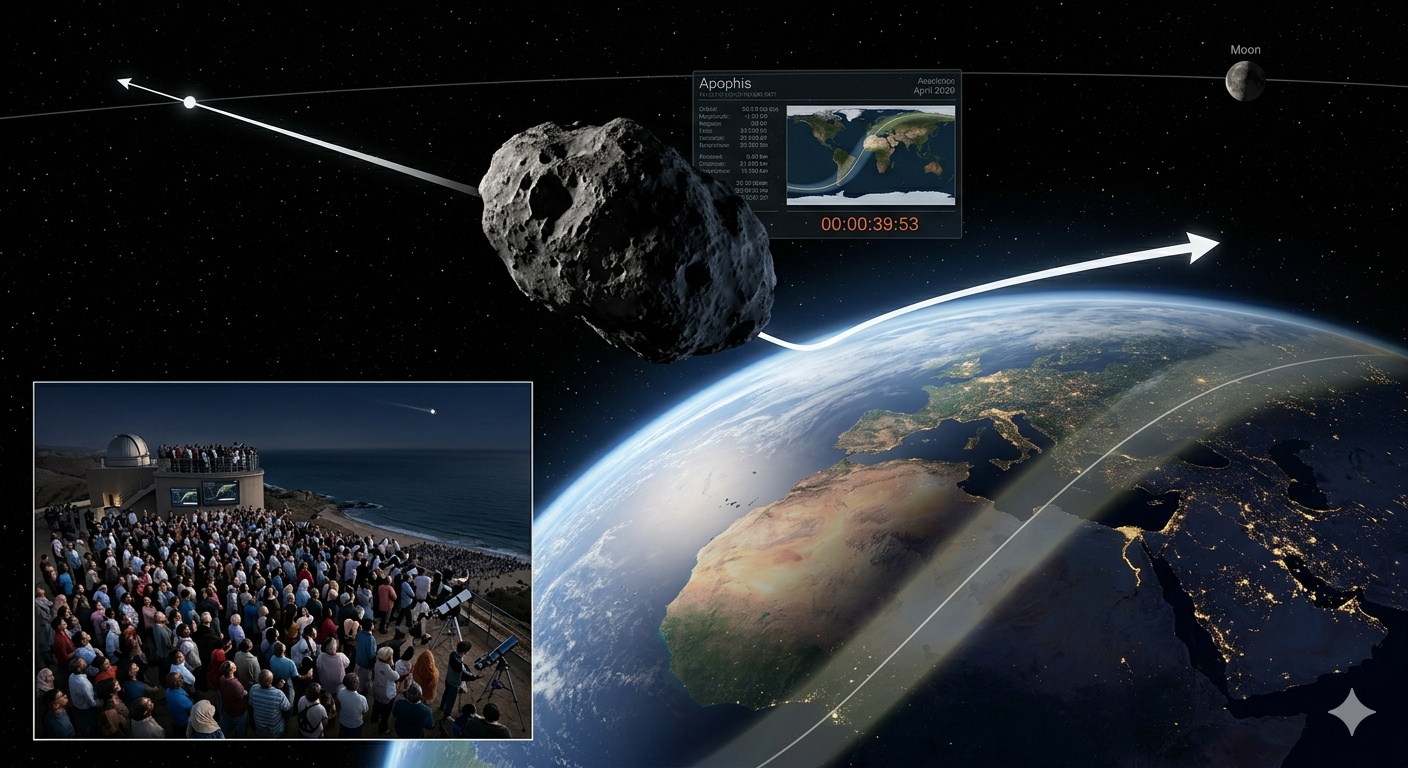
On April 13, 2029, a Friday, up to 2 billion people will be able to see with the naked eye a 340-meter asteroid crossing the sky, in the closest passage ever recorded of an object of this size
On the night of April 13, 2029, residents of Europe, Africa, and Western Asia will look up at the sky and see something that no living human has ever seen: a naked-eye asteroid crossing the firmament. It will not be a fixed point like a star, nor a quick streak like a meteor. It will be a point of light with brightness comparable to that of the stars of Ursa Major, moving perceptibly — sweeping across the sky a distance equivalent to the diameter of a full moon every minute, for hours.
The object is called Apophis and is about 340 meters long, a size comparable to the height of the Eiffel Tower. It will pass approximately 31,600 kilometers from the Earth’s surface, a distance shorter than that of many satellites in geostationary orbit. According to NASA, an event of this type occurs, on average, once every 7,500 years, which reinforces the extremely rare nature of the approach.
The discovery of the Apophis asteroid and the initial panic about impact risk
The story of Apophis begins in June 2004, at the Kitt Peak National Observatory in Arizona, when astronomers Roy Tucker, David Tholen, and Fabrizio Bernardi identified an unusual point of light moving in the sky. The object was initially cataloged as 2004 MN4, with no immediate indication of significant threat.
-
In a flooded well, archaeologists found a 1,700-year-old Roman egg that still contains clear and yolk intact inside the very thin shell.

-
Something is happening around the Earth: Inside the huge explosion of fireballs in 2026

-
A hot air bubble coming from Argentina expands over Brazil, causing thermometers to exceed 38 degrees with a thermal sensation of 40 degrees in late March, affecting 6 states at once.

-
The radish leaf that almost everyone throws away has more polyphenols, flavonoids, and fiber than the consumed root, and a 2025 study showed that the leaf contains compounds that protect the intestine, combat inflammation, and may inhibit the growth of cancer cells.




However, initial orbital calculations revealed something unusual: a real probability of impact with Earth. The first estimates indicated about a 2.7% chance of collision on April 13, 2029, elevating the object to level 4 on the Torino Scale, the highest classification ever assigned to an asteroid at that time.
The repercussions were immediate. The possibility of impact generated global concern until an earlier image, recorded months before, allowed for a more precise recalculation of the orbit. With the new data, the risk was dismissed for 2029, although the hypothesis of impact in 2036 persisted for years.
What will happen on the night of April 13, 2029 during the asteroid passage
The maximum approach will occur at 21:46 UTC, when Apophis will be over the Atlantic Ocean after crossing Africa. Hours earlier, the asteroid will already be visible in the sky of Australia and will follow a trajectory that will take it across the Indian Ocean to densely populated areas.
During the approach, the asteroid will traverse more than 200 degrees in the sky and reach an impressive apparent speed of about 42 degrees per hour. This means it will cross the equivalent of a full moon per minute, becoming one of the rare celestial objects whose movement can be perceived in real time with the naked eye.

The brightness will reach a magnitude close to 3.1, sufficient to be visible even in areas with moderate light pollution. It is estimated that about 2 billion people will be able to observe the phenomenon, mainly in the Eastern Hemisphere.
How Earth’s gravity will alter the Apophis asteroid in real time
The passage of Apophis will not only be a visual spectacle. It also represents a unique scientific experiment. During the approach, the difference in gravitational force between the sides of the asteroid will create tidal effects capable of deforming its structure.

These forces can alter the rotation of the object, cause material displacements on its surface, and even generate small avalanches of regolith. After the encounter with Earth, the asteroid will have its orbit permanently modified, changing from a period of about 324 days to approximately 440 days around the Sun.
This orbital transformation will cause Apophis to change dynamic groups, moving from the category of Aten-type asteroids to the Apollo group, with a more external trajectory.
NASA and European missions will study Apophis up close
The event has mobilized space agencies around the world. NASA redirected the OSIRIS-REx mission, now called OSIRIS-APEX, to intercept Apophis after its passage by Earth. The probe will remain close to the asteroid for about 18 months, analyzing its structure and behavior.
The European Space Agency is also planning the RAMSES mission, which is expected to reach the asteroid before the approach and monitor the event from a short distance. Japan will contribute with the launch via the H3 rocket, highlighting the unprecedented international cooperation to study this phenomenon.
This will be the first time that multiple space agencies coordinate direct observations of an event of this nature.
Why the Apophis asteroid is important for planetary defense
Apophis is part of a group of approximately 2,000 potentially hazardous asteroids cataloged, with more than 140 meters in diameter and orbits close to Earth. Most of these objects have never been studied in such detail.

The information obtained during the 2029 passage will be crucial to understanding how asteroids react to intense gravitational forces and how their material behaves. This data is essential for developing planetary defense strategies, should a similar object pose a real risk in the future.
As NASA scientists highlight, this event represents a practical test of everything humanity has learned about monitoring and responding to asteroids over the past decades.
On April 13, 2029, while billions of people watch a point of light crossing the sky at an impressive speed, science will be recording one of the most important events ever observed in the history of modern astronomy.






Seja o primeiro a reagir!