





 Portuguese
  English
  Spanish
  4 min of reading
  0 comments


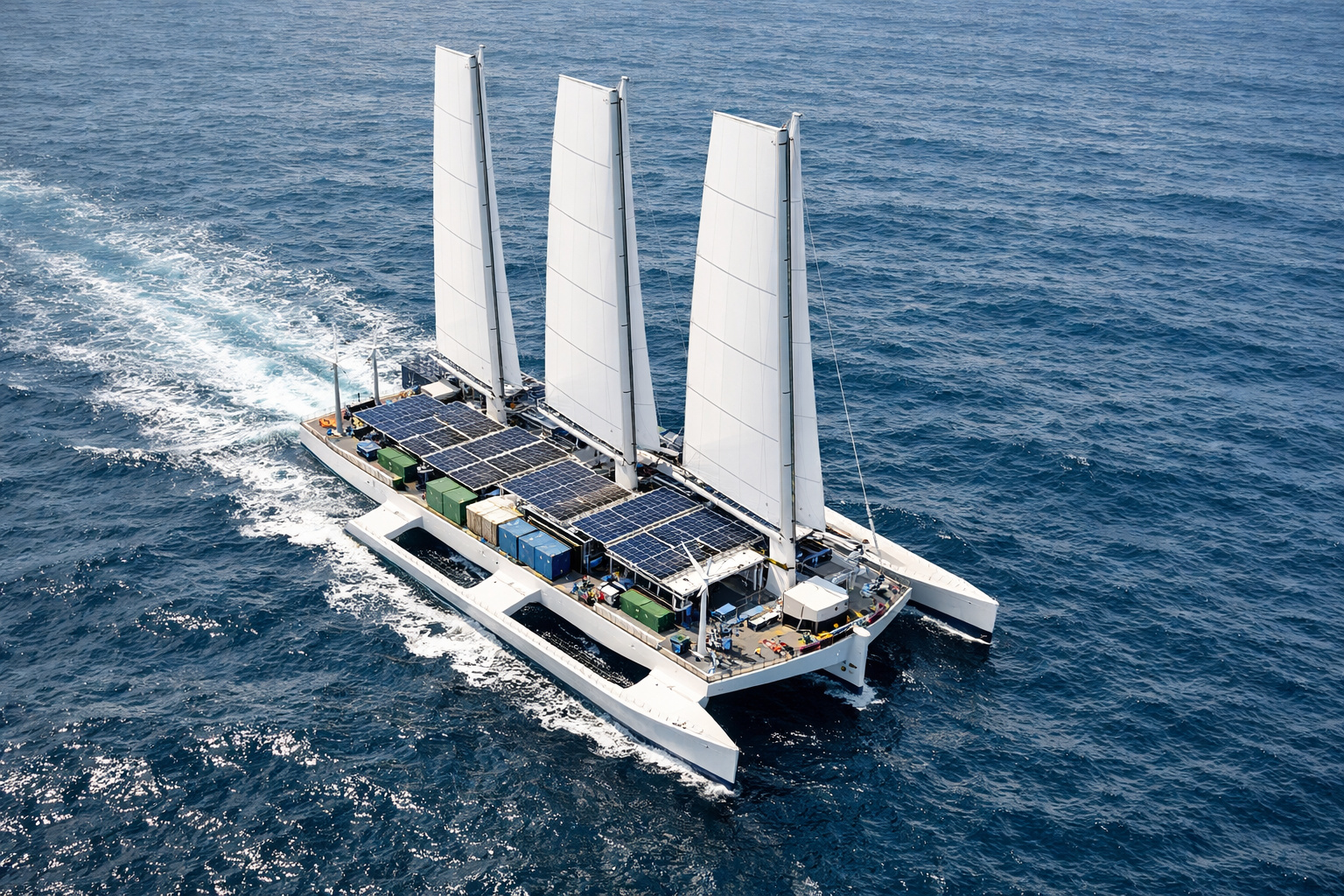
67-Meter Wind-Powered Trimarans Aim to Connect the USA and France in 15 Days, Offering a Sustainable Alternative to Air Freight with Up to 99% CO₂ Reduction
International shipping may be on the verge of a historic transformation. A French startup has decided to challenge the traditional model of global logistics by investing in a 100% sail-powered ship capable of drastically reducing carbon emissions while also offering a faster service than conventional maritime freight.
This information was reported by CNN International, which highlighted the project of the French company Vela, specialized in “green logistics,” according to details presented by the company itself and studies conducted in partnership with the consulting firm Carbone 4.
As the world seeks alternatives to reduce carbon footprints in cargo transportation, especially on strategic transatlantic routes, Vela’s proposal emerges as a concrete attempt to reposition sustainable maritime transport at the center of global climate discussions.
-
With earth, bamboo, straw, and lime mortar, a specialist builds a house for just over $460 and draws attention for its cost being much lower than traditional construction.

-
Rodrigo de Freitas Lagoon advances in environmental recovery with sanitation, elimination of irregular sewage, and the resumption of water sports in Rio de Janeiro.

-
Sustainable housing gains strength with a nationally awarded project in Campo Grande, highlighting innovative solutions that combine sustainability, urban integration, and efficiency in the use of natural resources.

-
City Where Residents Live Underground to Escape 52°C May Be a Picture of the Future on an Increasingly Hot Planet


100% Sail-Powered Ship Promises to Reduce Up to 96% of Emissions in Maritime Transport
The Vela project envisions the construction of a 67-meter long and 25-meter wide trimaran, with three hulls and an optimized structure for high-performance navigation. The cargo ship will be able to carry just over 400 tons of cargo between the East Coast of the United States and ports in France.
Additionally, the ship will be powered by sails that rise an impressive 61 meters above the waterline. Thus, the vessel will predominantly utilize wind power as its primary source of propulsion, drastically reducing fossil fuel consumption.
In addition, the electrical energy required for internal areas, operation, and climate-controlled holds will come from solar panels and two hydroelectric generators installed on board. Therefore, the proposal combines wind, solar, and hydraulic energy to support a low-emission navigation model.
According to a life cycle study conducted by Vela in partnership with Carbone 4, a crossing of the North Atlantic could emit up to 96% less CO₂ than a conventional fossil fuel-powered ship. When compared to air transport, this reduction may reach up to 99%.
Therefore, the potential environmental impact is significant. Considering that the transportation sector represents a significant share of global greenhouse gas emissions, solutions like this gain strategic relevance.
Speed of 14 Knots and Crossing in Up to 15 Days: How the USA–France Route Works

Although many associate sailboats with low speed, Vela’s trimaran intends to operate at an average of 14 knots. This speed is comparable to that of modern container ships, which is surprising for a vessel primarily powered by wind.
However, the key difference lies in the logistics model. The ship will carry about 100 times less cargo than a standard container ship. Conversely, this choice reduces loading and unloading times while allowing operation in less congested secondary terminals.
Consequently, the startup estimates it could load, cross the Atlantic, and unload in approximately 15 days. In practice, this means it could be up to twice as fast as traditional maritime transport on the USA–Europe route. Still, the crossing would be just one week slower than air transport.
In this way, the proposal occupies a strategically intermediate position: faster than conventional maritime freight, slower than air freight, but with drastically lower emissions than both.
In addition, the direct route between the United States and France eliminates multiple stops to complete the loading. This tends to reduce delays and increase logistical predictability, a crucial factor for companies that operate with sensitive products.
Target Market: Pharmaceuticals, Luxury Fashion, and Premium Foods
Vela does not intend to compete with the transport of low-value commodities. On the contrary, the startup aims at companies that currently depend on air transport for high-value goods, such as pharmaceuticals, luxury cosmetics, premium fashion, and specialty foods.
These sectors require strict temperature control and cargo integrity. Therefore, the ship will feature climate-controlled holds powered by renewable energy generated on board.
The Japanese pharmaceutical giant Takeda has already signed a transportation agreement with Vela, according to CNN International. This move signals that large corporations are starting to consider sustainable transport alternatives to reduce emissions without compromising timelines and quality.
Therefore, the project is not limited to a nautical innovation. It represents an attempt to reposition sustainable maritime transport as a viable alternative to air freight in certain strategic niches.
Green Logistics Could Redefine the Future of Transatlantic Trade
By combining an average speed of 14 knots, a capacity of 400 tons, 61-meter sails, solar and hydroelectric generation, and a reduction of up to 96% in emissions, the French startup raises a central question: is it possible to make international transportation less polluting without sacrificing efficiency?
If the model works as promised, the impact could extend beyond the USA–France route. After all, global companies are facing increasing pressure to reduce carbon emissions across their supply chains.
In this context, green logistics stops being a marketing differentiator and becomes a strategic requirement. Consequently, projects like Vela’s could accelerate the energy transition in international maritime transport.
Even though operational and economic challenges remain, the initiative demonstrates that technological innovation and sustainability can go hand in hand. Thus, the 100% sail-powered ship could mark the beginning of a new phase in transatlantic commercial navigation.
Do you believe that sustainable maritime transport could replace part of air freight in the coming years, or is it still a risky bet?










-

-

-

3 pessoas reagiram a isso.