





 Portuguese
  English
  Spanish
  4 min of reading
  0 comments


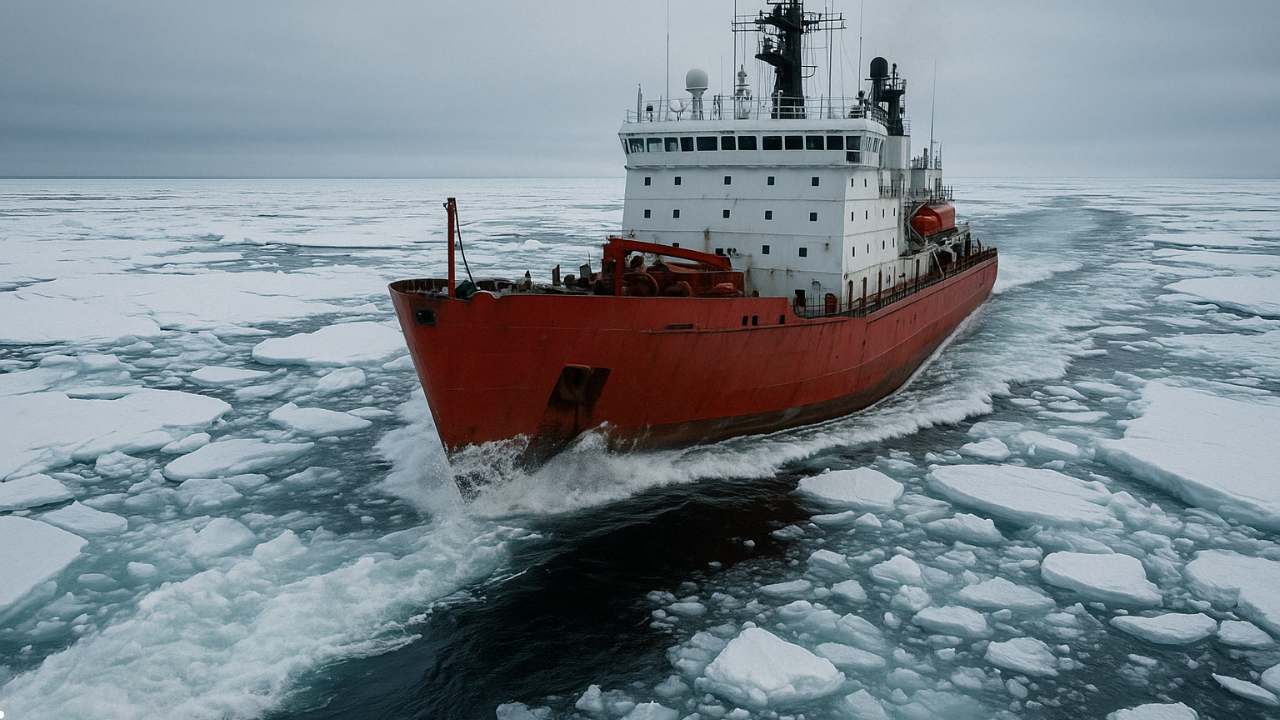
These Giants of the Frozen Seas Are Not Just a Feat of Modern Engineering, But Also Silent Protagonists in the Geopolitical Disputes of the Northern Seas.
Imagine a vessel cutting through the ice as if it is paving the way through a thin layer of glass. No, this is not a scene from science fiction or a product of artificial intelligence: it is the reality of powerful icebreaker ships. They are the silent heroes of the northern seas, facing the most hostile conditions on the planet with a combination of robust engineering, extreme propulsion, and global strategy.
In times of climate change, accelerated melting, and territorial disputes in polar regions, these heavy machines gain prominence in scenarios that go far beyond science and navigation. They carry within their hulls the history, politics, and future of maritime operations in frozen regions.
The Origin of Icebreaker Ships and Technological Evolution
The history of icebreaker ships dates back centuries, in the cold waters of the Arctic and the White Sea, in northern Russia. In the 10th century, Russian settlers were already using small wooden vessels called koch, designed to navigate between ice floes. These primitive vessels had rounded, reinforced hulls, allowing them to glide over the ice and withstand pressures that would destroy ordinary ships. This basic feature has remained and evolved over time.
-
Friends have been building a small “town” for 30 years to grow old together, with compact houses, a common area, nature surrounding it, and a collective life project designed for friendship, coexistence, and simplicity.

-
This small town in Germany created its own currency 24 years ago, today it circulates millions per year, is accepted in over 300 stores, and the German government allowed all of this to happen under one condition.

-
Curitiba is shrinking and is expected to lose 97,000 residents by 2050, while inland cities in Paraná such as Sarandi, Araucária, and Toledo are experiencing accelerated growth that is changing the entire state’s map.

-
Tourists were poisoned on Everest in a million-dollar fraud scheme involving helicopters that diverted over $19 million and shocked international authorities.


At the end of the 19th century, the IRMC emerged, considered the first modern oceanic icebreaker. Built in England for the Russian Navy, under the supervision of Admiral Stephan Makarov, the ship weighed about 5,000 tons and had steam engines with 10,000 horsepower. Its ability to climb over ice layers and break them with its own weight revolutionized polar navigation. With an operational career of more than 60 years, the IRMC paved the way for the technologies that today operate on industrial scales.
How Icebreaker Ships Work
Icebreaker ships are not simple vessels with reinforced hulls: they are true floating fortifications prepared to face extreme pressures. The hull is designed with special geometries, such as the sloped and rounded bow, which allows the vessel to climb over the ice and crush it. The underwater areas, bow, and stern are coated with low-temperature steel and polymers that reduce friction. All of this is to ensure that the ship does not get stuck or suffer serious damage while operating in the northern seas.
Beyond shape, power is essential: extremely powerful engines are crucial to push the ship against the ice. While conventional vessels operate with powers ranging from 5 to 10 MW, modern icebreakers, such as the Russian nuclear models, reach powers exceeding 60 MW or more than 80,000 horsepower. Some models use azimuth thrusters, which rotate 360°, offering precise maneuverability in icy waters. These technologies ensure that maritime transport, research missions, and even tourist cruises in the Arctic can occur even in the coldest months.
The Strategic Importance in the Northern Seas
The role of icebreaker ships goes far beyond opening routes for other vessels. They are key players in the geopolitical disputes of the northern seas, especially in the Northern Sea Route (NSR), which skirts the Arctic coast of Russia. This route has the potential to reduce the distance between Asia and Europe by up to 40%, saving fuel and time. With global warming and the retreat of polar ice caps, these passages have become more navigable, increasing global strategic interest.
Russia, which holds the largest Arctic coast, heavily invests in modernizing its icebreaker fleet, including nuclear versions and port infrastructure in the region. The transpolar route and the Northwest Passage, contested by Canada and the United States, are also on the radar of countries aiming to secure military, economic, and scientific presence in the area. The Arctic is now considered a new chessboard of international geopolitics.
Brazil’s Participation in Polar Missions
Despite being far from the poles, Brazil also makes its presence felt in scientific initiatives at the extremes of the planet. In November 2024, it led the International Antarctic Coastal Circumnavigation Expedition, with 61 scientists from seven countries. The mission traveled over 20,000 km aboard the Russian icebreaker Akademic Tryoshnikov, aimed at studying the impact of climate change on Antarctic ecosystems.
The project involved the participation of Fiocruz, which conducts research on the release of frozen pathogens due to permafrost melting. The Brazilian institution is part of a global research group that monitors public health threats from polar regions. Brazil’s contributions in areas such as biotechnology and epidemiological surveillance are viewed as strategic for understanding the consequences of global warming and extreme climate phenomena.
Icebreaker ships are more than just logistical solutions. They represent humanity’s resistance against the most hostile environments on the planet. Their missions ensure not only the continuity of global trade in the northern seas but also the generation of vital scientific knowledge to understand the future of the planet. At the same time, their presence in polar regions reinforces disputes over sovereignty and power in a scenario of accelerated climate transformations.
The future of the frozen seas is becoming increasingly warm, not just due to climate but also due to the diplomatic tensions that are concentrated there. It is up to the international community to monitor this advancement with attention and responsibility, ensuring that technology serves the common good and not just economic and military interests. After all, navigating is necessary, but understanding what we are doing to the planet is even more essential.
Source: Port Technology










Seja o primeiro a reagir!