





 Portuguese
  English
  Spanish
  4 min of reading
  0 comments


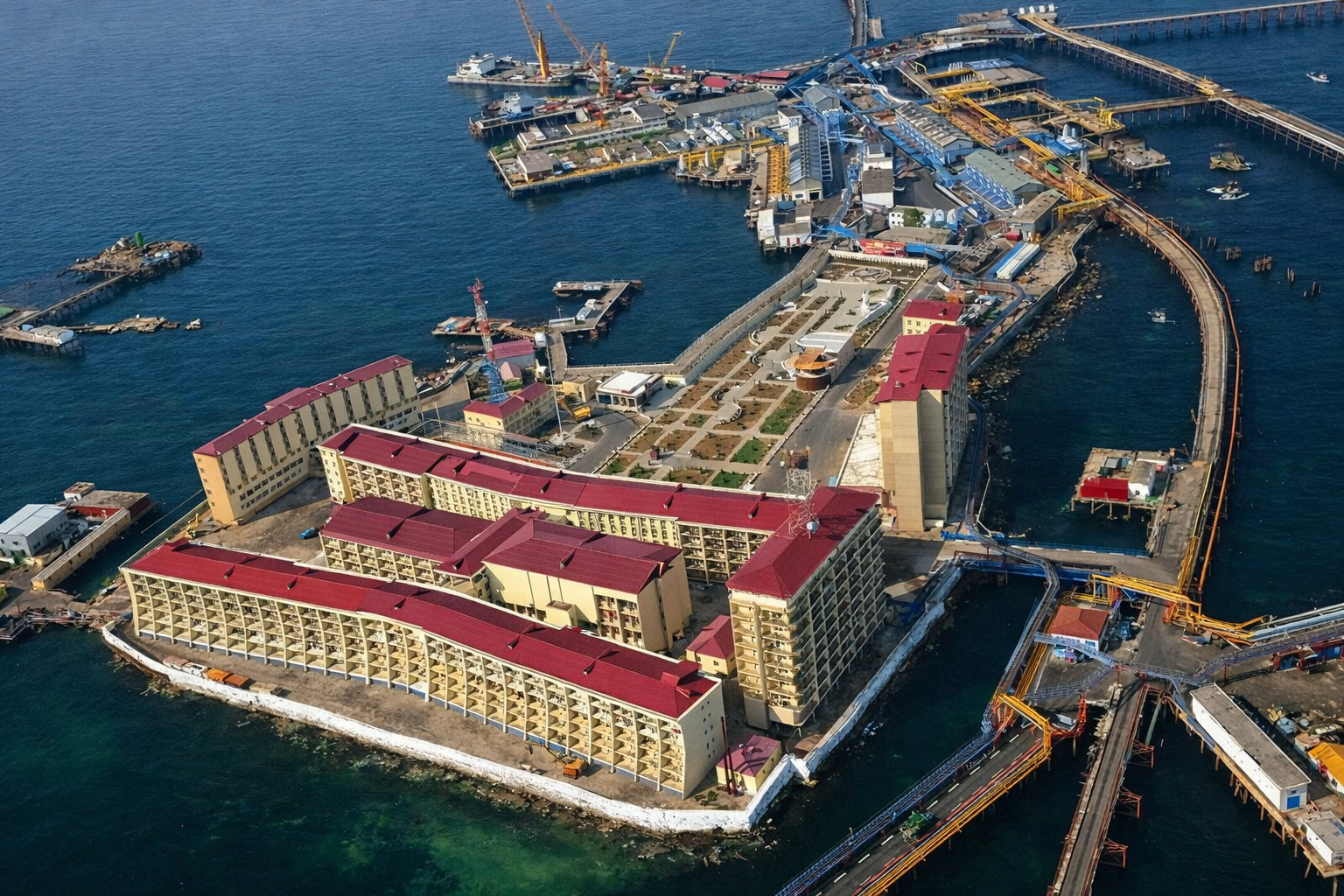
Built On Pilings And Extraction Platforms, Neft Daşları Is Recognized As The First Urban Settlement And Permanent Offshore Oil Field In The World.
In the middle of the Caspian Sea, far from the coast and surrounded only by water, there exists one of the most unlikely cities on the planet. Its name is Neft Daşları, which in Azerbaijani literally means “Rock of Oil.” Built on interconnected metal platforms linked by kilometers of elevated bridges, it has become one of the greatest symbols of oil engineering in the 20th century.
What started as a simple offshore drilling point evolved into something much larger: an industrial city built on the sea, with residential buildings, a hospital, a cinema, dining halls, plants, a helipad, and even a soccer field.
The Birth Of The First Offshore City In The World
The history of Neft Daşları began in 1949, when Soviet geologists discovered large oil reserves beneath the Caspian Sea bed. The initial drilling was successful, and it quickly became clear that the field had enormous strategic potential for the economy of the then Soviet Union.
-
Petrobras evaluates suspension of sales to distributors and considers canceling the cooking gas auction following guidelines from the Federal Government.
-
Lula reveals a masterstroke by Petrobras to undo a deal made by Bolsonaro, which involves the return of an important refinery that currently produces less than half of what was expected and makes Brazil dependent on international diesel.

-
A study confirms that the natural gas sector will reduce greenhouse gas emissions in Brazil by 0.5% and accelerate the energy transition by 2026.

-
Petrobras implements a severe adjustment and confirms a 55% increase in the price of aviation kerosene with a proposal for installment payments for the companies.



Rather than operating only with isolated platforms, engineers decided to expand the complex. Metal structures were installed over the sea and connected by walkways. Over time, these platforms grew, forming a vast suspended network.
Neft Daşları officially became the first major city built on offshore oil platforms in the world.
A Complete City In The Middle Of The Water
Unlike modern platforms, which function only as temporary workplaces, Neft Daşları was designed for prolonged permanence. Over the decades, the city came to have:
- Multi-story residential buildings
- Hospital and medical center
- Cinema and leisure areas
- Small markets and cafeterias
- Helipad for air transport
- Improvised soccer field
The elevated streets — some built on artificial embankments and others supported by metal beams — created something reminiscent of a suspended industrial neighborhood. At the peak of production, about 5,000 workers lived and worked in shifts on site.
Massive Oil Production
Throughout its history, Neft Daşları produced over 170 million tons of oil and billions of cubic meters of associated natural gas. These numbers place the complex among the most important of offshore exploration in the 20th century.

For decades, the city was one of the energy pillars of the Soviet Union and subsequently of Azerbaijan, the country that inherited the structure after the end of the USSR.
The infrastructure grew so much that it amounted to hundreds of kilometers of bridges and walkways connecting drilling rigs scattered throughout the sea.
A Symbol Of Soviet Engineering
Neft Daşları was not just an oil field — it was also industrial propaganda. Photographs from the time showed workers living in the middle of the sea, defying waves, winds, and storms to extract energy from the depths.
The city represented Soviet technological dominance over extreme environments. Building in the sea, far from solid ground, required bold solutions and constant structural adaptations.
Decline And Wear
Over time, however, production began to decline. New onshore fields and more modern technologies reduced the city’s offshore dependency.
Moreover, maintaining a massive infrastructure in a marine environment is costly and complex. Some metal structures suffered corrosion, and some areas were deactivated.
Today, Neft Daşları still operates partially, but on a reduced scale. It is estimated that between 2,000 and 3,000 workers continue to operate on site in shifts.
A Living City Or Industrial Relic?
For many, Neft Daşları is a relic of the heavy oil era and Soviet engineering. For others, it is an extreme example of how far energy exploration can go.
Visually, the city looks like it is straight out of a post-apocalyptic movie: aging buildings, rusty metal bridges, and industrial structures spread across the maritime horizon.

But it remains active — extracting oil, keeping workers busy, and reminding the world of a time when energy drove political, economic, and territorial decisions.
A Unique Milestone In The History Of Offshore Exploration
Although there are numerous platforms spread around the world today, none have evolved in the same way as Neft Daşları. It remains the only city built on a massive network of interconnected platforms, with real urban characteristics.
More than an oil field, it is a living chapter in the history of offshore engineering — a city raised on steel, supported by oil, and shaped by the sea.
And as long as its structures withstand the waves of the Caspian, Neft Daşları will continue to be one of the most unlikely cities ever built by humanity.










-

-

-

3 pessoas reagiram a isso.