





 Português
  Inglês
  Espanhol
  4 min de leitura
  0 comentários


“`html
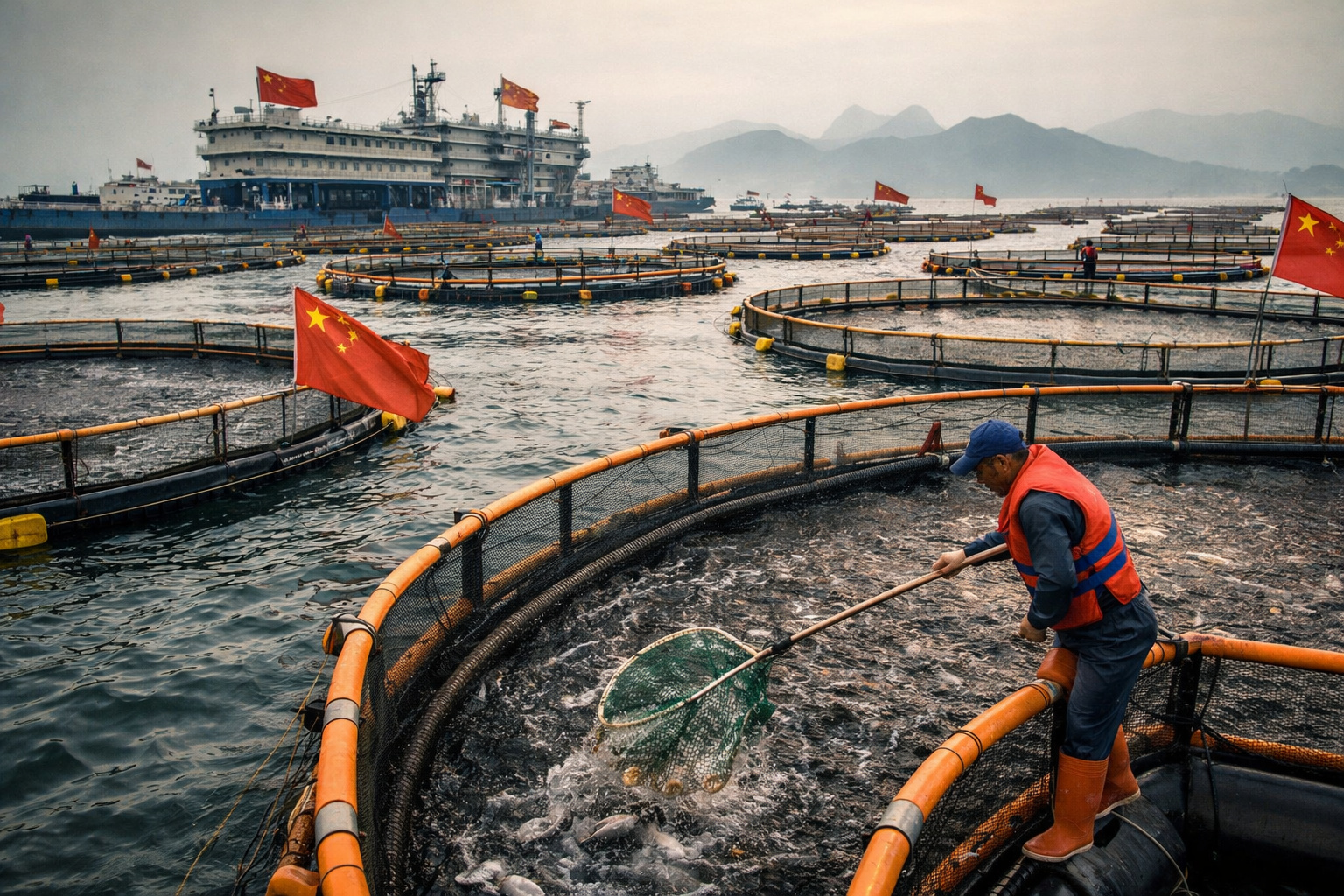
China dominates global farmed fish production, accounting for about 40% of the world’s fish and using industrial-scale aquaculture to influence the global market.
While many imagine that large food producers are concentrated in countries like the United States or Brazil, the global reality of fishing and aquaculture points to an absolute leader: China. The Asian country has built, over the past decades, a true food powerhouse based on fish and seafood production.
According to scientific studies published in the journal Frontiers in Marine Science, China accounts for more than 60% of all global aquaculture, that is, the controlled breeding of fish, crustaceans, and other aquatic organisms. This impressive number shows that most of the farmed fish consumed on the planet originates from Chinese territory. This dominance is not just statistical. It reflects a highly structured production model, with intensive use of technology, state planning, and integration with global logistics chains.
-
Drought may be creating stronger superbugs in the soil and helping antibiotic resistance reach hospitals, warns a study highlighting a problem that could grow alongside extreme weather.

-
The biggest scam in history: Napoleon’s France deceived the United States by selling them a territory that was Spanish.

-
Why is the Danakil Desert so dangerous? It has unstable terrain and how extreme temperatures and toxic gases turn the region into one of the most hostile environments on Earth.

-
With a height of 221 meters and a capacity for trillions of liters, Hoover Dam still holds a trick that makes water defy logic.


Much more than aquaculture: nearly half of global fish
The impact of China is not limited to aquaculture. When considering all fish production — including traditional fishing and captive breeding — the country also occupies a dominant position.
According to data released by the FAO (Food and Agriculture Organization of the United Nations), China accounts for about 36% to 40% of all fish produced in the world, consolidating itself as the largest global producer of aquatic food.
Other international analyses, such as the one published by the Dialogue Earth portal, reinforce this scenario by pointing out that the country alone is responsible for a massive share of global production, surpassing any other competitor by a wide margin. This level of participation places China in a unique strategic position: the country not only produces more but also directly influences the balance between supply and demand in the international market.
Mega fish farms and industrial-scale production
One of the main factors behind this dominance is the use of mega fish farms. Unlike traditional fishing models, China has massively invested in controlled breeding on a large scale, with systems that include industrial tanks, marine farms, and even offshore structures.
Technical reports and sector analyses show that the country has developed a highly efficient system, capable of producing gigantic volumes of animal protein with cost control and production predictability.
This model allows China to maintain a constant supply, reducing risks associated with traditional fishing, such as climate variations or overfishing. At the same time, it ensures internal supply for a population of more than 1.4 billion people.
Direct influence on international prices
With such a scale of production, China plays a central role in global price formation. When the country increases or decreases its production, the effects are felt in international markets, impacting everyone from exporters to end consumers.
FAO data indicates that China is also responsible for about 45% of global fish consumption, which further reinforces its weight in the global food system. This means that the country acts simultaneously as the largest producer and largest consumer, creating a cycle of influence that few agricultural sectors in the world can replicate.
Food security and long-term strategy
The dominance of aquaculture is not only economic but also strategic. China uses this sector as a tool for food security, ensuring continuous access to animal-based proteins for its population.
International reports highlight that aquaculture is already the main source of aquatic food on the planet, surpassing traditional fishing in growth and relevance. By leading this movement, China not only secures its internal supply but also positions itself as a key player in the future of global food.
The future of the global fish market
With the global demand for protein constantly growing, the trend is that aquaculture will continue to expand its role in the coming decades. And, in this scenario, China is expected to remain a protagonist.
Its large-scale production model, combined with investments in technology and infrastructure, places the country at a competitive advantage over other nations. More than that, it consolidates a new reality: the global fish market is no longer defined solely by who catches more, but by who produces better — and today, no one does this on a larger scale than China.
“`









Seja o primeiro a reagir!