





 Portuguese
  English
  Spanish
  4 min of reading
  0 comments


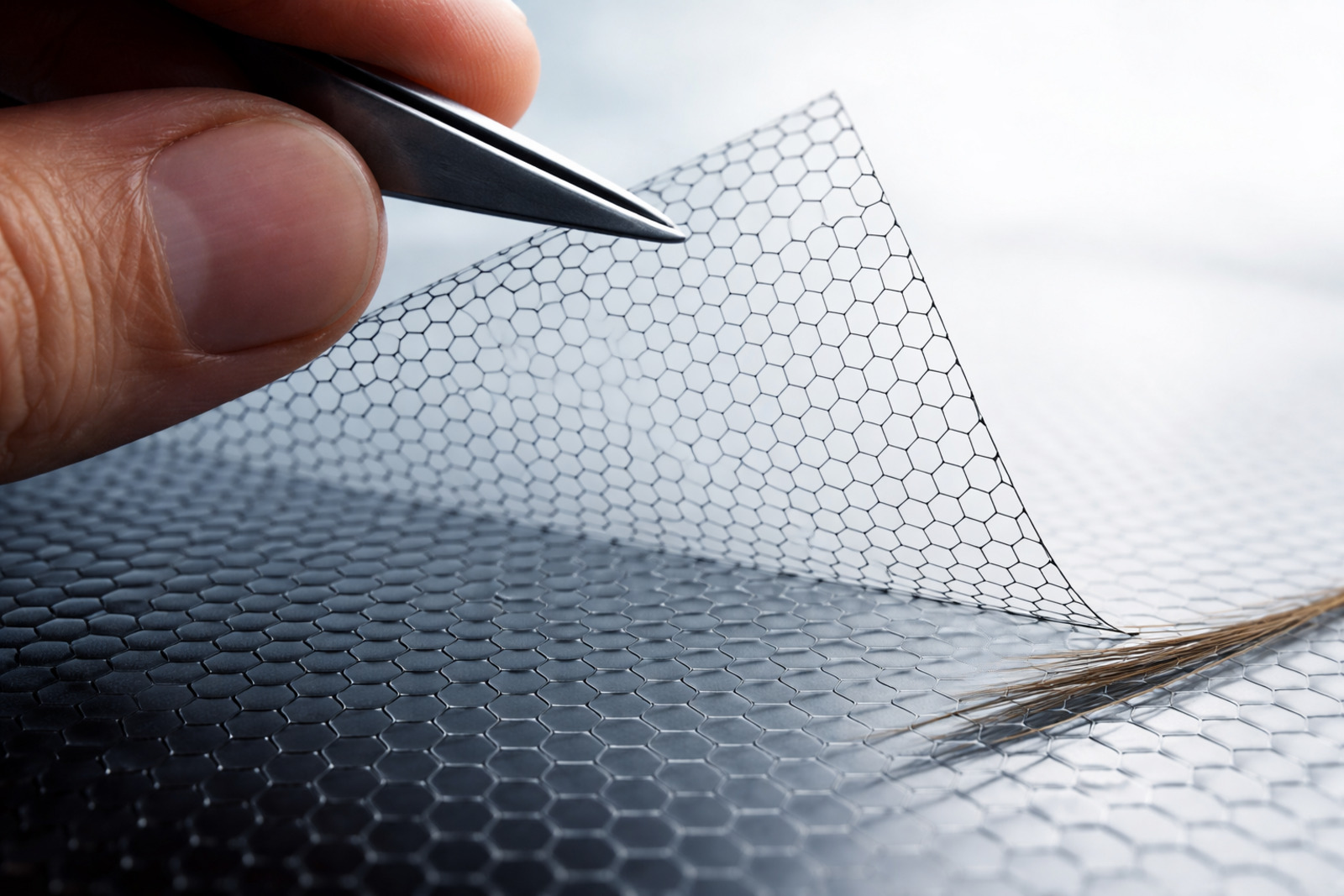
Graphene combines superior strength to steel, atomic thickness, extreme flexibility, and high electrical conductivity, expanding its potential in technology, health, and industry
Graphene has gained prominence as a carbon material with a single atom thickness, hexagonal structure, and applications in economic, technological, and health fields, combining lightness, strength, flexibility, electrical conductivity, and the potential to alter industrial and scientific processes.
From the discovery of compounds to the formation of graphene
Scientific and technological development has driven a significant evolution of materials in recent decades.
Since the 1960s, various graphite compounds have been identified and analyzed, revealing superconducting properties.
-
Scientists find about 1 million giant live eggs hatching in an active underwater volcano, discover a natural furnace on the ocean floor, and reveal one of the most unlikely nurseries ever seen in the ocean.
-
Scientists launched a bait camera to the bottom of the Pacific Ocean and saw something that no one expected.

-
Is a smart plug worth it in a regular home? What does it offer: turns on and off via smartphone, creates routines by schedule, prevents forgotten devices, sometimes monitors consumption, and improves habits without renovation or miracles.

-
Airbus and Mercedes take the G-Class to the skies: the ACH145 helicopter priced at R$ 78 million debuts in São Paulo, unit goes to Brazilian, AMG cabin, 5-blade rotor, and a 2-year wait.

In the 1970s, polyacetylenes emerged, formed by chains of atoms with some saturated hydrogen bonds.
In 1985, a new configuration of carbon in molecular form was observed for the first time.
This form was composed of 60 atoms arranged similarly to a soccer ball.
In 1991, another form of carbon was observed, carbon nanotubes, described as thin sheets that can be rolled and exhibit semiconductor properties.
This structural basis corresponds to graphene, defined as a sheet of carbon that is only one atom thick.
The atoms are organized in a hexagonal lattice, similar to the structure of a honeycomb.
Structure of carbon and different forms of the material
Known as a wonder material, graphene is a nanomaterial that can be obtained from different compounds or chemical elements.
In this case, it is pure carbon with distinct physical properties, although it maintains the same chemical nature.
The material is seen as a pioneer of other forms of carbon. When layers of atoms are rolled into each other to form a sphere, fullerenes emerge; when they take on a cylindrical shape, they produce nanotubes.
On the other hand, the overlap of more than 10 three-dimensional layers results in graphite.
This set of possibilities shows how graphene occupies a central position in understanding the different structures of carbon and in its practical application.
Extreme lightness, strength, and flexibility
Graphene is described as ultra-light. A single gram of the material, if spread out, would be enough to cover a soccer field. Moreover, it is 100,000 times thinner than a human hair.
Among its characteristics is the fact that it is as thick as an atom, as hard as diamond, and extremely flexible.
A sheet of graphene can be deformed without breaking, maintaining its structural integrity.
The material also supports strong electric currents without heating up. Therefore, it is noted as a thermal conductor superior to pure elements like silver. It is also malleable, elastic, and flexible.
A sheet of graphene can be reversibly stretched by 10% of its normal size.
In another described application, the material can bend up to 20% of its original size without suffering damage, reinforcing its versatility in technology.
Multiple properties and potential applications
Graphene can be up to 200 times stronger than steel and 5 times lighter than aluminum. Depending on the material used, it can act as an excellent conductor of electricity or as an insulator.
It can also be melted to create different graphene materials intended for specific applications.
The advancement of technological knowledge and the use of new techniques pave the way for innovative materials and alternatives in device manufacturing.
The text also points to possibilities in the development of pharmaceutical and chemical products. The material is highly resistant to corrosion and ultraviolet rays, as well as being highly impermeable, even to helium and hydrogen.
Another characteristic is its antimicrobial action, allowing use in health treatments, such as dentistry.
Surfaces where graphene is applied are less likely to break, becoming more durable.
Transparency, conduction, and frequency multiplication
Pure graphene is practically transparent, similar to glass. As the number of overlapping sheets increases, so does light absorption. At the same time, the material maintains strong thermal and electrical conductivity.
Among the potential applications is the possibility of frequency multiplication. When dosed with an electrical signal of a certain frequency, the material can generate another wave with double or triple intensity.
This characteristic would allow working with clock cycles much higher than current ones. Experts also point it out as one of the potential successors to silicon in future technological applications.
Graphene is also described as very dense, resisting even the penetration of helium gas molecules. In contrast, it allows the passage of water, which evaporates in a graphene container at the same rate observed in an open container.
With information from Tempo.com.







Seja o primeiro a reagir!