





 Portuguese
  English
  Spanish
  6 min of reading
  0 comments


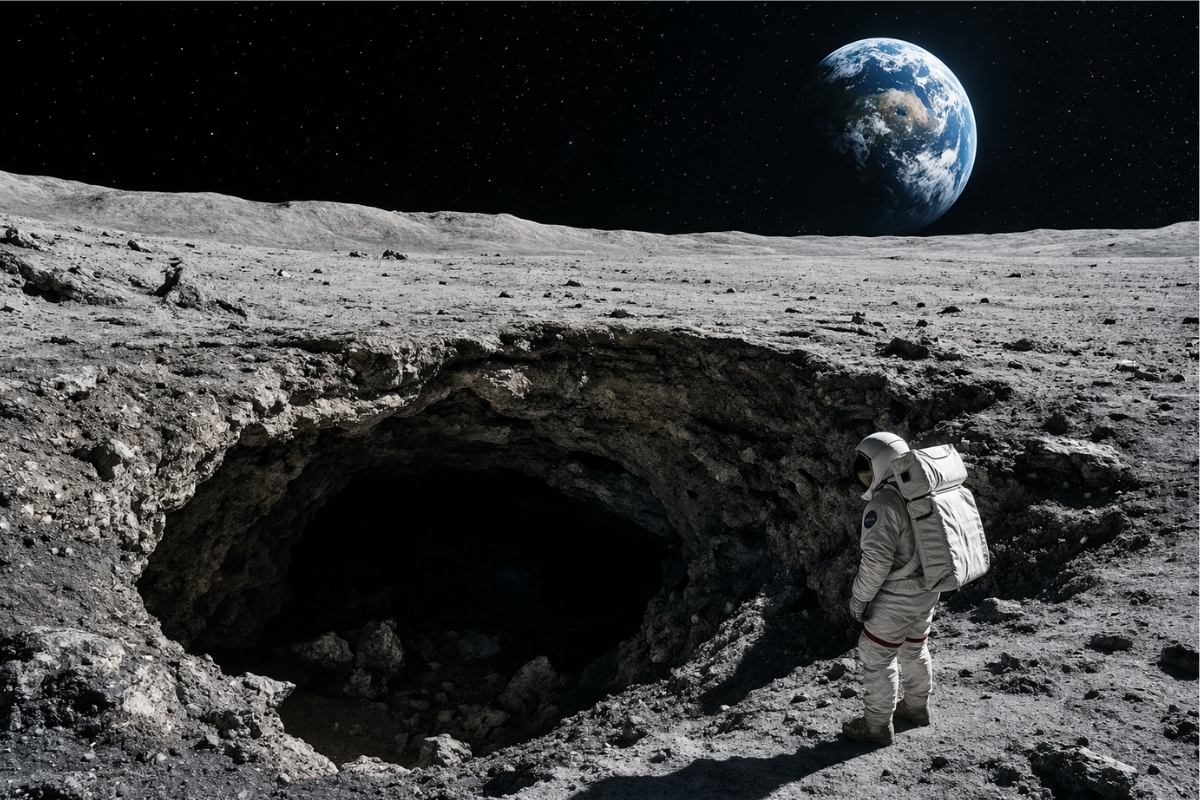
Scientists turn their eyes to the interior of the Moon after NASA identifies stronger signs of a cave linked to a pit in Mare Tranquillitatis, a structure that could pave the way for natural shelters capable of supporting long missions beyond Earth.
The idea seems straight out of science fiction, but it gained momentum with real data analyzed by scientists: the Moon may harbor underground caves capable of serving as natural shelters for astronauts. What reignited this debate was a new reading of information collected by the Lunar Reconnaissance Orbiter (LRO), from NASA, which brought the most consistent evidence so far of an accessible underground conduit beneath a lunar pit.
This result does not mean that researchers have already mapped a “complete network” of tunnels spreading through the lunar underground. But it means something even more important from a scientific point of view: the hypothesis of the so-called lunar lava tubes, discussed for decades, now has a much more robust direct indication. And suddenly, the Moon seems less like a hostile desert and more like a world with natural hideouts capable of protecting human missions in the future.
What NASA really found
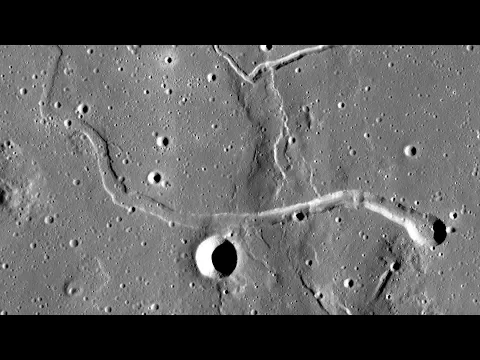
The new evidence came from the reanalysis of radar data obtained in 2010 by the Mini-RF instrument aboard the LRO. Scientists studied a pit located in Mare Tranquillitatis, a region famous for being relatively close to the site where Apollo 11 made the first human landing on the Moon. The radar indicated the presence of a cavity extending more than 200 feet, or more than 60 meters, from the base of this pit.
-
Is a smart plug worth it in a regular home? What does it offer: turns on and off via smartphone, creates routines by schedule, prevents forgotten devices, sometimes monitors consumption, and improves habits without renovation or miracles.

-
Airbus and Mercedes take the G-Class to the skies: the ACH145 helicopter priced at R$ 78 million debuts in São Paulo, unit goes to Brazilian, AMG cabin, 5-blade rotor, and a 2-year wait.

-
New material could change everything: it is the thickness of an atom, 200 times stronger than steel, and 100,000 times thinner than a human hair.

-
A new study published in Nature reveals that the SLIT3 protein can increase calorie burning by activating brown fat in the body, functioning as a kind of “biological switch.”


The most interesting detail is that the total extent of this structure is still unknown. NASA states that the conduit may continue for much greater distances beneath the lunar sea, possibly through sections far beyond what has already been identified. In other words, what today appears as a detected segment may just be the “entrance” to a much broader underground system — although this still needs to be confirmed by future missions.

Why these caves may exist on the Moon
The most accepted explanation involves the volcanic past of the satellite. Billions of years ago, the Moon had intense geological activity, with lava flows traversing its surface. In certain scenarios, the outer part of these lava rivers cooled and hardened first, while the hot material continued to flow inside. When this magma finally drained or ceased, a hollow channel remained: the so-called lava tube.
On Earth, similar structures exist in volcanic regions such as Iceland, Hawaii, and the Canary Islands. On the Moon, however, these formations can reach even more impressive dimensions. Since lunar gravity is much lower than Earth’s, the ceilings of these cavities can remain stable over much greater lengths and widths. This helps explain why scientists consider the existence of gigantic underground voids plausible, some potentially large enough to house human infrastructure.
The 2024 study and the scientific leap
The article published in the journal Nature Astronomy was decisive because it did not merely repeat an old suspicion. The authors claim that radar images of the Mare Tranquillitatis pit reveal a subterranean void of dozens of meters, consistent with an accessible cave conduit below the opening observed on the surface. This is the central point of the advancement: it is not just about seeing a hole and imagining what might be below, but using radar signatures to infer the actual presence of a hollow space.
This also helps resolve an important question in planetary science. For years, lunar pits have been interpreted as candidates for cave entrances, but there was a lack of more direct evidence of connection to extensive underground volumes. The new work does not settle the question for the entire Moon, but it strongly reinforces the idea that at least some of these pits do indeed lead to internal conduits. For space exploration, this distinction makes all the difference.

The great attraction for future human bases
The interest in lunar caves is not just geological. It is deeply practical. The surface of the Moon is an extreme environment, exposed to solar and cosmic radiation, the bombardment of micrometeorites, and violent temperature variations between lunar day and night. Finding a natural shelter would reduce some of these risks without initially requiring fully shielded structures built from scratch.
NASA’s own data showed in 2022 that permanently shadowed areas within lunar pits can maintain temperatures around 17 °C. This contrasts with the sunlit surface of the Moon, which can reach about 127 °C during the day and plummet to approximately -173 °C at night. An underground environment with such thermal stability would be valuable for equipment, life support systems, and the operational comfort of long-duration missions.
Cave network or a single tunnel? The difference matters
This is precisely where many headlines exaggerate. What exists today is a sum of increasing evidence: pits detected by orbiters, thermal measurements suggesting protected environments, and now a radar study pointing to an accessible conduit beneath one of these pits. This supports the hypothesis that the Moon has several caves and perhaps connected systems in some regions, but it does not yet authorize claiming that a vast underground network has already been directly mapped.
Even so, the scenario is exciting. In space science, a major discovery rarely appears ready and complete. The norm is for evidence to advance in layers: first the suspicion, then the indications, then local confirmation, and only then the detailed mapping. In the case of the Moon, it seems we are precisely in this transition between the indication phase and the point confirmation phase, which is already enormous from a strategic point of view.
How a mission could explore these caves
The European Space Agency, ESA, has been studying mission concepts dedicated to detecting, mapping, and exploring lunar caves. In 2021, the agency explained that it selected proposals for different stages of this challenge: initial reconnaissance of pits, controlled descent by probes or robots, and exploration of lava tubes with autonomous vehicles designed for underground environments.
The technical challenge is enormous. It is not enough to land near the pit: it would be necessary to map the terrain accurately, ensure communication between the surface and interior, deal with low lighting, test mobility systems on slopes, and develop robots capable of navigating in unknown environments. Still, international interest shows that these caves have ceased to be mere lunar curiosities and are now seen as a strategic objective for the next era of exploration.
What this discovery changes going forward
The new finding does not immediately transform a lunar cave into a habitable base. Before that, it will be necessary to confirm dimensions, structural stability, terrain composition, accessibility, and potential risks. But it changes something decisive: there is now a stronger scientific justification to treat the lunar underground as a real piece of the planning for future human missions, including in the context of prolonged stay on the Moon.
In the end, the image of the Moon may be changing before our eyes. Instead of just craters, dust, and silence, the satellite is also being seen as a world with hidden depth — literally. If future missions confirm what the radars have begun to reveal, the first human refuges beyond Earth may not be built on the lunar surface, but within it.







Seja o primeiro a reagir!