





 Portuguese
  English
  Spanish
  3 min of reading
  0 comments


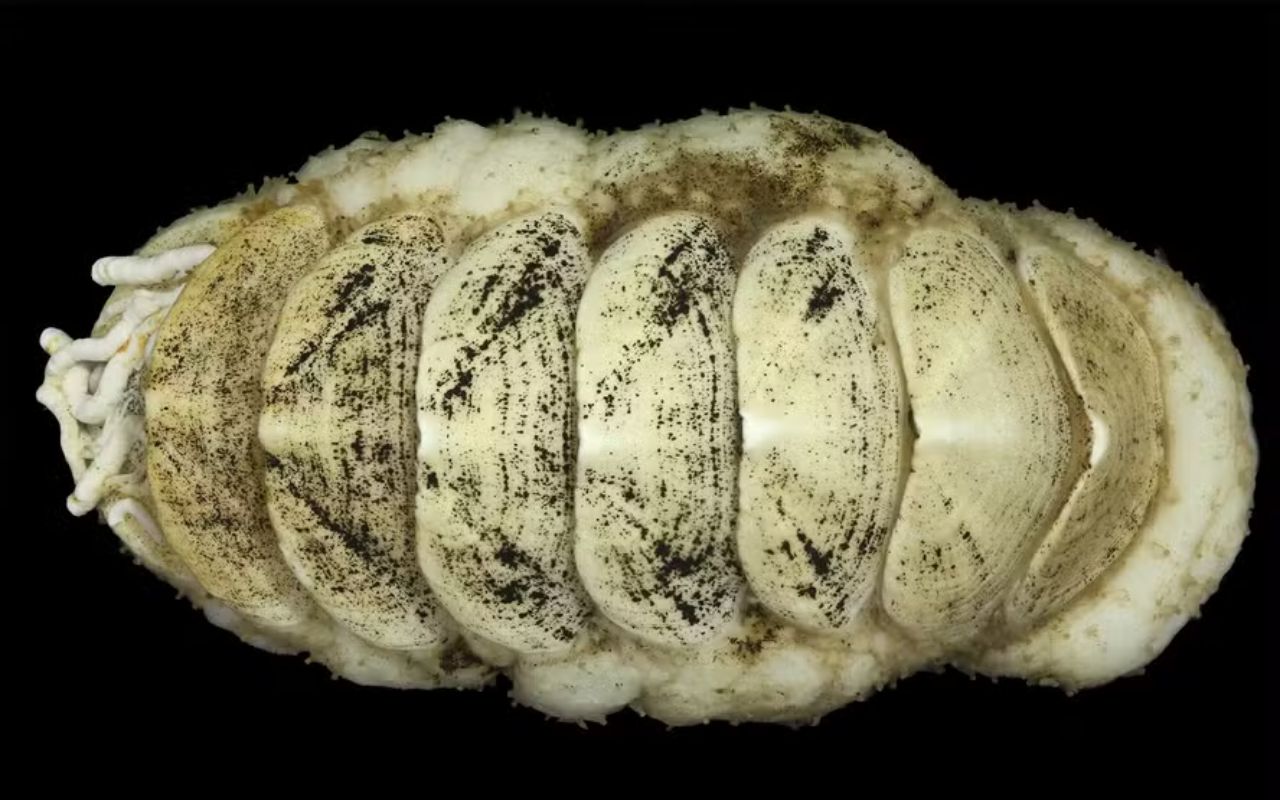
New Mollusk Species Discovered at the Bottom of the Ocean Named Ferreiraella populi After Popular Vote, Bridging Science and Public Participation.
A new mollusk species, discovered in the depths of the Pacific Ocean, has just gained an official name chosen by the public: Ferreiraella populi.
The naming, announced in 2026 by researchers connected to the Senckenberg Ocean Species Alliance, took place after an online campaign that mobilized thousands of people around the world, allowing the internet to participate directly in the scientific process.
Found at over 5,000 meters deep, the animal was named this way to symbolize collaborative science and bring society closer to the study of still little-known marine biodiversity.
-
Motorola launched the Signature with a gold seal from DxOMark, tying with the iPhone 17 Pro in camera performance, Snapdragon 8 Gen 5 that surpassed 3 million in benchmarks, and a zoom that impresses even at night.

-
Satellites reveal beneath the Sahara a giant river buried for thousands of kilometers: study shows that the largest hot desert on the planet was once traversed by a river system comparable to the largest on Earth.

-
Scientists have captured something never seen in space: newly born stars are creating gigantic rings of light a thousand times larger than the distance between the Earth and the Sun, and this changes everything we knew about stellar birth.

-
Geologists find traces of a continent that disappeared 155 million years ago after separating from Australia and reveal that it did not sink, but broke into fragments scattered across Southeast Asia.

How the Internet Helped Name Ferreiraella populi?
The initiative started when science communicator and YouTuber Ze Frank featured an episode on his channel dedicated to a strange creature from the depths — a type of newly discovered “chiton,” belonging to the genus Ferreiraella.
From this video, users were invited to submit names for the species, accompanied by creative justifications.
In just one week, the campaign yielded over 8,000 name suggestions via social media and digital platforms. Among all the proposals, the name Ferreiraella populi stood out.
The final choice was made by the team of scientists responsible for the official description of the species, who evaluated the proposals and opted for one that represented the collective engagement of the global community.
What is Ferreiraella populie and Where Was It Found
The new mollusk species described as Ferreiraella populi is a type of chiton — a marine invertebrate that has eight articulated plates forming a protective shell.
Unlike other mollusks that have a single shell, chitons are covered by multiple plates that allow mobility and adaptation to irregular surfaces.
The animal was originally found in 2024 in the depths of the Izu-Ogasawara Trench, a submarine trench of the Pacific Ocean about 5,500 meters deep.
There, Ferreiraella populi lives exclusively on sunk wood at the seabed, a rare habitat known as “wood-fall” in the abyssal environment.


In addition to its unusual armor, the chiton has a iron-reinforced radula, a rasping tongue specially adapted for feeding, and a community of small worms living near its tail, feeding on its waste — a surprising example of microecological complexity even in extreme environments.
The Science Behind the Name
The process of assigning scientific names follows strict biological rules, including the need for each name to be novel, latinized, and published in a recognized scientific vehicle.
The formal description of Ferreiraella populi was published in the Biodiversity Data Journal, an open-access scientific journal, making the name official in the international taxonomic record.
The epithet populi was chosen as a tribute to global collaboration, translating to “of the people” — a way to acknowledge that, for the first time in many cases, the internet and civil society directly participated in the choice of a formal scientific name.
Importance for Ocean Conservation and Knowledge
The rapid naming of Ferreiraella populi — just two years after its discovery in 2024 — highlights a significant change in how new species can be described.
Traditionally, this process can take ten or twenty years, but the combination of digital technology and public engagement helped to accelerate this formal recognition in an unprecedented manner.

This case also highlights how much of marine biodiversity is still unknown, especially in extreme and inaccessible environments like ocean trenches.
The scientific documentation of new species like Ferreiraella populi is crucial for conservation strategies, especially in the face of threats like resource exploitation and mining in deep-sea areas.
With information from Revista Galileu






-

-

5 pessoas reagiram a isso.