





 Portuguese
  English
  Spanish
  5 min of reading
  24 comments


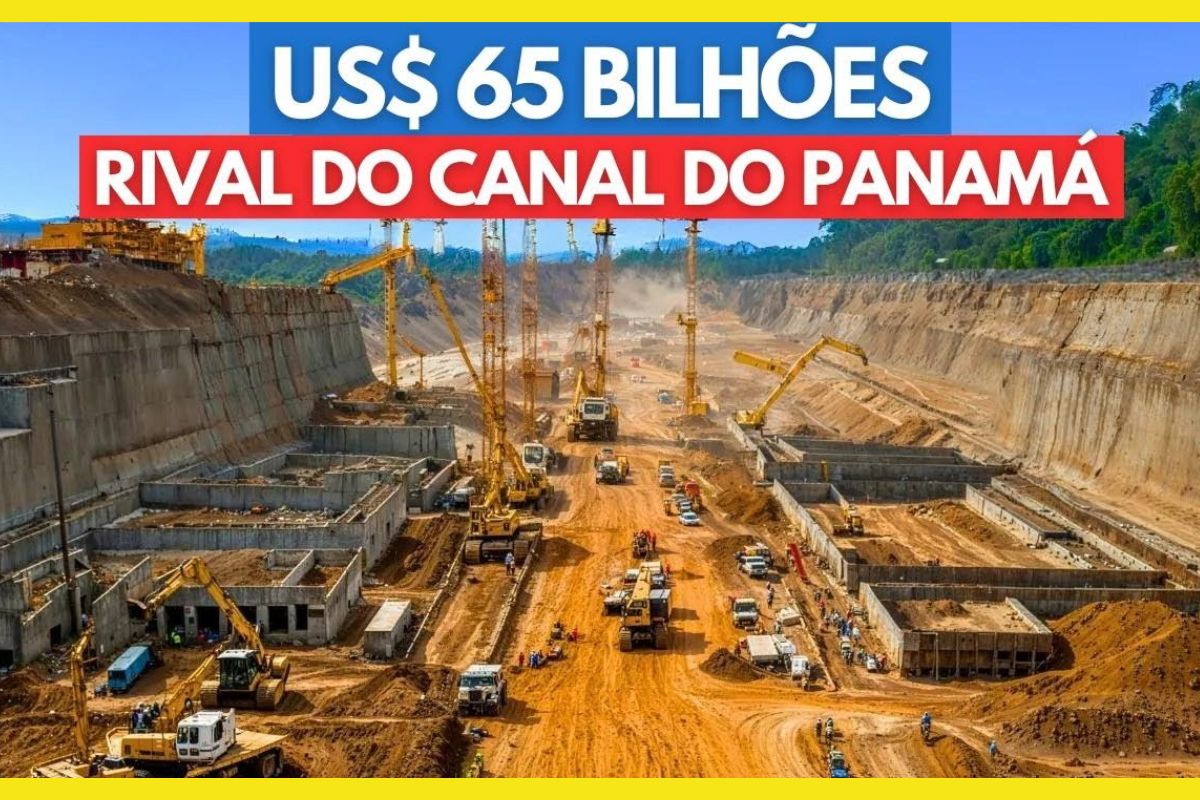


With Promises to Attract China and Russia, the Nicaraguan Government Tries to Make a New Maritime Route Worth 65 Billion Dollars Viable to Compete for Global Logistical Prominence.
The Nicaraguan government revives megaproject for an interoceanic canal capable of connecting the Atlantic and Pacific Oceans and rivaling the Panama Canal. The proposal, estimated at around 65 billion dollars, was resumed by President Daniel Ortega in 2024, with the aim of boosting the local economy and attracting investments from China and Russia.
The project envisions a route of 445 kilometers, more than five times the length of the Panama Canal, and promises to transform the country into a new strategic hub for global maritime trade. However, the plan faces environmental criticism, financial uncertainties, and international skepticism regarding its viability.
An Old Dream with Global Ambitions
The idea of building a canal in Nicaragua dates back to the 19th century, when Spanish explorers and European powers saw the local geography as a natural alternative to Panama.
-
Brazil becomes a beacon of hope for ending plastic waste by leading a global plan that could prevent millions of tons from entering the oceans.

-
The low-cost solution called PatchPal, invented in South Africa to fix potholes in minutes, does not crack and prevents water from entering, becoming more compact with each car that drives over it, revolutionizing road repairs that governments have forgotten.

-
The 2nd safest city in Brazil is attracting new residents, industries, formal jobs, and also has a giant free park.
-
“Brazilian California”: the city is one of the best places to live in Brazil.

Even before 1914, the United States considered the Nicaraguan route, but ended up opting for Panamanian territory, where they completed the canal that would become a symbol of modern engineering.
Decades later, the proposal resurfaced several times. The most recent attempt occurred in 2013, when the Nicaraguan government signed an agreement with the Hong Kong Nicaragua Canal Development Group, led by businessman Wang Jing.
The plan, estimated at 50 billion dollars, envisioned a 278 km extension, crossing Lago Nicaragua, the largest in Central America.
Despite the promise of competing with the Panama Canal, the project was halted due to financial problems, protests from local communities, and strong environmental opposition. In 2024, the government officially canceled the concession to the Chinese company, but Ortega decided to resume the initiative with a new layout and new partners.
The New Plan: 445 km Extension and Redesigned Route
In the new version, the Nicaragua Canal would avoid Lago Nicaragua, the focus of environmental criticism, and follow a route starting in Bluefields, in the Caribbean, passing through Lago Cholotlan to reach Puerto Corinto, in the Pacific.
With width between 290 and 540 meters and depth of up to 27 meters, it would be able to accommodate super tankers and mega cargo ships that currently do not fit in the Panama Canal.
The government promises tax exemptions for foreign investors and property guarantees to companies involved in the construction.
Besides the economic impact, Ortega advocates that the project will position Nicaragua strategically in international logistics, offering an alternative to the capacity limitations and water scarcity of the Panama Canal.
Still, analysts point out that financial viability remains uncertain, and that the country is unlikely to bear the cost without a robust international consortium.
Economic Impacts and Environmental Risks
The main promise of the project is to generate hundreds of thousands of jobs and increase the Nicaraguan GDP by up to 10% per year during the construction phase. However, critics remind that this optimism contrasts with the fragility of the country’s finances and its dependence on foreign capital.
Environmentalists warn that the canal could cause serious damage to biodiversity, with risks of large-scale deforestation, water pollution, and displacement of indigenous communities. Lago Cholotlan, for example, already suffers from contamination and would be directly affected by excavation and heavy vessel traffic.
The Inter-American Court of Human Rights condemned Nicaragua for failing to consult local communities in previous attempts, and the new plan still needs to meet consultation and social compensation requirements.
Colossal Engineering and Geographical Challenges
Building a 445 km canal in Nicaraguan territory will require unprecedented engineering solutions in Central America.
The country faces seismic, volcanic, and intense climatic risks, as well as having water reservoir shortages, complicating the use of locks like in the Panamanian model.
To enable the operation, artificial lakes and complex drainage systems would be necessary, raising costs and environmental impact.
Engineers warn that technical and logistical challenges may make the canal more expensive and time-consuming than expected, reducing its potential economic return.
Nevertheless, the government insists on presenting the project as a symbol of sovereignty and national development, comparing it to major global infrastructure milestones.
Rivalry with the Panama Canal and Geopolitical Scenario
The Panama Canal remains the main maritime route in the Americas, responsible for about 6% of global trade.
However, it faces bottlenecks caused by historical drought and the capacity limitations of the locks. In this context, the Nicaraguan canal emerges as a possible relief route, especially for large ships.
However, direct competition with Panama hits a wall due to the credibility and operational experience. With over 110 years of operation and constantly modernized infrastructure, Panama remains the safest and most reliable option.
Moreover, the resumption of the project under the influence of China and Russia raises concerns in Washington, which sees the move as an attempt to expand the presence of rival powers in Central America.
If financed by Beijing, the Nicaragua Canal could reinforce the Chinese strategy of global logistical control, aligned with the New Silk Road.
Despite the enthusiasm of the Ortega government, no international consortium has confirmed financial support so far.
Experts believe that, without direct Chinese support or a guarantee of quick returns, the project will remain stuck on paper, as occurred in all previous attempts.
Even so, the canal continues to be a symbol of national ambition and geopolitical competition in Latin America.
For Nicaragua, the project represents a dream of autonomy and global relevance; for critics, a monumental environmental and economic risk.
And you, do you believe that the Nicaragua Canal will come to fruition this time, or will it remain a myth of engineering and Latin American geopolitics? Share your opinion in the comments.







The tunnel under the English channel was also impossible! It could strengthen the economy of Central America and create jobs, especially if they build larger locks for the ever expanding container/petroleum/LNG tankers!
Good luck!
Hire me to proofread and edit your articles